Light filtering roller shades are the middle ground of window coverings — they soften harsh sunlight into a warm glow, give you daytime privacy, and keep a clean, minimal look, all without plunging the room into total darkness. If sheer shades feel too exposed and blackout shades feel too cave-like, light filtering roller shades are usually the right answer. Here’s how to choose, mount, and get the most out of them.
- How Light Filtering Differs From Sheer and Blackout
- Where They Work Best
- Fabric Choices
- Inside vs Outside Mount
- Measuring Correctly
- Operating Systems and Safety
- Installation Basics
- What They Cost
- Care and Longevity
- Dual and Layered Roller Shade Options
- Color and Openness Trade-Offs
- Energy Efficiency Benefits
- Inside vs Outside Mount for Privacy
- Bottom Line
How Light Filtering Differs From Sheer and Blackout
Roller shade fabrics are rated by opacity, which describes how much light passes through:
- Sheer / light screening (5-25% openness): you can see through them; they cut glare but offer little privacy.
- Light filtering (roughly 1-5% openness or a tight semi-opaque weave): daylight diffuses through, you get daytime privacy, but silhouettes may show at night with interior lights on.
- Room darkening / blackout (0% openness with backing): block nearly all light and provide full privacy day and night.
Light filtering sits deliberately in the middle. During the day, people outside can’t make out details inside, but at night, when it’s brighter indoors than out, backlit silhouettes can be visible — an important thing to know for bedrooms and bathrooms.
Where They Work Best
- Living rooms and family rooms — soft, even daylight without glare on the TV.
- Kitchens and dining areas — bright but not harsh, with easy-to-clean fabric.
- Home offices — reduced screen glare while keeping the room feeling open.
- Nurseries and bedrooms — a gentler option, though pair with blackout if you need full dark for sleep.
Fabric Choices
Light filtering roller shades come in several fabric families, each with a different feel:
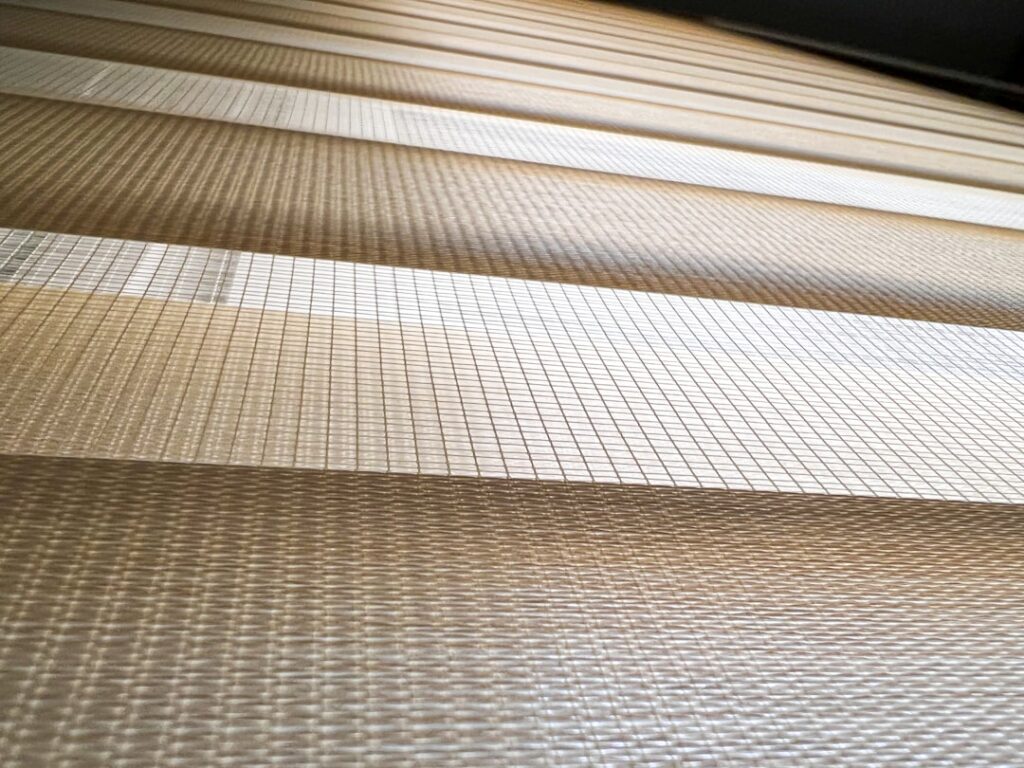
- Solar/screen weaves: a tight open weave that filters light and cuts UV, ideal near screens and sunny exposures. Openness of 1-3% gives good privacy with a view-through quality.
- Textured semi-opaque fabrics: linen-look or woven textures that add warmth and diffuse light softly with no view-through.
- Vinyl or PVC-coated fabrics: wipe-clean and moisture-tolerant, good for kitchens and baths.
UV blocking matters if you have hardwood floors, artwork, or furniture that fades — light filtering fabrics typically block 60-95% of UV depending on weave, protecting interiors while keeping the room bright.
Inside vs Outside Mount
Where you mount the shade changes both the look and the light control.
- Inside mount: the shade sits within the window recess for a clean, built-in look that shows off the trim. Requires enough depth (usually 2-3 inches) and a fairly square opening. Leaves small light gaps at the sides.
- Outside mount: the shade mounts on the wall or frame above the window, overlapping the opening. This maximizes coverage, hides an out-of-square window, and reduces side light gaps — the better choice when privacy and light control matter most.
Measuring Correctly
- Inside mount: measure the exact recess width at the top, middle, and bottom, and use the narrowest. Measure height on both sides and use the longest. Confirm the recess is deep enough for the roller and brackets.
- Outside mount: add 3-4 inches to the window width and center it so the shade overlaps 1.5-2 inches on each side. Add several inches of height above the frame so the roller mechanism clears the glass when raised.
Order to the manufacturer’s stated tolerance — most factory shades account for a small deduction on inside mounts so they roll freely without rubbing.
Operating Systems and Safety
Roller shades come with several lift options:
- Continuous cord loop: a beaded chain you pull; durable and precise. Always install the included cord tension device anchored to the wall — a loose looped cord is a strangulation hazard for children and pets.
- Cordless spring roller: push up or pull down with no cord at all, the safest choice for homes with kids.
- Motorized: battery, plug-in, or hardwired motors for remote and smart-home control, worth considering for hard-to-reach windows.
For any home with young children, cordless or motorized is strongly recommended to eliminate cord hazards entirely.
Installation Basics
- Mark bracket positions — level and equal distance from each end of the roller.
- For inside mounts, screw brackets into the top or sides of the recess; for outside mounts, hit studs where possible or use appropriate drywall anchors.
- Clip the roller tube into the brackets and confirm it spins freely without the fabric rubbing the frame.
- Install the cord tension device or, for cordless, test the spring travel.
- Attach the bottom-rail end caps and check that the shade rolls straight — a shade that tracks to one side usually means a bracket is out of level.
What They Cost
Pricing spans a wide range depending on size, fabric, and lift system:
- Budget ready-made: $20-$50 per shade for standard sizes at big-box stores.
- Mid-range custom cordless: $60-$150 per window with better fabric and exact sizing.
- Premium and motorized: $150-$400+ per window for designer fabrics, motors, and smart-home integration.
Custom sizing is worth it for oddly shaped or oversized windows where a ready-made shade would leave big gaps.
Care and Longevity
Most light filtering fabrics dust easily with a vacuum brush attachment or a dry microfiber cloth. Vinyl and PVC-coated versions wipe clean with a damp cloth. Avoid soaking fabric shades, which can leave water rings. With normal use, a quality roller shade lasts 7-10 years or more before the mechanism or fabric shows wear.
Dual and Layered Roller Shade Options
If the nighttime silhouette issue bothers you, a dual roller (also called day-night or zebra) shade solves it. A dual roller mounts two fabrics on one bracket system — a light filtering layer for daytime and a room-darkening layer you pull down after dark for full privacy and light control. Zebra shades take a different tack, alternating sheer and opaque horizontal bands that you align to filter or block light in one continuous fabric. Both cost more than a single light filtering shade (typically $60-$200 per window) but give you the flexibility of two treatments in one clean housing, which is ideal for bedrooms that need daytime light and nighttime dark.
Color and Openness Trade-Offs
Fabric color affects both view and heat. Darker light filtering fabrics offer better view-through to the outside and cut glare more aggressively, but they absorb heat. Lighter fabrics reflect more solar heat and brighten a room but wash out the outside view and let a little more light glow through. Openness factor (the percentage of the weave that is open) further tunes this: a 1% openness gives strong privacy with a hint of view, while 3-5% openness opens up the view at the cost of some daytime privacy. Order swatches and test them against your actual window light before committing to a whole house.
Energy Efficiency Benefits
Light filtering roller shades do more than manage glare — they trim energy costs. In summer, a reflective solar-screen fabric bounces a share of incoming solar radiation back outside, easing the load on your air conditioner, especially on south- and west-facing windows. In winter, closing shades at night adds a small insulating air layer against cold glass. While roller shades don’t insulate as well as cellular honeycomb shades, pairing a solar-screen roller with proper mounting (an outside mount that overlaps the frame reduces air leakage around the edges) delivers a measurable comfort improvement on sun-baked or drafty windows.
Inside vs Outside Mount for Privacy
Because light filtering fabric shows silhouettes at night, mounting choice directly affects how private the shade feels. An inside mount looks tailored but leaves quarter-inch light gaps along each side jamb, and those gaps let sightlines and light slip through at the edges. An outside mount that overlaps the frame by 1.5-2 inches per side closes those gaps and blocks more light, which is why bedrooms and bathrooms usually do better with an outside mount. If you love the clean recessed look of an inside mount but want the privacy of an outside mount, add side channels or a light-blocking valance to seal the perimeter. For living rooms, where the silhouette concern is minor, the inside mount’s built-in appearance usually wins.
Bottom Line
Light filtering roller shades give you soft, glare-free daylight and daytime privacy in a sleek, low-profile package. Just remember the nighttime silhouette limitation — if you need full darkness or total privacy after dark, pair them with a blackout layer or dual roller system. For everyday living spaces, they hit the ideal balance of light, privacy, and clean looks at a reasonable price.