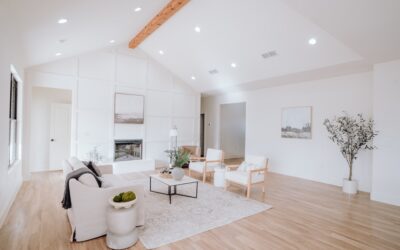
The most common decorating mistake in a living room is not the wrong color or style. It is art that is too small for the wall. Getting living room wall art size right comes down to one reliable proportion: the art, or the group of pieces acting as one unit, should span about two-thirds of the width of the sofa beneath it. On a wall with no furniture against it, the art should cover roughly 60 to 75 percent of the open width.
Those two ratios handle most rooms. From there, ceiling height decides how tall the piece can be, and the shape of the wall decides whether a single statement piece or a pair works better. Large pictures for living room walls almost always look more finished than a scattering of small frames, as long as they leave breathing room on all sides.
- The Two-Thirds Rule for Living Room Wall Art Size
- Sizing to the Wall, Not Just the Sofa
- One Statement Piece vs. a Pair
- Tools and Materials
- Step-by-Step: Planning and Hanging Living Room Art
- Troubleshooting a Living Room Wall That Looks Off
- Cost Ranges for Living Room Art
- When to Call a Pro
- Frequently Asked Questions
The Two-Thirds Rule for Living Room Wall Art Size
Designers lean on the two-thirds rule because it creates a visual connection between the sofa and the art. When the art is much narrower than the sofa, the two pieces look unrelated, as though the art floated off by itself. When the art is wider than the sofa, the wall looks top-heavy.
Here is how the math works on common sofa widths:
| Sofa width | Target art width | Example options |
|---|---|---|
| 60 in (loveseat) | 40 to 45 in | One 30×40 hung horizontally |
| 72 in | 48 to 54 in | One 36×48 or two 24×30 side by side |
| 84 in | 56 to 63 in | One 40×60 or two 24×36 |
| 96 in | 64 to 72 in | One 48×72 or three 20×24 |
| 120 in sectional run | 80 to 90 in | Panoramic 24×72 plus space, or a triptych |
A range from about 0.6 to 0.75 of the sofa width is safe. Go toward the low end for busy, high-contrast images and the high end for calm, minimal art, which can handle more size without dominating the room.
Sizing to the Wall, Not Just the Sofa
Sometimes the sofa is not the right reference. A sofa floating in the middle of the room, a fireplace wall or a long bare wall beside the entry all call for sizing against the wall itself. Measure the open width between windows, doors or built-ins, then multiply by 0.6 to 0.75.
A 12-foot wall with nothing on it can take art around 86 to 108 inches wide in total. That is beyond most single canvases, so this is where a large panoramic piece, a triptych or an oversized frame with a generous mat comes into play. On a narrow wall, perhaps 3 to 4 feet between a window and a corner, a tall vertical piece around 24×36 or 30×40 hung portrait-style usually looks better than a horizontal one.
Ceiling height and vertical space
Ceiling height sets the upper limit on how tall art can go. A standard 8-foot ceiling, with a sofa back around 32 to 36 inches high, leaves roughly 50 to 55 inches of wall over the sofa once you allow a gap at each end. Art about 30 to 40 inches tall fits comfortably there. With 9- or 10-foot ceilings, you can go to 48 inches tall or more, and on a vaulted or two-story wall, very tall vertical pieces or stacked arrangements help fill the extra height without leaving dead space.
Keep about 8 to 10 inches between the top of the sofa back and the bottom of the art. Less than 6 inches and heads will bump the frame; more than 12 and the art disconnects from the furniture. At the top, leave at least a foot of space under the ceiling or crown molding.
One Statement Piece vs. a Pair
Both approaches work. The right one depends on the wall, the budget and the mood you want.
When a single statement piece works best
- The sofa is a standard length, roughly 72 to 96 inches.
- You want a calm, uncluttered look with one strong focal point.
- The art is an original painting or a large photograph that rewards close viewing.
- The wall is clean, with no windows or switches breaking it up.
When a pair or trio works best
- The sofa is extra long or a sectional, and a single canvas wide enough would be costly or hard to move.
- A light switch, thermostat or outlet sits awkwardly in the middle of the wall.
- You like symmetry, or you want to echo a pair of lamps or end tables.
- You plan to swap art seasonally and want smaller, lighter pieces.
With pairs, keep the gap between frames around 2 to 4 inches so they read as a single unit, and measure the total width including that gap when applying the two-thirds rule. Two 24×36 frames hung horizontally with a 3-inch gap span 75 inches, which suits a sofa of about 100 to 112 inches.
If you love big wall décor but your space is tight, a single oversized mirror or a large textile hanging can play the same role as art and still follow the same sizing rules.
Tools and Materials
- Tape measure and pencil
- Painter’s tape or kraft paper for mock-ups
- Laser level for lining up a pair or trio
- Stud finder that also detects wiring
- Drill, picture hooks or anchors rated for the weight
- Step ladder and a helper for anything over about 30 inches wide
A laser level is especially useful for pairs and trios. It projects one straight line across the full span so the top edges of every frame line up exactly, which is surprisingly hard to do with a short bubble level.
Step-by-Step: Planning and Hanging Living Room Art
- Measure the sofa and the wall. Write down the sofa width, sofa back height, open wall width and ceiling height.
- Calculate the target width. Multiply the sofa width by 0.66 for a starting point. Adjust within the 0.6 to 0.75 range based on the image.
- Check the height. Subtract the sofa back height plus 8 to 10 inches, and 12 inches at the top, from the ceiling height. That is the maximum art height.
- Tape a template. Cut kraft paper to the exact size of the art you are considering and tape it up. Step back to the far side of the room and look at it for a day or two.
- Mark the hanging points. Measure from the top of each frame to its hanger and transfer that measurement to the template, then drill straight through the paper.
- Install hardware. Hit studs where possible. Otherwise, use anchors rated well beyond the frame weight.
- Hang and level. Remove the paper, hang the art, and fine-tune with the level.
Safety while drilling and climbing
Cables often run vertically from outlets and switches, so be cautious drilling directly over them. If you need to drill in a stud bay that holds an outlet or switch, turn off the breaker and confirm power is off with a non-contact voltage tester first. Never probe live wiring. If you want a picture light or a new outlet added for lighted art, hire a licensed electrician; plug-in picture lights should go directly into a wall outlet, not a power strip draped behind the sofa.
For ladder work, place the step ladder on a flat floor rather than on the sofa cushions, lock the spreaders, and never stand on the top step. Do not balance on furniture to reach a high spot. For tall walls in two-story living rooms, call a pro with the right equipment.
Troubleshooting a Living Room Wall That Looks Off
Art looks too small, but you love it. Reframe it with a wider mat and a larger frame, which can add 6 to 10 inches of visual width. Or flank it with two narrow vertical pieces to extend the grouping.
Art feels too big. Check the gap to the sofa and ceiling first. Often the piece is fine, but it is hung too high, which leaves a tall empty band underneath. Lowering it closer to the sofa can fix the proportion.
Off-center wall features. If a window or door makes the wall asymmetrical, center the art on the sofa rather than on the wall. The furniture is the stronger visual anchor.
Art clashes with a TV. When the TV shares the wall, treat the TV and art as one composition and keep the combined width within the same ratio, or move the statement piece to the opposite wall.
Cost Ranges for Living Room Art
Large prints on canvas or paper in the 36×48 to 40×60 range typically run from about a hundred dollars to several hundred, with framed giclée prints and originals costing more. Custom framing for a big piece can easily match or exceed the print cost. Hiring a handyman or art installer usually costs a modest flat fee per piece, rising for heavy work, plaster walls or very tall walls. Spending a little more on one well-scaled piece usually gives a better result than buying several small ones.
When to Call a Pro
An art installer is worth the fee if the art weighs more than about 40 pounds, the wall is plaster, brick or stone, the piece needs to go high on a two-story wall, or you want integrated lighting. Any new hardwired fixture or outlet should be installed by a licensed electrician. A pro can also help plan a mixed arrangement around a fireplace or TV, where getting living room wall art size and spacing right is trickier.
Frequently Asked Questions
How wide should art be over a couch?
About two-thirds of the couch width is the standard target, with a safe range of 60 to 75 percent. For an 84-inch couch, that means art roughly 56 to 63 inches wide, either as one piece or a pair.
What size wall art for a large living room wall?
Cover 60 to 75 percent of the open wall width. On a 12-foot wall, that can be 86 inches or more in total, which usually calls for a panoramic canvas, a triptych or an oversized framed piece.
Is it better to have one big picture or two smaller ones?
One big picture creates a single focal point and a calmer look. Two smaller pieces are easier to handle, can work around switches or thermostats, and suit long sofas and sectionals. Keep a 2 to 4 inch gap so the pair reads as one unit.
How much space should be between the sofa and art?
Leave 8 to 10 inches between the top of the sofa back and the bottom of the frame. That gap keeps heads from hitting the art while keeping it visually tied to the furniture.
Does ceiling height change how big the art should be?
Yes. Higher ceilings allow taller art. On an 8-foot ceiling, art around 30 to 40 inches tall usually fits over a sofa, while 9- or 10-foot ceilings can handle 48 inches or more.