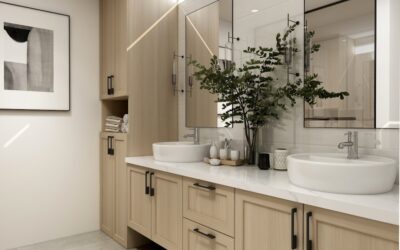
Walk into a showroom and two vanities can look nearly identical while one costs $600 and the other $4,000, and the difference lives in places you cannot see from across the room. A luxury bathroom vanity is defined by solid wood or plywood box construction, dovetailed drawers on soft-close undermount glides, a genuine stone or premium engineered top, and hardware that still operates smoothly a decade later. Builder-grade units use particleboard, stapled joints, and cultured-marble tops that yellow and chip.
Part of our Bathroom Remodeling & Flooring guide — explore the full guide →
Knowing what separates a true luxury bathroom vanity from a lookalike helps you spend your money on the parts that determine how the piece performs and ages, not just the finish you see on day one.
What Defines a Luxury Bathroom Vanity
Start with the cabinet box. A high-end vanity uses solid hardwood frames and doors with plywood side and back panels, which resist the humidity swings of a bathroom without swelling or delaminating. Particleboard boxes, common in budget units, absorb moisture at the base and blow out over time, especially around the plumbing cutouts.
Drawer construction is the tell that never lies. Luxury drawers are solid-wood boxes joined with dovetails and ride on full-extension, soft-close undermount slides rated for 75 to 100 pounds. Open a drawer fully; if it extends completely, closes silently, and the corners are interlocked rather than stapled, you are looking at real quality.
Countertop Choices That Signal Quality
The top is where a vanity earns its luxury label visually and functionally. Natural stone and premium engineered surfaces separate the high end from the rest.
- Quartz: nonporous, stain-resistant, low maintenance, $50 to $120 per sq ft
- Marble: stunning veining but porous and etch-prone, $75 to $250 per sq ft, needs sealing
- Granite: durable and heat-tolerant, $40 to $100 per sq ft
- Solid-surface (Corian): seamless integrated sinks, mid-range cost
- Avoid for luxury: cultured marble and laminate, which read as builder-grade
An integrated or undermount sink elevates the look further, since a drop-in sink with a visible rim reads as builder-grade even on a nice top. Undermount sinks also wipe clean without a caulk lip catching grime.
Sizing and Single Versus Double
Vanity dimensions drive both function and cost. Standard vanity heights have shifted from the old 30- to 32-inch “comfort” height toward 34 to 36 inches, which suits most adults far better and feels current. Depth is typically 21 to 24 inches, though shallow 18-inch depths help in tight powder rooms.
A single vanity works up to about 48 inches wide; beyond 60 inches, a double vanity with two sinks becomes practical and is a strong resale feature in a primary bathroom. Allow at least 30 inches of clear space in front for comfortable use, and keep 4 inches minimum between the edge of the vanity and a side wall so drawers clear the trim.
Wood Species and Finish
The wood and finish set the tone of the room. Solid maple, oak, cherry, and walnut are the mainstays, with walnut and rift-sawn white oak reading as the most contemporary and premium. A hand-applied, multi-step finish with a catalyzed topcoat resists water spots and the daily assault of splashes, toothpaste, and cosmetics far better than a single sprayed coat.
Painted vanities are equally luxurious when the paint is a hard-curing enamel over properly sealed wood. Watch for a finish that wraps the inside of the cabinet and the drawer boxes, not just the visible faces, since that interior finish is another marker of a piece built to last.
Hardware, Plumbing, and Details
Small components carry a surprising amount of the luxury feel. Solid metal pulls and knobs in finishes like brushed brass, matte black, or polished nickel weigh noticeably more than hollow zinc lookalikes. Soft-close hinges on every door should be standard at this level.
Consider the faucet and its mounting. A widespread faucet with separate handles set 8 inches apart looks more custom than a single 4-inch centerset. Wall-mounted faucets and floating (wall-hung) vanities create a clean, spa-like effect but require in-wall plumbing and blocking planned before the walls are closed, so factor that into a remodel timeline.
Freestanding, Floating, or Custom
Luxury vanities come in three formats. Freestanding furniture-style vanities anchor traditional and transitional bathrooms and often include decorative feet and legs. Floating vanities mount to the wall for a modern, open look that makes small rooms feel larger and simplifies floor cleaning, but they demand solid blocking in the wall to carry the load of the cabinet plus a stone top.
A fully custom vanity from a cabinet shop lets you match exact dimensions, wood, and storage to your space, at $2,500 to $10,000-plus depending on size and materials. Semi-custom lines from brands like Ronbow, James Martin, and Restoration Hardware bridge the gap between stock and custom, typically $1,500 to $5,000 for the cabinet before the top.
Budgeting the Whole Piece
Price a luxury vanity as a system, not just a cabinet. A quality 48-inch single vanity cabinet runs $1,200 to $3,500, the stone top adds $400 to $1,500 fabricated and installed, and a good faucet and undermount sink add $300 to $800. Installation, if you hire out, is another $200 to $600.
Spend where it lasts: solid box construction, dovetailed soft-close drawers, and a stone top will still look and work beautifully in fifteen years. A luxury bathroom vanity is ultimately an investment in daily-use furniture that lives in a wet room, so prioritize the construction and materials over the trendiest finish, and you get a piece that stays both handsome and functional far longer than its budget-grade cousin.
Storage Design and Interior Organization
What separates a vanity that merely looks expensive from one that lives beautifully is the interior. Luxury vanities plan around the plumbing, using U-shaped drawers that wrap around the P-trap so you get usable storage where lesser units waste the whole cabinet on a single door and a tangle of pipes. Full-extension drawers let you reach the very back, and a mix of shallow top drawers for cosmetics and deep lower drawers for towels and hair tools makes daily routines effortless.
Consider built-in organizers when you spec the piece. Removable drawer dividers, a tip-out tray at the sink front for sponges and rings, an integrated electrical outlet inside a drawer for charging a razor or toothbrush, and a pull-out hamper all elevate function to match the finish. These features cost more upfront but are the details that make a bathroom feel genuinely custom rather than simply pricey.
Match the storage to who uses the room. A shared primary bath benefits from a double vanity with a bank of drawers for each person and a shared center cabinet. A guest powder room can prioritize looks over capacity with a slim floating vanity, since it holds little beyond hand towels. Think through what actually needs a home in the room before you fall for a showroom piece that photographs well but stores almost nothing.
A luxury vanity rewards a little upkeep with decades of service. Seal a marble or granite top on the schedule the fabricator recommends, typically once or twice a year for marble and every two to four years for granite, using a penetrating stone sealer. Wipe standing water rather than letting it sit around the faucet base and backsplash, since prolonged moisture is what eventually attacks even well-finished wood at the seams and toe kick.
Protect the finish with everyday habits: keep nail polish remover, hair dye, and harsh cleaners off stone and painted surfaces, and use a soft cloth with mild soap rather than abrasive pads. A quality vanity is a fixture buyers notice and appraisers credit, so treating it well preserves both its beauty and the resale premium it adds to the bathroom. Done right, it is one of the few remodel investments that still looks intentional and current long after cheaper fixtures around it have been replaced.
When you shop, bring a short checklist and use it on every piece you consider, because the marketing language blurs together fast. Pull a drawer fully open to confirm it is a dovetailed solid-wood box on soft-close undermount glides. Knock on the cabinet sides to feel whether they are plywood or hollow-sounding particleboard. Check that the finish wraps the interior, not just the show faces, and that the top is genuine stone or a quality engineered surface with an undermount sink. Verify the hardware feels solid and heavy in the hand. If a vanity passes those five checks, it is built to last; if it fails two or more, you are paying luxury prices for builder-grade construction dressed up to look the part, and no showroom lighting will change how it holds up in a decade of daily use.