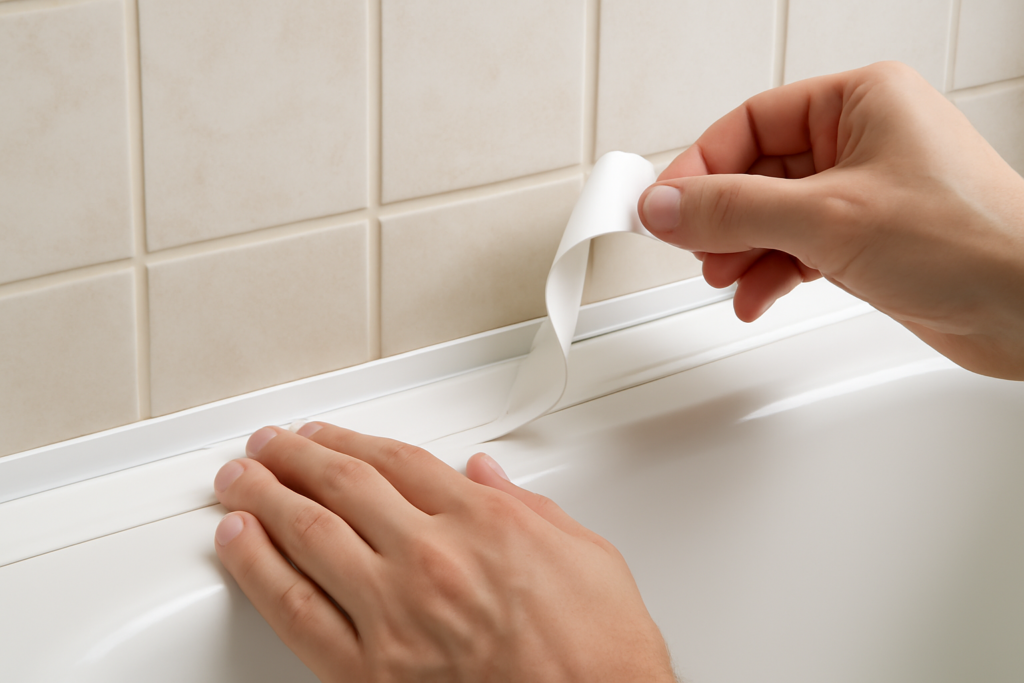
Not everyone can run a caulk gun, and plenty of renters are not allowed to try. Magic peel and stick caulk targets exactly that gap: a pre-formed flexible vinyl strip, folded into an L-profile with adhesive backing, that presses over a tub or countertop joint in minutes with no gun, no tooling, and no cure time. Magic — the cleaning-products brand behind Magic Eraser-adjacent tub and tile products, sold under the Weiman/Homax family — packages it as a 1-5/8-inch-wide by 11-foot roll in white, running $8 to $12 at big-box stores and online. It is a genuinely clever product that solves real problems for specific users, and it is also routinely bought by the wrong people for the wrong joints. Understanding how it works makes clear which camp you are in.
Part of our Paint & Walls guide — explore the full guide →
What It Is, Physically
Unwind the roll and you find a soft PVC strip, hinged down the middle like a long white bookbinding, with peel-away liners covering pressure-sensitive adhesive on both wings. The hinge lets the strip fold to roughly 90 degrees, so one wing bonds to the horizontal surface (tub deck, countertop) and the other to the vertical (tile wall, backsplash). The finished appearance mimics an oversized, perfectly uniform caulk bead — a crisp white cove with dead-straight edges that gunned caulk only achieves with tape and practice.
The 1-5/8-inch width is a design choice worth noticing: each wing covers about 3/4 inch of surface, which lets the strip bridge over old stained caulk lines, hairline gaps, and slightly irregular joints while presenting a clean face. That bridging ability is the product’s core trick. Unlike gunned caulk, which must bond inside the joint, the strip only needs sound, smooth surfaces on either side of it.
How Installation Works
- Prep the surfaces. Adhesion is everything, so clean both faces with rubbing alcohol and let them dry completely. If old caulk is loose or moldy, strip it out first; the strip can cover stable discolored caulk, but it cannot anchor to peeling material.
- Warm the roll. The vinyl and adhesive both behave better above 65°F. In a cold bathroom, sit the roll in warm water (in its packaging) or a sunny window for ten minutes — cold vinyl fights the fold and the tack.
- Measure and pre-cut. Cut lengths for each run with scissors, adding an inch of overage. For inside corners, most instructions have you butt two strips with a small overlap or a 45-degree scissor miter.
- Peel, fold, and press. Remove the liner from one wing at a time, seat the hinge into the joint, and press the wing down progressively along the run — do not stretch the strip as you go, or it will creep back and open gaps at the ends.
- Roll it down. Firm, even pressure activates a pressure-sensitive adhesive. Run a wallpaper seam roller or a firm fingertip along both edges twice.
- Wait before wetting. Even “instant” adhesives gain most of their strength over 24 hours. Keep the shower dry for a day and the bond life improves dramatically.
An 11-foot roll handles a standard 5-foot tub’s three exposed sides (roughly 10 linear feet) with little to spare, so buy two rolls if your layout includes a window ledge or an extra corner.
Where Peel and Stick Caulk Genuinely Wins
Rentals top the list. The strip installs without tools, hides an ugly-but-sound caulk line for showings or daily sanity, and peels off at move-out without damaging surfaces — a security-deposit-friendly upgrade no gunned product matches. Speed is the second win: a tub perimeter takes 20 to 30 minutes with zero skill curve, versus stripping, drying overnight, gunning, and tooling a silicone job. It also shines as a cosmetic bridge over permanently stained (but intact) caulk, as an emergency fix before guests arrive, and for users with arthritis or tremor who physically cannot tool a wet bead. On laminate countertop backsplash seams — a low-water, low-flex joint — it can honestly last for years and look factory-made the whole time.
Where It Fails, and Why
Physics sets the limits. A tub perimeter is a moving joint — the tub drops 1/16 inch or more when a person plus 40 gallons of water loads it — and repeated flexing works at the strip’s adhesive edges. Once any edge lifts even slightly, capillary action pulls shower water behind the vinyl, and trapped water behind an impermeable strip is a better mold incubator than the stained caulk you covered. This is the standard failure mode: edges whiten, lift, and shadow with mildew in 6 to 18 months in a daily-use shower. Textured tile, stone with open grain, and dusty or soap-filmed surfaces shorten that timeline because the adhesive never fully wets the surface to begin with. Hot climates add another mode — adhesive creep on sun-warmed windowsills lets strips slowly slide. Treat the product as a 1-to-2-year cosmetic solution in wet service, not a substitute for a properly gunned 100 percent silicone joint, which is still the 10-year answer.
Getting the Longest Life From a Strip
Three habits stretch the service life meaningfully. First, do the alcohol wipe seriously — most early failures are prep failures, since soap film is invisible and everywhere in a bathroom. Second, fill the tub with water before applying the strip, exactly as you would before gunning silicone; installing at maximum joint deflection means daily use compresses the strip instead of stretching it. Third, squeegee or towel the strip line after showers for the first weeks and re-press the edges firmly once a week; pressure-sensitive adhesives continue building bond under pressure. If a small edge section lifts later, dry it thoroughly, work a dab of clear silicone under the flap with a toothpick, and tape it down overnight — a 5-minute repair that typically buys another season.
Alternatives in the Same Aisle
Magic is not alone in the category. InstaTrim sells the same concept in more widths and colors, including caulk-strip profiles down to 1/2 inch for tidier proportions on small joints. Generic tub-surround sealing tape from Amazon runs cheaper per foot with wildly variable adhesive quality. Up one level of permanence sit silicone sealant tapes and, of course, the $6 cartridge of kitchen-and-bath silicone plus a $5 finishing tool — more skill, more mess, and several times the lifespan. A sensible decision rule: if you own the home, the joint sees daily water, and you can wait 24 hours for cure, gun real silicone. If you rent, need it done in half an hour, or are covering a cosmetic sin rather than sealing a leak, the peel-and-stick strip is the right tool and no one should talk you out of it.
Removal: The Part Renters Care About Most
Removal is genuinely easy when the time comes, which is half the product’s appeal. Start at a corner, lift an edge with a fingernail or plastic scraper, and pull the strip back slowly against itself at a low angle — pulling straight out tears the vinyl and leaves adhesive behind, while a slow peel usually brings most of the adhesive along with the strip. Warm the run with a hair dryer for 30 seconds per foot first and the adhesive releases even more cleanly. Any residue left on tile, glass, or enameled steel wipes off with an adhesive remover like Goo Gone or a rag dampened with mineral spirits; on plastic or fiberglass surrounds, stick to warm soapy water and patience, since solvents can dull those finishes. The whole job on a tub perimeter takes 15 minutes, and the surfaces underneath emerge exactly as you left them — which is more than can be said for badly gunned silicone.
The Honest Bottom Line
Magic peel and stick caulk does what it claims: an instant, straight, white waterproof-faced trim line over a joint, no skill required, removable without damage. Its ceiling is set by adhesive physics on a flexing wet joint, so grade it as a cosmetic and temporary-to-medium-term product and it scores well; grade it against tooled silicone and it loses on lifespan every time. At $8 to $12 a roll it is cheap enough to try with low stakes, ideal for renters and quick refreshes, and legitimately durable on dry, stable joints like countertop backsplashes. Prep with alcohol, install warm, load the tub first, and give it a dry 24 hours — do those four things and you will land at the long end of its lifespan range instead of peeling a mildewed strip off in six months.