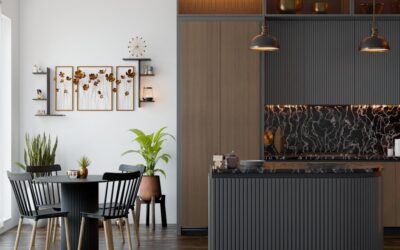
Walk into almost any modern kitchen with crisp, perfectly smooth painted cabinets, and there’s a good chance you’re looking at engineered wood, not solid lumber. MDF kitchen cabinet doors have become the go-to choice for painted and Shaker-style kitchens because they hold a factory-smooth finish that real wood simply can’t match. Understanding where MDF shines and where it falls short helps you decide whether it belongs in your remodel.
Part of our Kitchen Remodeling guide — explore the full guide →
What MDF Actually Is
Medium-density fiberboard is made by breaking down wood fibers, mixing them with resin, and pressing the mixture under heat into dense, uniform panels. The result has no grain, no knots, and no natural expansion lines, which is precisely why cabinet makers love it. A sheet of MDF weighs more than plywood of the same size because it’s so dense, typically around 45 to 50 pounds per cubic foot.
That density is the source of both its strengths and its weaknesses. It machines cleanly for routed profiles and paints beautifully, but it also soaks up water like a sponge if the surface is ever breached.
Why Painted Kitchens Favor MDF
If you want a flawless white or colored kitchen, MDF is usually the smarter material. Solid wood expands and contracts with humidity, and over a year or two those movements can crack paint at the joints, leaving thin lines that homeowners find maddening. Because MDF has no grain and no seasonal movement, painted MDF doors stay smooth and seamless.
The surface also takes primer and paint evenly, with no grain telegraphing through the finish. That’s why high-end cabinet lines often use a solid wood frame with an MDF center panel, combining the strength of one with the finish quality of the other.
The Moisture Question
The most common worry about MDF is water, and it’s a fair one. Standard MDF that gets soaked will swell, and once it swells it won’t return to shape. But in real kitchens, doors face steam and the occasional splash, not standing water, and a properly sealed and painted door repels day-to-day moisture just fine.
To reduce risk, look for moisture-resistant MDF, sometimes labeled MR-MDF and often dyed green, especially for doors near the sink or dishwasher. Keep the bottom edges sealed, wipe up spills promptly, and MDF holds up for many years. The one place to avoid bare MDF entirely is under a leaking sink, where sustained dampness will destroy any engineered panel.
Durability in Daily Use
Day to day, MDF doors resist warping and cracking better than solid wood, but they’re more vulnerable to impact damage. A sharp knock on a corner can dent or chip the dense edge, and unlike wood you can’t sand out a deep gouge because there’s no grain to blend into. Small dings, though, fill and repaint invisibly, which is a genuine advantage over wood’s visible grain.
Hinges and hardware hold well as long as the screws bite into solid material; use the pilot holes provided and avoid overtightening, which can strip the dense fiber.
Weight is worth a mention too. MDF is heavier than solid wood of the same size, so a full run of MDF doors puts more strain on hinges over the years. This rarely causes trouble on standard doors, but on oversized pantry or appliance-garage doors it’s a reason to spec sturdier concealed hinges rated for the extra load. Quality European hinges with a six-way adjustment make it easy to keep heavy MDF doors hanging square long after installation.
Cost Compared to Solid Wood
Budget is where MDF often wins. Here’s a rough comparison for door material alone:
- MDF Shaker doors: roughly $10 to $30 per door, painted grade.
- Solid maple or oak doors: roughly $30 to $70 per door depending on species.
- Full custom hardwood: $70 and up per door.
Across a full kitchen of 25 to 40 doors and drawer fronts, choosing MDF for painted work can save $800 to $2,000 without any visible downgrade in a finished, painted result. For a stained wood look, though, MDF is the wrong choice, since it can’t take stain convincingly and must be painted.
MDF Versus Thermofoil and Wood
Many “MDF” doors are actually thermofoil, an MDF core wrapped in a heat-fused vinyl skin. Thermofoil is inexpensive and wipes clean easily, but the film can peel near ovens and dishwashers where heat builds up. A painted MDF door has no film to delaminate, so for longevity near heat sources, paint-grade MDF beats thermofoil.
Against solid wood, the decision comes down to finish: choose MDF for painted kitchens and solid wood for stained, natural-grain looks. Plywood boxes paired with MDF doors is a common and durable combination in quality cabinetry.
Caring for MDF Doors
Maintenance is simple. Follow these habits and painted MDF stays sharp for a decade or more:
- Wipe spills and splashes promptly, especially along bottom edges and around the sink.
- Clean with a damp cloth and mild soap; skip abrasive pads that can dull the paint.
- Touch up chips quickly with matching paint so moisture can’t reach the exposed core.
- Adjust hinges seasonally to keep doors aligned and gaps even.
If a door ever swells or chips beyond repair, replacements are easy to order in matching sizes and repaint, which is far cheaper than replacing a solid wood door.
The Bottom Line
For a painted kitchen on a sensible budget, MDF kitchen cabinet doors deliver a finish that solid wood struggles to match, at a lower price and with less risk of seasonal cracking. Keep them sealed, protect them from standing water, and pair them with sturdy plywood boxes. Do that, and you’ll get a smooth, modern kitchen that looks custom without the custom-hardwood price tag.