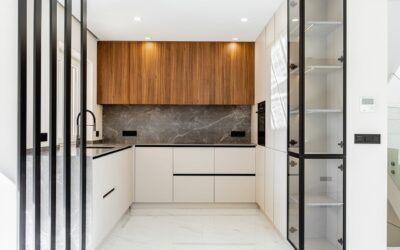
Cabinet material determines how long your kitchen holds up to daily abuse from steam, grease, slammed doors, and heavy pots. Choosing the best kitchen cabinet materials means balancing durability, moisture resistance, appearance, and budget across two separate components: the cabinet box and the door. Builders and manufacturers use different materials for each, and understanding the trade-offs helps you avoid paying premium prices for average performance or skimping in areas where quality matters most.
Part of our Kitchen Remodeling guide — explore the full guide →
Solid Wood Cabinets
Solid hardwood remains the gold standard for cabinet doors and face frames. Maple, cherry, oak, and birch are the most popular species for kitchen cabinetry. Maple is dense, fine-grained, and takes paint beautifully. Cherry darkens naturally over time and suits traditional kitchen designs. Red oak offers a prominent grain pattern and strong durability at a lower price point than maple or cherry.
Solid wood cabinet doors range from $150 to $500 per door depending on species and style. The material is easy to refinish, repair, and modify over its 30- to 50-year lifespan. However, solid wood expands and contracts with humidity changes, which can cause warping, cracking, or joint separation in poorly finished or improperly acclimated pieces. Solid wood is almost never used for the cabinet box itself because flat panels warp. Instead, box construction uses plywood or engineered materials.
Plywood Cabinet Boxes
Plywood is the top-tier choice for cabinet box construction. Made by layering thin wood veneers with alternating grain directions, plywood resists warping, cracking, and moisture far better than solid wood panels. Cabinet-grade plywood, typically 0.5-inch or 0.75-inch thick, holds screws securely and supports heavy loads on shelves without sagging.
Birch plywood is the industry standard for quality cabinets, priced at $40 to $60 per sheet. Marine-grade plywood offers even better moisture resistance for kitchens with high humidity or near dishwashers. Plywood cabinet boxes cost 15% to 25% more than particleboard alternatives, but the longevity and structural integrity justify the premium. Most semi-custom and custom cabinet brands use plywood boxes as their baseline, with particleboard offered only in budget lines.
MDF for Doors and Panels
Medium-density fiberboard is engineered from wood fibers bonded with resin under heat and pressure. The result is an extremely smooth, uniform panel with no grain, knots, or voids. MDF excels as a material for painted cabinet doors because it machines cleanly, accepts primer and paint without grain telegraphing, and costs significantly less than solid wood.
MDF doors typically run $50 to $150 each, roughly half the price of solid wood. Shaker-style and flat-slab designs in MDF are virtually indistinguishable from painted solid wood at arm’s length. The weakness is moisture. Standard MDF swells and deteriorates when exposed to standing water. Moisture-resistant MDF (often labeled MR-MDF or green MDF) performs better in kitchen environments but still cannot match plywood in wet conditions. Never use standard MDF for cabinet boxes under sinks or next to dishwashers.
Particleboard and Melamine
Particleboard is the most affordable cabinet box material, made from wood chips and sawdust bonded with adhesive. It forms the backbone of stock and flat-pack kitchen cabinets from big-box retailers. A standard particleboard cabinet box costs 30% to 50% less than a plywood equivalent.
The drawbacks are real. Particleboard holds screws poorly, sags under heavy loads on wide shelves, and swells irreversibly when wet. Melamine-coated particleboard adds a thin, wipeable surface layer that improves appearance and minor moisture resistance, but the core material still fails when saturated. For a budget kitchen renovation expected to last 10 to 15 years, melamine particleboard boxes are an acceptable compromise. For a kitchen you plan to keep for 20 or more years, plywood is the better investment.
Stainless Steel and Aluminum
Metal cabinets have a niche following in modern and industrial kitchen designs. Stainless steel cabinets are completely waterproof, fireproof, and impervious to insects. They are standard in commercial kitchens and increasingly popular in high-end residential projects. Expect to pay $800 to $2,000 per linear foot installed for stainless steel cabinetry.
Aluminum-frame cabinets with glass or acrylic panel inserts offer a lighter, less expensive metal option at $500 to $1,200 per linear foot. Both metal options dent and scratch visibly, show fingerprints constantly, and create a cold aesthetic that does not suit every kitchen style. They are best used as accent pieces, such as an island or a single wall of uppers, rather than a full kitchen of metal cabinetry.
Thermofoil and Laminate Doors
Thermofoil doors are made by heat-wrapping a thin vinyl film over an MDF core. They deliver a seamless, easy-to-clean surface in dozens of colors and faux wood patterns at $75 to $175 per door. Laminate doors bond a decorative paper or plastic layer to a substrate under high pressure, offering similar aesthetics at comparable prices.
Both materials resist staining and clean easily with a damp cloth. The main risk with thermofoil is heat damage. Cabinets adjacent to ovens, toasters, or dishwasher steam vents can experience delamination where the vinyl peels away from the MDF. Keep thermofoil doors at least 3 inches from heat-generating appliances. Laminate is slightly more heat-resistant but can chip at the edges if struck with hard objects.
How to Choose the Right Material Combination
Most quality kitchens use a combination of materials rather than one throughout. A proven formula for durability and value is plywood cabinet boxes with solid wood or MDF doors. This gives you structural strength where it matters most and the aesthetic finish you want at a reasonable price.
For a budget of $5,000 to $10,000 on cabinets alone, plywood boxes with MDF painted doors deliver excellent results. At $10,000 to $20,000, solid maple or cherry doors on plywood boxes provide a premium look with decades of durability. Below $5,000, melamine particleboard boxes with thermofoil doors are the practical choice, but plan for replacement in 10 to 15 years. Regardless of budget, always prioritize plywood for the sink cabinet. That single box takes the most moisture abuse in the entire kitchen and should be built from the best material you can afford.