
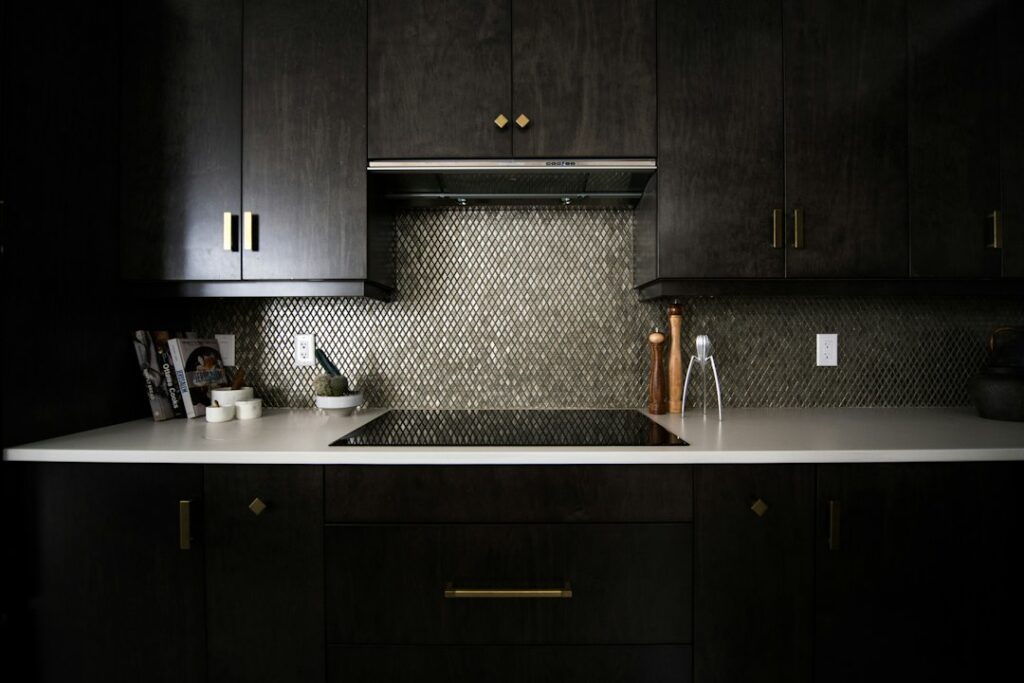
Cabinet hardware is often called the jewelry of the kitchen, and for good reason: swapping it changes the entire mood for a fraction of a remodel’s cost. Modern kitchen cabinet pulls lean on clean lines, matte and satin finishes, and generous proportions to give a kitchen a current, intentional look. The right pulls can make builder-grade cabinets feel custom; the wrong ones can date an otherwise beautiful kitchen instantly.
Part of our Kitchen Remodeling guide — explore the full guide →
Choosing well means balancing finish, size, and placement, three decisions that work together. This guide breaks down each so your hardware looks designed rather than defaulted.
- Pulls vs. Knobs vs. Handleless
- Popular Modern Pull Styles
- Finishes That Define the Look
- Sizing Pulls Correctly
- Placement and Orientation
- Installation Tips
- Mixing Pulls and Knobs
- Matching Hardware to Cabinet Color
- Coordinating With the Whole Kitchen
- Budget and Where to Splurge
- Choosing Minimalist Cabinet Pulls
Pulls vs. Knobs vs. Handleless
Modern design generally favors bar pulls over small round knobs, because the long, straight line of a pull reinforces the clean geometry of contemporary cabinetry. Knobs still have a place, often on upper doors paired with pulls on drawers, but an all-pull kitchen reads more distinctly modern.
At the extreme minimalist end, some kitchens go handleless entirely, using integrated finger channels or push-to-open latches. For most homeowners, though, well-chosen bar or edge pulls deliver the modern look while keeping cabinets easy to grab with wet or full hands.
Popular Modern Pull Styles
The contemporary category covers several distinct looks:
- Bar pulls: Straight, round or square tube pulls, the modern default. Sleek and versatile in any length.
- Flat/blade pulls: Thin, flat rectangular profiles that feel architectural and ultra-clean.
- Edge and finger pulls: Mounted on the door edge for a nearly invisible, European look.
- Tab and drop pulls: Small, understated hardware for a quiet minimalist statement.
- Appliance pulls: Oversized bar pulls scaled for refrigerator and dishwasher panels.
Within these, the profile matters: round tube pulls feel softer and more transitional, while flat or square pulls feel sharper and more strictly modern.
Finishes That Define the Look
Finish is the single biggest driver of a pull’s personality. The most on-trend modern options:
- Matte black: The defining modern finish, bold against white, wood, and green cabinets alike. Hides fingerprints well.
- Brushed brass/gold: Warm and elegant, softening an otherwise cool modern palette. Satin, not shiny, is the current look.
- Brushed/satin nickel: A safe, versatile neutral that resists showing smudges.
- Stainless steel: Clean and durable, coordinating naturally with appliances.
- Matte gold and champagne bronze: Softer warm metals gaining popularity in transitional-modern kitchens.
Coordinate the pull finish with your faucet and lighting for a pulled-together kitchen. Mixing metals can work when done deliberately, for example matte black pulls with brass lighting, but keep the hardware itself in one finish for consistency.
Sizing Pulls Correctly
Two measurements matter on any pull: overall length and center-to-center (the distance between the mounting screws, abbreviated CTC). Order by CTC to ensure a proper fit, and scale the pull to the drawer or door.
A widely used guideline is to choose a pull roughly one-third the width or height of the drawer front or door:
- Small drawers (up to 12 in): 3 to 4 inch CTC pulls
- Standard drawers (12 to 24 in): 4 to 6 inch CTC pulls
- Wide drawers (24 to 36 in): 8 to 12 inch CTC pulls, or two pulls
- Cabinet doors: 4 to 5 inch CTC pulls mounted vertically
- Appliance panels: 12 to 18 inch appliance pulls
Undersized pulls on a big drawer look timid; generously scaled pulls read as intentional and modern. When unsure, size up slightly.
Placement and Orientation
Where you mount hardware is as important as what you choose. Standard modern placement:
- Drawers: Center the pull horizontally on the drawer front, both left-to-right and top-to-bottom. On very tall drawer fronts, place it slightly above center.
- Base cabinet doors: Mount pulls vertically near the top corner of the door, 2.5 to 3 inches down from the top edge.
- Upper cabinet doors: Mount pulls vertically near the bottom corner, 2.5 to 3 inches up from the bottom edge, so they are easy to reach.
Consistency is everything: use a template or a hardware jig so every pull lands in exactly the same spot. Even a quarter-inch of variation across a run of cabinets is visible and looks sloppy.
Installation Tips
Installing pulls is a straightforward DIY job, but precision separates good from great. A few pointers:
- Buy or make a cabinet hardware jig ($15 to $25), which sets consistent hole positions across every door and drawer.
- Mark and drill with the jig clamped in place, using a sharp bit sized to the screw (usually 3/16 inch).
- Drill from the front through a backer, or clamp scrap behind the hole, to prevent the wood from blowing out and splintering on the back side.
- If your cabinets already have holes from old hardware, buy pulls with matching CTC, or use a backplate to cover mismatched holes.
- Secure with the machine screws provided, checking each pull is level before final tightening.
Standard screws come in 1-inch lengths; thicker doors or backplates may need longer screws, sold cheaply in multipacks.
Mixing Pulls and Knobs
A designer trick that reads as intentional rather than indecisive is combining pulls and knobs strategically. The most common approach uses pulls on all drawers and knobs on all doors, which gives drawers the leverage they need to slide open smoothly while keeping doors visually lighter. Another version reverses it in certain kitchens, but the drawer-pull, door-knob pairing is the reliable default.
If you go this route, keep both the pulls and knobs in the exact same finish so the mix looks planned. On very large or heavy drawers, two knobs or a single long pull both work; a wide drawer with one tiny center knob looks under-hardwared and is harder to open evenly. For a strictly modern look, though, an all-pull kitchen with matching bar pulls on doors and drawers is the cleanest, most contemporary choice, and it is the safest bet if you are unsure.
Matching Hardware to Cabinet Color
The interplay between pull finish and cabinet color makes or breaks the look. Matte black pulls pop dramatically against white, light gray, and pale wood cabinets, creating the high-contrast graphic look that defines many modern kitchens. Against dark navy or forest green cabinets, black pulls can disappear, so brushed brass or champagne bronze often works better there, adding a warm glint that lifts the dark color.
On natural wood-veneer cabinets, black and matte gold both look at home, while stainless and satin nickel keep things quiet and let the wood grain star. A useful rule is to decide whether you want the hardware to stand out or blend in: high contrast makes the pulls a design feature, while a tonal match keeps the cabinets themselves the focus. Either can look great, but choosing deliberately, rather than defaulting to whatever the store had in stock, is what separates a designed kitchen from a builder-grade one.
Coordinating With the Whole Kitchen
Cabinet pulls do not live in isolation; they should speak to the faucet, lighting, and other metal finishes in the room. The cleanest approach is to pick one dominant metal, say matte black, and carry it through the pulls, the faucet, and the pendant lights over the island. That repetition ties the whole kitchen together and makes even modest cabinets look considered.
Deliberate metal mixing works too, and is increasingly common: matte black hardware with brass or gold lighting and faucet, for instance, creates depth without looking accidental. The key is limiting the palette to two metals at most and repeating each one in more than one place so it reads as a pattern rather than a mismatch. Keep the cabinet hardware itself in a single finish, then echo the room’s second metal in the fixtures. Get that coordination right and the pulls become the connective tissue that makes the whole space feel cohesive.
Budget and Where to Splurge
Cabinet pulls range from $2 to $3 each for basic bar pulls up to $20 to $40 each for designer solid-brass hardware. A typical kitchen has 25 to 40 pieces of hardware, so even mid-range pulls at $6 to $10 each total $150 to $400 for the whole kitchen, one of the highest-impact updates per dollar you can make. Splurge on the finish quality, since cheap coatings on matte black or brass can wear at the fingertips within a couple of years.
Chosen and installed with care, modern kitchen cabinet pulls transform the feel of a kitchen for a modest investment, tying the cabinetry to your faucet and lighting and giving even standard cabinets a crisp, custom, contemporary edge.
Choosing Minimalist Cabinet Pulls
Minimalist cabinet pulls keep hardware almost out of sight: thin edge pulls, recessed or integrated channels, small tabs and slim profiles that sit close to the door. They suit flat-panel and slab cabinets best, where any bulky handle breaks the clean face. The choice comes down to how much grip you need and how much of the pull you want to see.
Types of Minimalist Pulls Compared
| Type | How it mounts | Visibility | Grip | Good fit |
|---|---|---|---|---|
| Edge pull | Screws to the top or back edge of the door | Thin lip only | Fair; fingers hook under the lip | Slab doors and drawers |
| Tab pull | Screws to the back face, small tab overhangs | Very low | Fair for light doors | Uppers and small drawers |
| Recessed or inset pull | Routed pocket in the door face | Flush with the surface | Fair to good | Custom or new doors |
| Integrated channel (J-pull) | Machined into the door or a profile rail | Reads as a shadow line | Good along the full width | Handleless kitchens |
| Slim bar pull | Two screws through the face | Low profile, thin diameter | Very good | Retrofit on existing cabinets |
Retrofit vs New Doors
Edge pulls, tab pulls and slim bar pulls work on most existing cabinets. Recessed pulls and integrated channels need routing or new doors, so they are usually a remodel choice rather than a weekend swap. Edge pulls also need a door edge thick enough to take the screws, typically 3/4 inch, and a little clearance between doors and the face frame so fingers can get behind the lip.
Practical Tips
- Match the pull finish to the cabinet for the quietest look, such as black on black or a white tab on white doors.
- Use longer edge pulls on wide drawers so they open evenly from either side.
- Test grip on heavy pots-and-pans drawers; a tiny tab can be hard to pull when the drawer is full.
- Consider push-to-open latches for uppers and minimal pulls on drawers if you want doors with no hardware at all.
- Keep placement consistent with a jig, because small hardware makes any misalignment easier to spot.
Minimal hardware costs about the same as standard bar pulls, though recessed and integrated systems add fabrication cost. Order one sample first and test it on an actual door before buying a full kitchen set.


