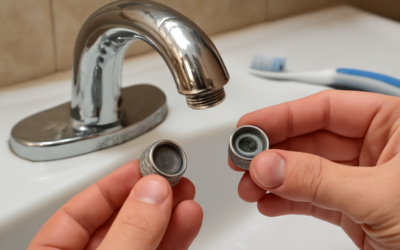
When a kitchen faucet suddenly sprays sideways, dribbles weakly, or splashes all over the sink, the culprit is almost never the faucet itself, it is the little screen at the tip. The Moen kitchen faucet aerator is the small threaded insert that mixes air into the water stream, and it is the single most common source of pressure and spray complaints on Moen faucets. The good news is that servicing a Moen kitchen faucet aerator takes about five minutes and usually costs nothing. This guide walks through removal, cleaning, thread sizing, and when a replacement makes sense.
Part of our Kitchen Remodeling guide — explore the full guide →
I have fixed more “broken” faucets by cleaning an aerator than by any other repair. Before you call a plumber or shop for a new faucet, start here.
What a Moen Kitchen Faucet Aerator Does
The aerator screws onto the very end of the spout and does three jobs at once. It splits the water into many small streams and introduces air, which produces the soft, non-splashing flow you expect. It also limits the total flow rate to conserve water, and its screen catches sediment and mineral debris before it sprays out.
That debris-catching function is exactly why aerators clog. Over months, hard-water minerals, tiny rust flakes, and grit from the municipal supply collect on the screen and inside the small flow disc. As the openings clog, the stream weakens, sprays erratically, or splits into a spray that shoots past the drain. Nine times out of ten, a clogged aerator masquerades as a much bigger problem.
Removing the Aerator: Threads and Direction
Most Moen aerators unthread by hand. Grip the aerator and turn it, and here is the direction people get wrong: because you are facing up at the underside of the spout, “lefty-loosey” looks reversed. Turn the aerator clockwise when viewed from below, which is counterclockwise from the faucet’s perspective, to loosen it. If it is stuck from mineral buildup, wrap the aerator in a cloth to protect the finish and use pliers gently, or a Moen aerator key if your model has a hidden, recessed aerator.
Moen uses several styles. Standard aerators have external threads on the aerator that screw into the spout, or the reverse. Many newer Moen pull-down and pull-out spray heads have the aerator integrated into the spray face rather than a separate insert, on those, the whole spray head unthreads from the hose. Check your specific model before assuming.
Thread Sizes You Might Encounter
Faucet aerators come in standardized sizes, and knowing yours helps if you need a replacement. The common kitchen sizes:
- Regular male: 15/16 inch-27 thread (the most common kitchen size)
- Regular female: 55/64 inch-27 thread
- Junior/small: less common on kitchen faucets, more on bathroom
Male-threaded aerators have external threads and screw up into the spout; female-threaded aerators have internal threads and screw onto external spout threads. If you are buying a replacement, take the old one to the store or measure the diameter. Many Moen models use proprietary integrated spray heads, so for pull-down faucets it is often simplest to order the Moen replacement part by faucet model number rather than a universal aerator.
Cleaning a Clogged Aerator
Cleaning restores flow without spending a dime. Follow this routine:
- Close the drain or lay a towel down so no small parts disappear down the drain.
- Unthread the aerator and note the order of the internal parts as you disassemble, there is usually a screen, a flow restrictor disc, and a rubber washer, and they must go back in the same order.
- Rinse each part under running water and brush the screen with an old toothbrush to dislodge grit.
- For heavy mineral scale, soak the parts in white vinegar for 30 to 60 minutes, then scrub again. The vinegar dissolves the calcium and lime deposits.
- Reassemble in the correct order and thread the aerator back on hand-tight, plus a slight snug with a cloth-wrapped pliers if needed.
Turn the water on and check the stream. A clean aerator delivers a full, straight, aerated flow. If it still sprays sideways, one of the internal screens may be seated wrong, so take it apart and recheck the orientation.
Understanding Flow Rates
Aerators are stamped or specified with a flow rate in gallons per minute (GPM). Standard kitchen aerators run 1.5 to 2.2 GPM. The federal maximum for kitchen faucets is 2.2 GPM, and many water-conscious regions and Moen’s own eco models use 1.5 GPM. If your flow feels weak even after cleaning, and the aerator is a low-flow model, you can swap in a higher-GPM aerator (up to 2.2) for more volume, though you will use more water.
Conversely, if the faucet splashes too aggressively, a lower-GPM aerator calms the stream. The flow restrictor disc inside the aerator is the part that sets this rate, some people remove it entirely for maximum flow, but that defeats the water-saving purpose and can make the stream splash.
When to Replace Rather Than Clean
Cleaning solves most problems, but replace the aerator when the plastic threads are stripped, the screen is torn, or the rubber washer has hardened and cracked so it leaks around the threads. A leak dripping from the base of the aerator usually means a failed washer, a fifty-cent fix.
Genuine Moen replacement aerators and spray heads carry Moen’s lifetime limited warranty on many residential faucets, so if your faucet is registered, contact Moen customer service, they frequently ship a free replacement aerator or spray head. That warranty is one of the strongest in the industry and worth using before you buy a third-party part. To make the warranty claim smooth, have your faucet’s model number ready, it is usually printed on a sticker under the sink on the supply lines or in your original paperwork, along with the approximate purchase date. Moen’s support team can identify the exact aerator or spray head your model uses and ship the correct part, which saves you the guesswork of matching thread sizes at the hardware store. Even out of warranty, ordering the manufacturer’s own part guarantees a proper fit, whereas a universal aerator sometimes threads on but sprays differently than the faucet was engineered to deliver.
Troubleshooting Common Aerator Problems
Beyond a simple clog, a few specific symptoms point to specific fixes. If the stream sprays wildly in one direction, the screen is likely partially blocked on one side or a part went back in crooked, take it apart and reseat everything flat. If the flow is weak from every faucet in the house, the problem is not the aerator at all; suspect the main pressure regulator or a partially closed shut-off valve.
Sputtering or spitting air usually means air is trapped in the line, common right after the water was shut off for a repair, and it clears after running the faucet for a minute. If the aerator keeps clogging within weeks of cleaning, you likely have sediment breaking loose upstream, often from a water heater or aging galvanized pipes; flushing the water heater and installing a whole-house sediment filter solves the recurring problem at the source.
Whining or whistling from the faucet under flow points to a flow restrictor that is too tight or slightly damaged. Try a fresh aerator of the correct GPM. And if you recently had plumbing work done and suddenly your Moen faucet barely trickles, pull the aerator first, construction debris and pipe scale routinely dislodge during repairs and lodge right in that screen. It is the first thing a plumber checks, so check it yourself before paying for a service call.
Keeping Flow Strong Long-Term
A Moen kitchen faucet aerator needs almost no maintenance, but a quick clean every six months in hard-water areas prevents the gradual flow decline most people never diagnose. If your home has very hard water, a whole-house or under-sink softener dramatically slows the buildup. Next time your kitchen faucet acts up, spend five minutes at the tip before you spend anything at all, the fix is almost always right there in that little screen.
To make the twice-a-year clean painless, keep a small stash on hand: a spare washer or two, a cheap toothbrush dedicated to the job, and a small jar of white vinegar. When you pull the aerator, snap a quick photo of the disassembled parts in order so reassembly is foolproof, this saves the frustration of guessing which way the flow disc faces. And if your faucet is a Moen pull-down with an integrated spray head rather than a removable aerator, remember the whole spray face soaks in vinegar the same way; you do not have to buy a new head just because the nozzles clogged. A few minutes of attention keeps a Moen faucet delivering the strong, even, splash-free stream it did the day it was installed, often for the full life of the faucet.