Of all the international tile styles clients bring me, the moroccan tile bathroom is the one that demands the most discipline. Moroccan design is built on dense geometric pattern — star-and-cross layouts, interlocking eight-point stars, tessellated mosaics that trace back to the fez tile tradition and centuries of Islamic geometric art. Done right, it’s the most transporting bathroom you can build. Done wrong, it’s visual noise you regret by the second mortgage payment. After installing a couple dozen of these, here’s my field guide.
Part of our Bathroom Remodeling & Flooring guide — explore the full guide →
- Understanding the Moroccan Tile Vocabulary
- The Patterns That Define the Style
- Color: Go Jewel-Toned or Go Quiet
- Where Each Tile Belongs
- Real Costs for a Moroccan Tile Bathroom
- Layout Rules That Keep Pattern From Becoming Chaos
- Fixtures and Finishes That Complete the Room
- Maintenance Reality Check
- Small Bathrooms and Powder Rooms: The Best Canvas
Understanding the Moroccan Tile Vocabulary
People use “Moroccan tile” to mean at least four different things, and knowing which one you want changes your budget by a factor of five:
- Geometric patterned tile — cement or porcelain tiles printed or pigmented with traditional Moroccan motifs: eight-point stars, quatrefoils, trellis patterns, and radiating medallions. This is what most people picture. Porcelain versions run $4 to $10 per square foot; true encaustic cement runs $12 to $25.
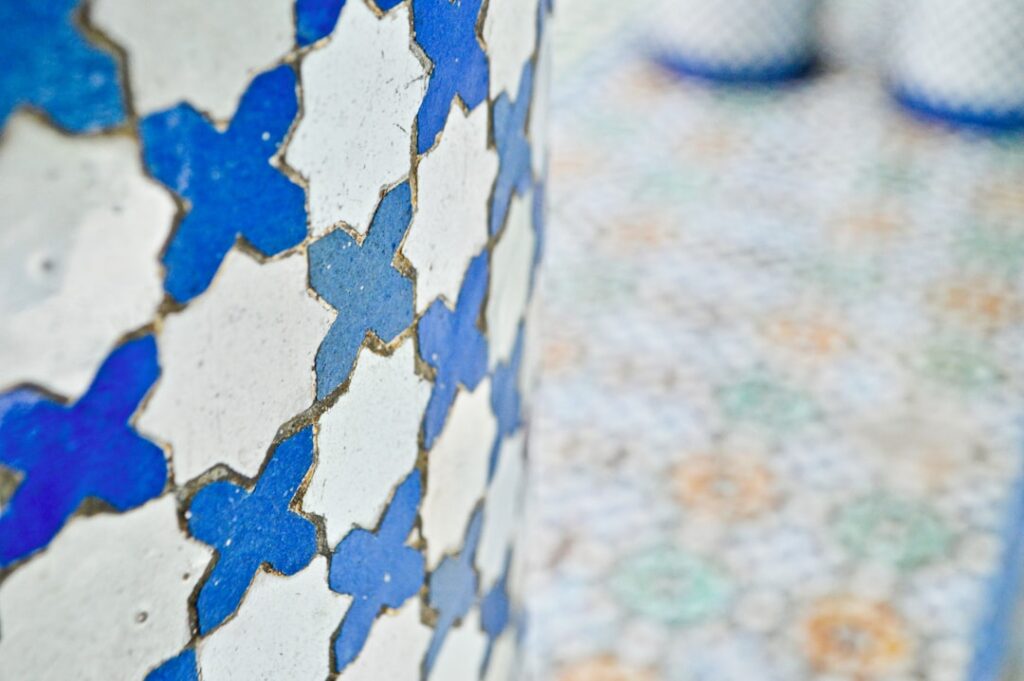
- Shaped tile — the physical silhouettes themselves: arabesque/lantern shapes, picket, hexagon, and star-and-cross combinations. The shape carries the style even in a single solid color.
- Zellige — hand-cut, hand-glazed terracotta squares from Fez with gorgeous surface irregularity. I’ll touch on it below, but zellige in showers is its own deep subject with real installation quirks, and I cover that separately. For this article, know that it’s the texture option, not the pattern option.
- Mosaic tilework — genuine hand-assembled geometric mosaic, rare and expensive in the US, mostly seen as imported table tops and fountains rather than bathroom surfaces.
The Patterns That Define the Style
Moroccan geometry differs from Spanish or Portuguese tile in a specific way: it’s almost never pictorial. No flowers painted loosely by hand, no scenes. It’s mathematics — repeating stars, interlaced straps, and tessellations that expand infinitely. The workhorses for bathrooms:
- Eight-point star (khatam) — the signature motif. Available as printed 8×8 porcelain squares or as physical star-and-cross two-piece sets.
- Arabesque / lantern shape — a curvy, onion-dome silhouette, usually 6 or 8 inches tall. In glossy white it’s subtle; in emerald or cobalt it’s a statement.
- Trellis and lattice prints — quatrefoil grids that read Moroccan without heavy color. Good for clients who want a whisper, not a shout.
- Radiating medallion panels — large-scale patterns assembled from multiple tiles, best as a single feature wall behind a tub.
Color: Go Jewel-Toned or Go Quiet
Moroccan palettes fall into two camps, and mixing them is where designs fall apart. The jewel-tone camp uses saturated cobalt, emerald, teal, and terracotta — colors pulled from Marrakech riads. The neutral camp uses white, sand, and clay with pattern carried by shape and layout alone. Both work. What doesn’t work is a busy multicolor pattern floor plus a saturated wall plus colored fixtures. In a typical 40 to 60 square foot bathroom, I allow one saturated element.
My most-repeated combinations: cobalt pattern floor with plaster-white walls and brass fixtures; all-white arabesque shower walls with a warm sand floor; emerald lantern-shape vanity wall with everything else in cream. Grout matters enormously with shaped tile — contrasting grout doubles the pattern’s intensity, matching grout calms it down. With arabesque shapes I almost always match the grout to the tile.
Where Each Tile Belongs
| Surface | Best Choice | Avoid |
|---|---|---|
| Bathroom floor | Porcelain Moroccan print, PEI 3+, DCOF ≥ 0.42 | Wall-rated cement look-alikes, glossy finishes |
| Shower walls | Porcelain prints, arabesque ceramic, zellige accent | Unsealed cement tile (stains, effloresces) |
| Shower floor | 2-inch hex or square mosaic in solid clay tones | Large patterned tile (no slope conformity, slippery) |
| Vanity wall | Anything — this is the lowest-risk hero surface | Nothing off-limits |
| Tub surround/apron | Star-and-cross or medallion feature panel | Overly busy print if the floor is patterned |
Cement tile deserves a special warning in bathrooms: it’s beautiful and authentic to the style, but it’s porous, needs penetrating sealer before grouting and reapplication every 1 to 2 years, and can shadow and etch in wet zones. In showers I substitute porcelain reproductions every time. On a bathroom floor outside the wet zone, cement is livable if the owner accepts the maintenance.
Real Costs for a Moroccan Tile Bathroom
For a standard 5×8 bathroom with tiled shower, here’s what I quote in 2026 dollars:
- Budget ($4,000–$7,000 installed): Printed porcelain pattern floor ($5/sq ft), white ceramic shower walls with one arabesque accent band, stock mosaic shower pan.
- Mid-range ($8,000–$13,000): Porcelain pattern floor, full arabesque or star-and-cross shower walls, upgraded urethane grout, niche with feature tile.
- High-end ($14,000–$25,000): Encaustic cement dry-area floor, zellige shower walls, handmade shaped tile features, custom medallion panel behind the tub.
Labor runs high on this style. Shaped tiles like arabesque generate slow, wasteful cuts — every edge and every plumbing penetration takes three times the time of square tile. I add 25 to 50 percent to labor for lantern shapes and star-and-cross layouts, and I tell clients to order 15 to 20 percent overage instead of the standard 10 because miscuts on curved profiles are inevitable.
Layout Rules That Keep Pattern From Becoming Chaos
- Center the pattern on the room’s sight line — usually the doorway view or the tub — not on a wall corner. A medallion print sliced awkwardly at the threshold ruins the whole effect.
- Give pattern a frame. Traditional Moroccan rooms border patterned fields with solid bands. A 4-inch solid clay-tone border around a patterned floor makes the field read as a rug and hides the perimeter cuts.
- Limit pattern to roughly a third of visible surfaces. My reliable ratio: one patterned plane, one textured or shaped plane, everything else quiet.
- Respect scale. An 8-inch star repeat in a powder room reads elegant; a 24-inch medallion repeat in the same room gets amputated by every wall and looks accidental.
- Dry-lay and photograph before setting. Multi-tile repeats are easy to rotate wrong. One tile set 90 degrees off in a star field is the only thing anyone will ever see.
Fixtures and Finishes That Complete the Room
The moroccan tile bathroom rewards warm metals — unlacquered brass, aged bronze, copper. Chrome fights the style. Wood vanities in walnut or oak, plaster or limewash paint on untiled walls, and woven or pierced-metal light fixtures finish the picture. If you’re using a saturated tile color, pull towels and paint from the tile’s background tone rather than adding a third color family. Arched mirrors and arched shower openings echo the arabesque geometry and cost little if planned during framing.
Maintenance Reality Check
Porcelain Moroccan prints are as low-maintenance as any tile — neutral pH cleaner, done. Cement tile needs sealer on a schedule and gentle cleaners only; anything acidic (vinegar, most bathroom sprays) etches it. Shaped-tile installations have more grout lines per square foot than large format, so spend the extra $40 to $80 per bathroom on urethane or epoxy grout and you’ll never regrout. Textured and handmade surfaces in showers benefit from a squeegee habit; hard-water spotting shows more on glossy jewel tones than on matte neutrals.
Small Bathrooms and Powder Rooms: The Best Canvas
One counterintuitive lesson from the field: the smaller the room, the better Moroccan tile performs per dollar. A powder room floor is often 15 to 20 square feet — meaning even a $20-per-square-foot encaustic cement splurge is a $300 to $400 material decision, and the maintenance burden of cement tile is trivial in a room with no shower humidity. Dense pattern that would overwhelm a large primary bath feels like a jewel box at powder-room scale. My favorite small-room formula: patterned floor in cobalt or emerald, walls in warm white plaster or limewash, an arched mirror, a single brass sconce, and a wood floating vanity. Total tile spend under $600, and it becomes the room guests photograph. In tight spaces, keep the repeat small (4-inch to 8-inch motifs), run the pattern wall-to-wall without a border, and let the walls stay completely quiet — the room is the frame.
Final take from the trenches: the moroccan tile bathroom succeeds when you commit to one strong geometric statement and surround it with restraint. Choose porcelain over cement anywhere water lives, frame your pattern like the rug it’s imitating, match grout to tile on shaped installations, and let brass and plaster do the supporting work. Skip the temptation to combine every pattern you loved on the inspiration board — the riads that inspired this style were built by craftsmen who understood that geometry needs breathing room. Give it that room and the bathroom will feel like a small vacation every morning, for as long as you own the house.
Prefer to explore on your own?
See how new flooring looks in your actual room in seconds — free, no signup.
Try the free Floor Studio →