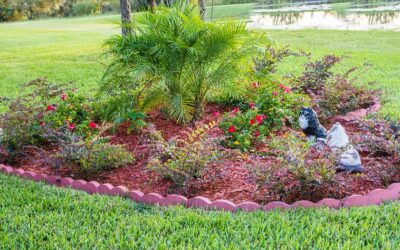
A landscape bed without a defined border looks unfinished no matter how much mulch you spread or how nicely the plants are arranged. The right edge separates lawn from bed, keeps mulch from migrating, and gives the whole yard that “the homeowner clearly cares” appearance worth thousands in resale value. Good mulch border ideas match your home’s style, your maintenance tolerance, and your budget. Here are ten approaches that work, with real costs and pros and cons of each.
Natural Trench Edging
The cheapest and one of the cleanest looks. Cut a 4 to 6 inch deep V-shaped trench at the bed perimeter with a half-moon edger ($25) or a flat spade. Slope the lawn side at 45 degrees and the bed side vertical. The visual contrast between turf, the dark trench, and mulch gives sharp definition for free.
The drawback: trench edges need re-cutting every 4 to 6 weeks during growing season. Bermuda grass and zoysia send runners across the gap quickly. Plan on 30 to 60 minutes of edging per 100 linear feet of bed per month.
Steel Landscape Edging
Powder-coated steel edging is the most durable option for clean modern lines. Brands like Col-Met and EverEdge sell 16 ft sections that cost about $25 to $40 each. Total installed cost runs $4 to $7 per linear foot. The steel sticks out 1/2 to 1 inch above the soil and bends smoothly into curves.
Steel edging lasts 20+ years without rusting through if quality powder-coated. The thin profile is barely visible from a few feet away, which gives a “naturally edged” look without the weekly maintenance. Best for contemporary homes and minimalist landscape designs.
Stacked Stone Borders
Natural stone stacked along bed edges creates an organic, English-garden look. Use fieldstone, river rock, or quarried wall stone in 4 to 8 inch sizes. Set the stones into a shallow trench so the bottom 1/3 sits below grade — this prevents them from rolling or kicking out from mower contact.
Stone costs $200 to $400 per ton, with each ton covering about 25 linear feet of single-layer border. The installation is heavier but the finished look is timeless. Pairs well with traditional, cottage, and farmhouse home styles.
Brick Edging
Standard clay paver bricks set on edge or laid flat create a classic, defined border. Set bricks in a 4 inch deep trench with 1 inch of paver sand underneath for leveling. Total cost runs $3 to $6 per linear foot including labor.
For best results, match the brick to your home’s accent brick if any. Mismatched brick edging looks like an afterthought. Soldier-course (vertical brick) installations stand 3 to 4 inches above grade and contain mulch better than flat-laid courses.
Cobblestone Edging
Belgian block and granite cobblestones cost more but bring upscale character. Real granite cobbles run $5 to $9 each; manufactured concrete versions are $2 to $4. Set in concrete or paver sand to keep them from shifting under mower bumps.
A 50 linear ft cobblestone border with installation runs $400 to $1,200. Most appropriate for historic homes, European-style landscapes, and properties where the rest of the hardscape uses similar stone. Avoid on ultra-modern homes where the look clashes.
Concrete Curbing
Continuous extruded concrete curbing creates a custom, seamless border with no joints. Specialty contractors extrude the curb on-site using a curbing machine that produces 4 to 6 inch tall, 6 inch wide curbs in any color or stamp pattern. Cost is $5 to $9 per linear foot installed.
Decorative options include integral color (pigment mixed into the concrete), stamped patterns mimicking brick or stone, and exposed aggregate. Cures fully in 3 to 5 days. Lasts 25+ years with no maintenance beyond an occasional pressure wash.
Wood Edging
Cedar, redwood, or pressure-treated 4×4 timbers cut into 18 to 24 inch lengths and set on end create a rustic border. Drill 1/2 inch holes through adjacent timbers and pin them together with rebar driven into the ground.
Cost runs $2 to $5 per linear foot. Cedar lasts 8 to 12 years; pressure-treated lasts 15 to 20 years before showing rot at the soil line. Best for woodland gardens, cabin properties, and homes with significant wood trim accents.
Plastic Landscape Edging
The black plastic strip from the home improvement store ($1 to $2 per linear foot) is the budget option but rarely looks as good as advertised. Frost heaves push it out of the ground over 2 to 3 winter cycles, and mowers nick the top edge.
If using plastic edging, invest in the heavy-duty 5 to 6 inch wide products like Master Mark Terrace Board ($30 for 20 ft) rather than the flexible thin profiles. Stake every 18 inches with the 10-inch spike pegs that come in the kit.
Decorative Stone Edging
For a maintenance-free border, set a 6 to 12 inch wide strip of decorative gravel or river rock between the lawn and the mulch bed. The gravel strip blocks turf migration, drains well, and never needs re-edging. Cost runs $1 to $2 per sq ft of strip.
Pair gravel borders with metal or stone edging on the lawn side to keep the gravel from spilling into the grass. Without an inner edge, gravel migrates into the lawn within a year and is impossible to mow over.
Living Plant Borders
Boxwood, mondo grass, or liriope planted in a tight row creates a green living border. Boxwoods grown 18 inches apart fill in within 2 to 3 years; mondo grass closes in within 1 year. Cost runs $3 to $8 per linear foot depending on plant size at purchase.
Living borders need annual trimming and look best in formal gardens. The benefit is a softer, more organic edge than hard materials. The drawback is replacing dead plants when individual specimens fail.
Combination Approaches
Some of the best-looking landscapes mix two or more border types. A stacked stone border along the front of a bed transitioning to a steel edge on the sides. Brick along the curb-facing edge with a natural trench against the foundation. Mixing materials by location lets you spend money where it shows most.
Picking the Right Border for Your Yard
Match the border to your home’s architecture, your maintenance tolerance, and your soil conditions. Heavy clay needs deeper edge installation to prevent frost heaving. Sandy soil holds shallow edges fine. Curvy bed lines pair better with steel or natural trenches; straight lines work with brick or concrete. The right choice elevates the whole landscape with a single weekend of work.