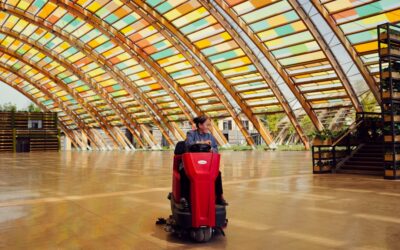
Walk into any commercial flooring contractor’s shop and you will almost certainly see a blue-and-silver ride-on scraper or a self-propelled surface prep machine wearing the National Flooring Equipment badge. Based in Minnesota and privately held since 1968, the company builds the machines that rip out 50,000 square feet of stuck vinyl in a weekend, grind concrete to the profile needed for epoxy, and handle the surface prep that makes or breaks every commercial flooring job. For a homeowner taking on a major demolition, the question is usually buy, rent, or hire — and the answer depends on what you are removing and how much of it.
What the Company Actually Makes
National Flooring Equipment (often abbreviated NFE) specializes in surface preparation and removal machines rather than finishing equipment. The product catalog breaks into four functional categories: ride-on and walk-behind scrapers for lifting flooring, concrete grinders and planers, shot blasters, and smaller handheld scrapers and power tools for edge work.
Flagship products include the 5700 ride-on scraper (rents for about $500 a day, costs $35,000+ to buy), the 555 walk-behind scraper (a staple in rental yards), and the 7700 Predator — an 85-pound multi-tool scraper that has become the go-to for removing ceramic tile thinset from large commercial spaces.
Where Homeowners Encounter These Machines
Very few homeowners buy NFE equipment. Almost all interaction with the brand happens through rental yards. Home Depot Tool Rental stocks the 555, 1160, and sometimes the 7700. Specialty rental yards (Sunbelt, United Rentals, local independents) carry the full lineup including the ride-on 5700 and 6280.
Rental pricing ranges are consistent nationally:
- 555 walk-behind scraper: $90 to $140 per day
- 7700 Predator handheld scraper: $75 to $110 per day
- 1160 walk-behind planer: $150 to $220 per day
- 5700 ride-on scraper: $425 to $650 per day
- 6280 self-propelled scraper: $300 to $500 per day
When a Rental Pays Off vs Hiring a Contractor
The calculation depends on square footage and flooring type. Removing 1,000 square feet of glued-down vinyl from a concrete slab with a 555 walk-behind takes 4 to 8 hours depending on adhesive age and slab smoothness. At $130 per day rental plus your labor, that is roughly $0.15 per square foot DIY.
A commercial floor removal crew charges $1.50 to $3.50 per square foot for the same work — $1,500 to $3,500 on that same 1,000 square foot job. The crossover point where DIY stops making sense is around 300 to 400 square feet. Below that, rental plus your time beats a contractor’s minimum charge. Above 3,000 square feet, a professional crew with a 5700 ride-on finishes in half a day and the math tilts back toward hiring.
What Each Major Machine Actually Does
Matching the tool to the flooring type prevents the “I wasted $200 and a weekend” outcome.
- 555 walk-behind scraper: good for vinyl sheet, glue-down carpet, resilient tile. Struggles with ceramic and hardwood.
- 7700 Predator (handheld): ceramic tile thinset, small rooms, corners and edges the larger machines cannot reach.
- 1160 walk-behind planer: removes concrete high spots, paint, thick epoxy, old thinset beds.
- 5700 ride-on: large commercial jobs over 2,500 square feet. Overkill for residential.
- Concrete grinders (2000 series): surface profiling before epoxy, polished concrete prep.
Learning Curve and Safety Notes
None of these machines are particularly dangerous compared to, say, a chainsaw — but they will damage your home if used carelessly. The 555 walks itself forward on momentum; let it ride up onto a transition strip and you can wreck a doorway in 3 seconds. Always start in an interior corner of the worst flooring area, not at a wall. Let the blade take small bites, not full-depth hero passes.
Wear hearing protection (these run 95 to 105 dB), safety glasses, and steel-toe boots. The airborne dust from removing old vinyl is a real hazard — older flooring may contain asbestos, and vinyl tiles installed before 1985 should be lab-tested before any mechanical removal. The test costs $35 and takes 3 days; doing it wrong means a $5,000 to $25,000 abatement bill and a contaminated house.
Buying New or Used — When It Makes Sense
Contractors who do flooring removal as a regular service buy NFE machines new. For a homeowner, buying used only makes sense in very specific cases: a multi-unit rental landlord who turns over 5+ units a year, a small contractor starting a business, or an investor flipping more than 3 houses annually.
Used 555 scrapers show up on Machinery Pete, IronPlanet, and Craigslist for $1,800 to $3,500 depending on condition and hours. That beats buying new at $5,800 but is still a bad deal for a one-off project. Rent it for $130, do the job, return it.
Parts, Service, and Support
NFE runs a factory service operation in Minnesota and an authorized dealer network across the US. Blade replacement — the most common maintenance — is straightforward, with OEM blades at $25 to $85 depending on machine and cut profile. Aftermarket blades run 40 to 60 percent cheaper and work fine for light use; for production commercial work, the OEM blades hold an edge 2 to 3 times longer.
Warranty on new machines is 1 year on parts, 90 days on wear items. Used machines carry no factory warranty but are often sold through dealers with 30-day mechanical guarantees.
The Practical Takeaway for a Homeowner
Rent, do not buy. Pick the right machine for your specific flooring type, reserve it midweek (weekend rentals go fast), and commit to the rental for a full day rather than 4-hour windows that inevitably run long. If you have 500-plus square feet of glued-down flooring to remove, an 8-hour rental and a strong back will save you thousands versus a commercial removal quote. And if the flooring is pre-1985 vinyl or sheet goods, stop and get the asbestos test done first.
Prefer to explore on your own?
See how new flooring looks in your actual room in seconds — free, no signup.
Try the free Floor Studio →