Layering an area rug over wall-to-wall carpet looks great in photos and slides around like a hockey puck in real life. A non slip rug pad for carpet is the fix, and it works on a completely different principle than the pads you’d use on hardwood. On a hard floor you want grip; on carpet you want stiffness, because the enemy isn’t a slick surface, it’s the plush pile underneath letting your rug wander and buckle.
Most people buy the wrong pad the first time. They grab a thin rubber gripper meant for tile, throw it under a rug on carpet, and wonder why the rug still creeps toward the couch. The right pad for a carpet-on-carpet situation is firmer, often with a needle-punched or dual-surface design, and choosing it correctly makes the difference between a rug that stays put for years and one you’re straightening every week.
- Why Rugs Slide on Carpet in the First Place
- Types of Rug Pads That Work on Carpet
- How to Choose the Right Thickness
- Getting the Size Right
- Installation and Care
- Common Mistakes to Avoid
- Matching a Rug Pad for Carpet to Pile Height, Traffic and Trip Safety
- Final Recommendation
- Top Pads Worth Buying and Where to Find Them
- Will a Rug Pad Damage or Stain My Carpet?
- Frequently Asked Questions
Why Rugs Slide on Carpet in the First Place
A rug on carpet floats on a springy cushion of fibers. Every footstep pushes the rug slightly, and because there’s no friction anchoring it to a hard surface, those small shoves add up. Over a week the rug migrates, the corners curl, and the edges ripple into tripping hazards. The pad’s job is to bridge that plush layer with something rigid enough to keep the rug’s shape and grippy enough to resist the constant nudging.
Thin rubber grippers fail here because they’re designed to bond a rug to a smooth floor. On carpet there’s nothing smooth to bond to, so they just ride along with the rug. You need a pad engineered specifically for carpet-over-carpet use.
Types of Rug Pads That Work on Carpet
Needle-Punched Felt with a Gripper Back
This is the workhorse. A dense felt top holds the rug’s shape while a rubberized or textured bottom digs into the carpet pile. These pads run about a quarter-inch thick and cost $30 to $80 for an 8-by-10 depending on brand. They resist bunching better than any other style and add a touch of cushion underfoot.
Dual-Surface Pads
Made for exactly this problem, dual-surface pads have one side tuned to grip carpet and the other to grip hard floors, so they’re versatile if you move rugs around the house. Brands like Gorilla Grip and RUGPADUSA sell carpet-specific versions in the $25 to $70 range.
Rug-to-Carpet Anchor Grippers
These are corner or strip anchors with hook-and-loop or a tacky gel that grabs the carpet below. They’re cheap, around $10 to $20 for a set of four, and work well for small or lightweight rugs, though they won’t stop a large rug from wrinkling in the middle.
How to Choose the Right Thickness
For carpet, firmness beats plushness. A quarter-inch needle-punched pad hits the sweet spot: thick enough to hold shape, thin enough that the rug doesn’t feel like a speed bump. Skip the half-inch memory-foam pads marketed for comfort; that softness is the opposite of what you need over an already-cushioned floor and it lets the rug shift more, not less.
If the rug sits in a low-traffic bedroom, you can go slightly thinner. In a hallway or living room where feet hit it constantly, spring for the denser felt-and-rubber construction even at the higher price.
Getting the Size Right
Cut the pad about one inch smaller than the rug on all sides. That keeps the pad hidden and prevents it peeking out past the rug’s edge. Most felt pads trim easily with sharp scissors or a utility knife, so buy the next size up and cut it down rather than leaving gaps at the corners where the rug will curl first.
- 5×7 rug: buy a pad sized around 4’10” x 6’10”
- 8×10 rug: buy a pad around 7’8″ x 9’8″
- 9×12 rug: buy a pad around 8’8″ x 11’8″
Installation and Care
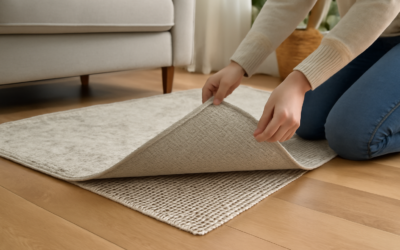
Lay the pad grip-side down on the carpet, center it, and set the rug on top. Press the rug edges down firmly so the corners engage the pad. That’s the whole job. There’s no adhesive and nothing to damage your carpet, which matters if you’re renting or plan to move the rug later.
Vacuum the rug normally, but lift it every few months to shake out the pad and vacuum underneath. Trapped grit works its way into both the pad and the carpet over time. Quality felt pads last five to ten years; cheap foam ones crumble and leave residue within a year or two, so the upfront cost of a good pad pays off.
Common Mistakes to Avoid
- Using a hard-floor rubber gripper on carpet. It won’t grab and the rug will still slide.
- Choosing a thick, squishy pad. Softness increases movement over carpet, not reduces it.
- Buying a pad the same size as the rug. The edges show and the corners lift.
- Ignoring rug weight. Heavy wool rugs need a firm felt pad; light cotton rugs can get by with corner anchors.
Matching a Rug Pad for Carpet to Pile Height, Traffic and Trip Safety
A rug pad for carpet has to suit the carpet underneath as much as the rug on top. The same pad that locks a rug in place over a tight commercial loop can feel wobbly over a deep plush, so check the pile before you buy and plan for how people actually walk across the room.
Why Rugs Creep in One Direction
Rugs over carpet rarely wander at random. Most creep follows the carpet’s nap, the direction the fibers lean after years of vacuuming and foot traffic. Each step presses the rug along that lean, which is why a rug often drifts toward the same wall or doorway every week. Run your hand across the carpet: the smooth direction is the way your rug will travel. A pad with a textured underside resists that pull far better than a bare rug backing.
Gripper Pads vs Cushion Pads Over Carpet
Gripper pads are thin and firm, built to hold position. Cushion pads are thicker and softer, built for comfort. Over carpet, the carpet already supplies the cushion, so a gripper style or a firm felt pad with a grip face is usually the better choice. A soft cushion pad stacked on soft carpet creates a spongy layer that lets the rug flex and ripple. Save cushion pads for thin flat-weave rugs over very low, dense carpet, where a little extra padding helps without adding movement.
Pile Height Compatibility
- Low pile and loop carpet: Most pads work here. A thin grip-backed felt pad holds well because the surface is firm and even.
- Medium pile: Choose a firm pad with a textured or needle-style underside that settles into the fibers.
- Plush, frieze or shag carpet: Pick the stiffest pad you can find and keep it thin. Deep pile swallows soft pads, and the rug will sway as you walk.
Trimming for a Clean Fit
Lay the pad flat for a day so it relaxes. Set the rug on it, fold back one half, and mark the cut line with chalk about an inch in from the rug edge. Trim with sharp shears or a utility knife against a straightedge, then repeat on the other half. Round the corners slightly so they do not poke out when the rug corners shift.
Trip Safety Over Carpet
A rug over carpet raises the floor height, and a lifted corner catches toes more easily than people expect. Keep rug edges out of door swings so a door never scuffs and folds them. Avoid placing a padded rug at the top of a stair landing or right at a threshold where carpet changes height. If a corner keeps curling, reverse-roll it overnight or add a small corner gripper under that spot.
Final Recommendation
For most homeowners layering an area rug over wall-to-wall carpet, a quarter-inch needle-punched felt pad with a gripper back is the safest buy. It holds the rug’s shape, resists the constant nudging that causes migration, and lasts the better part of a decade. Expect to spend $30 to $80 for a standard living-room size, cut it an inch smaller than the rug, and you’ll stop straightening that rug for good. For small accent rugs, a set of corner grippers at $15 does the trick without the bulk.
Top Pads Worth Buying and Where to Find Them
Shopping is easier once you know which products actually perform on carpet. RUGPADUSA’s Superior-Lock is my go-to for medium and large rugs; the 8-by-10 runs about $70 on the company’s site and Amazon, and it pairs a dense felt core with a natural-rubber grid that bites into pile. Gorilla Grip sells a felt-and-rubber pad in the same size for around $45 at Walmart and Amazon, a solid mid-price option. For corner anchors, the Sticky Toes or NeverCurl sets cost $12 to $20 at Home Depot and Amazon and handle 3-by-5 and 4-by-6 accent rugs.
Skip the ultra-thin PVC mesh sold for $10 to $15 in the flooring aisle. That stuff is engineered for hard floors, not carpet, and it will disappoint you within a week. Pay a little more for the felt-backed construction and you buy years of use instead of a return trip to the store.
- RUGPADUSA Superior-Lock: ~$70 for 8×10, best all-around for large rugs, trims with scissors.
- Gorilla Grip Felt + Rubber: ~$45 for 8×10, good value, widely stocked.
- NeverCurl / Sticky Toes corner grippers: $12 to $20 per set, ideal for small rugs.
Will a Rug Pad Damage or Stain My Carpet?
A quality felt pad with a natural-rubber backing is safe on carpet and leaves no residue. The trouble comes from cheap pads that use a coated PVC or adhesive-style backing; those can off-gas, break down, and leave a sticky or yellowed film on light carpet over a year or two, especially in warm rooms above 80°F. Stick to pads labeled natural rubber or needle-punched felt and you avoid the problem entirely.
If you rent, this matters double. A non-staining felt pad protects your deposit while still anchoring the rug, and because there’s no glue involved, you can lift everything and move on cleanup-free when the lease ends.
Frequently Asked Questions
Do I really need a pad if my rug has a rubber backing? Yes. Factory rubber backing grips hard floors, not carpet pile, and it can trap moisture against wall-to-wall carpet. A separate felt pad still helps hold the shape.
Can I use a hard-floor pad if it’s all I have? In a pinch, but expect the rug to keep sliding. The right tool costs $40 and solves it for years, so it’s worth the trip.
How often should I replace the pad? A good felt pad lasts five to ten years. Replace it sooner if it flattens, crumbles, or stops gripping. Foam pads often need swapping within a year or two.
Does a thicker pad grip better? No. Over carpet, firmness matters more than thickness, and a squishy half-inch foam pad actually lets the rug shift more. A firm quarter-inch felt pad is the sweet spot.