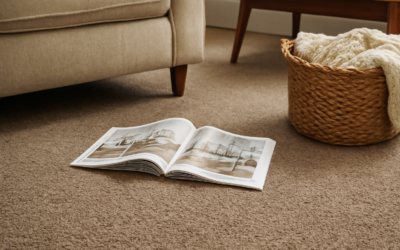
The loop construction that makes berber carpet distinctive is also what makes it polarizing. Nylon berber carpet sits in a sweet spot between the indestructible-but-expensive wool berber of the 1990s and the cheap olefin berber that dominated the 2000s and earned the style a bad reputation. Modern nylon berber from Shaw, Mohawk, and Stainmaster delivers 15 to 20-year residential lifespan, real stain resistance from solution-dyed fibers, and pricing between $3 and $7 per square foot installed. Knowing the spec sheet — face weight, loop density, twist level, and fiber type — separates the carpets that hold up from the ones that crush flat within three years.
What Makes Carpet “Berber”
Berber refers to the loop construction, not the fiber. True berber features uncut loops of yarn looped through the backing, creating a low-profile, durable surface that hides footprints and vacuum tracks. The look originated in hand-woven Berber tribal rugs from North Africa, where the practical knot-style construction translated naturally to industrial machine looping.
Berber loops can be uniform height (level loop) or alternating heights (multi-level loop). Pattern berbers add visual interest through varied loop heights and color flecks. The “flecks” — small contrasting yarn pieces woven into the carpet — hide stains and wear marks far better than solid colors, which is why berber became the dominant rec-room carpet style.
Why Nylon Outperforms Olefin Berber
The cheap olefin (polypropylene) berber that flooded the market in the 2000s crushes and mats within 3 to 5 years under normal residential traffic. Olefin fibers have no memory — once compressed, they stay compressed. Nylon fibers spring back after compression and resist matting for 12 to 18 years of comparable use.
Stain resistance also favors nylon. Solution-dyed nylon — where color is added to the molten polymer before the fiber is extruded — resists bleach, sunlight, and aggressive cleaners that fade or yellow olefin fibers. Shaw R2X, Mohawk SilverShield, and Stainmaster PetProtect all use solution-dyed nylon with topical stain-blocking treatments.
Reading the Spec Sheet
Four numbers separate good nylon berber from bad. Face weight measures yarn density per square yard — anything under 30 ounces is light-traffic only, 35 to 45 ounces handles normal residential use, and 50-plus ounces is heavy-duty commercial grade. Density measures how tightly loops are packed; 2,500 to 3,500 is solid for residential berber. Twist level (TPI, twists per inch) above 5.5 indicates loops that resist untwisting and showing wear.
Fiber denier — the thickness of individual yarn strands — matters too. Berber typically uses thicker denier fibers (1,200 to 1,800) than cut-pile carpets for durability. Check that the spec sheet shows continuous filament rather than staple fiber. Continuous filament sheds less and lasts longer.
Top Nylon Berber Products
Shaw Anso Caress berber lines at $3.50 to $5 per square foot installed offer 40 to 50-ounce face weights and lifetime stain warranty. Mohawk SmartStrand Silk berber at $4 to $6 per square foot installed uses triexta rather than pure nylon but performs comparably with better permanent stain resistance. Stainmaster PetProtect berber at $4.50 to $6.50 per square foot installed targets households with dogs and cats, with stain protection that handles pet accidents.
Commercial-grade berbers from Tarkett and J+J Flooring at $6 to $10 per square foot installed step up to 50-plus ounce face weights designed for office and retail environments. Worth considering for entry halls and basement family rooms in high-use households.
Padding Choice Matters More Than You Think
Berber needs firmer padding than cut-pile carpet. Soft, thick padding lets the loops flex too much, accelerating wear and unraveling. The CRI recommends 6 to 8-pound density padding at 3/8-inch maximum thickness for berber installations. Skip the cushy 7/16 or 1/2-inch memory foam pads that work fine for plush cut-pile.
Premium options include moisture-barrier padding from SpillStop or PetProof at $0.90 to $1.40 per square foot. For households with kids and pets, the spill-stopping layer adds 10 to 12 years of subfloor protection at modest upfront cost.
Installation Considerations
Berber requires more skilled installation than cut-pile because seams show every imperfection. Loops at seam edges must align exactly, and the carpet must be stretched with a power stretcher to prevent buckling under furniture. Budget for CRI-certified installers — typically $1.25 to $2.25 per square foot for berber installation.
Direction matters too. Berber has a pile direction even though it does not have a cut pile. All carpet pieces in a room must run in the same direction or color and texture appear to shift across seams. A good installer plans seam placement to fall in low-traffic areas — under sofas, against walls, never in doorways or main traffic lanes.
Snagging and Pulled Loops
The single biggest concern with any berber is pulled loops. A claw on a dog, a stiletto heel, or a vacuum beater bar can snag a loop and unravel a 6-inch run in seconds. Modern berbers use tighter loop construction and stronger backing adhesives that minimize this risk, but the inherent vulnerability remains.
Two precautions help. Use a vacuum with a beater bar off-switch — Miele Complete C3, Riccar Vibrance, and Dyson Ball Animal all offer suction-only modes for loop carpets. Trim pet nails regularly and clip any snagged loop with sharp scissors immediately to prevent it from running.
Cleaning and Maintenance
Vacuum weekly with suction-only or low-aggression beater settings. Professional hot-water extraction every 12 to 18 months extends carpet life. The CRI recommends professional cleaning every 12 months for households with pets, kids, or allergies. Look for IICRC-certified cleaners who use truck-mounted equipment for deeper extraction than rental machines deliver.
For spot cleaning, blot first — never scrub. Mix 1 teaspoon dish soap with 1 cup warm water and dab with a white microfiber. Rinse with plain water and blot dry. Avoid OxiClean, hydrogen peroxide, and bleach on light-color berbers — even solution-dyed fibers can show topical residue from aggressive cleaners.
Berber in Specific Rooms
The natural homes for nylon berber are family rooms, basements, home offices, and stairs. Skip it in primary bedrooms where bare-foot comfort matters and in dining rooms where pulled chairs can snag loops. Berber excels in high-traffic transition zones where its low profile and pattern-flecked color hide wear that destroys cut-pile faster.