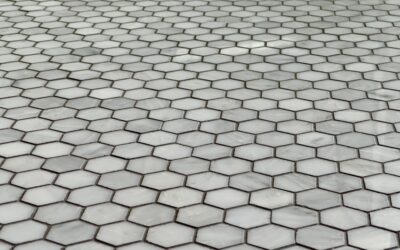
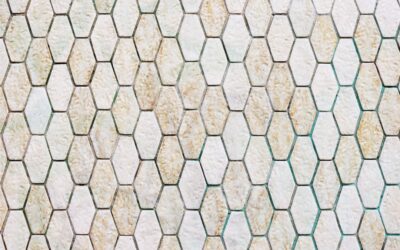
Walk into almost any 1920s American home and you will likely find the same floor: small white octagons stitched together with black dots. That pattern never went away, and it is having a serious revival. An octagon tile bathroom blends vintage character with a surprisingly practical surface, which is why designers keep returning to it for both period renovations and clean modern builds. If you are weighing this look for your own remodel, the details matter more than the Pinterest photo suggests.
Part of our Bathroom Remodeling & Flooring guide — explore the full guide →
Octagon tile is not a single product. It ranges from penny-sized mosaic sheets to large-format 8-inch porcelain, and each version behaves differently underfoot, on the wall, and on your budget. Here is what you actually need to know before you order a single box.
What Makes Octagon Tile Work in a Bathroom
The classic layout pairs an octagon with a small square “dot” that fills the gap where four octagons meet. That geometry is the whole appeal. It creates a repeating rhythm the eye reads as detailed without feeling busy, and it gives you a built-in accent color through the dot alone. Swap a white octagon with a cobalt dot and you get one mood; pair a soft gray octagon with a matte black dot and you get another entirely.
On a bathroom floor, small octagon mosaics have a real functional advantage. More tiles mean more grout lines, and more grout lines mean more traction. That texture is genuinely useful in a wet room where a large glossy tile can turn slick. It is the same reason contractors have specified 1-inch and 2-inch mosaics in shower pans for a century.
Choosing Your Material
Material choice drives durability, cost, and upkeep more than pattern does. These are the options worth considering.
- Porcelain: The workhorse. Dense, water-resistant with absorption under 0.5 percent, and rated for floors. Most modern octagon mosaics sold at big-box stores are porcelain and run $6 to $14 per square foot.
- Ceramic: Slightly softer and cheaper, usually $4 to $9 per square foot. Fine for walls and light-traffic floors, but check the PEI rating before using it on a main bathroom floor.
- Natural marble: Carrara and Thassos octagons deliver that authentic hotel-bath look for roughly $12 to $25 per square foot. Beautiful, but it etches with acids and needs sealing every 12 to 18 months.
- Cement encaustic: Rich pigment straight through the tile, but porous and demanding. Expect $15 to $30 per square foot and a strict sealing schedule.
For a first-time renovator who wants the vintage look with the least maintenance, a matte white porcelain octagon with a contrasting dot is the safe, smart pick. You get the aesthetic without babysitting the sealer.
Floor, Wall, or Both
Most people default to the floor, and that is where the pattern shines. A small-format octagon floor grounds the room and reads as intentional even in a compact 5-by-8-foot bathroom. If your space is tight, keep the octagons small — 1 or 2 inches — so the pattern completes several full repeats rather than getting chopped off at the walls.
Walls are the newer move. An 8-inch matte octagon running up a shower surround or a half-wall gives a bold, architectural surface that feels current rather than nostalgic. You can also split the difference: octagon mosaic on the floor, a simple subway or large-format tile on the walls, and let the floor carry the personality. Mixing every surface with octagons usually overwhelms a small room.
Cost of an Octagon Tile Bathroom
Budget depends on square footage, material, and whether you hire out. For a standard 40-square-foot bathroom floor, here is a realistic breakdown:
- Porcelain octagon mosaic: $240 to $560 in tile
- Thinset, grout, and sealer: $60 to $120
- Professional installation: $10 to $20 per square foot, or $400 to $800 for that floor
- Marble upgrade: add $300 to $500 in material
All in, a modest porcelain octagon floor installed by a pro typically lands between $700 and $1,400. DIY cuts that roughly in half, though octagon patterns are less forgiving than straight grids — you will spend the savings in time and cut tiles.
Installation Tips That Save Headaches
Octagon mosaics almost always arrive on 12-by-12-inch mesh-backed sheets, which speeds installation dramatically. Even so, a few practices separate a clean job from a crooked one.
- Dry-lay first. Set several sheets out without thinset to check how the pattern lands at the walls and find the center point. You want cut tiles balanced on opposite sides, not a full row on one edge and a sliver on the other.
- Mind the seams. The grout gap between sheets must match the gaps within each sheet, or the eye will catch the grid lines. Nudge sheets tight and stagger the mesh joints.
- Use the right trowel. A 3/16-inch V-notch trowel gives mosaics enough coverage without oozing up between the tiny tiles.
- Back-butter tricky cuts. Individual octagons cut to fit corners hold better with a thin skim of thinset on the back.
- Seal before grouting if you chose marble or cement, so the grout haze wipes off cleanly.
Grout color is the last big decision, and it is design as much as function. A dark grout emphasizes the octagon geometry and hides foot traffic; a light grout blends the pattern into a soft field. For a busy family bathroom, a mid-gray grout is the practical compromise that stays looking clean.
Pros and Cons at a Glance
Before you commit, weigh the trade-offs honestly.
- Pro: Timeless, adaptable style that suits vintage and modern homes alike.
- Pro: Extra grout lines add slip resistance in wet areas.
- Pro: Mesh sheets make installation faster than laying individual tiles.
- Con: More grout means more cleaning; sealing grout lines is a must.
- Con: Cutting the pattern cleanly at walls and fixtures takes patience.
- Con: Premium materials like marble and cement demand ongoing maintenance.
Frequently Asked Questions
Is an octagon tile floor hard to keep clean? Not the tile itself — porcelain and ceramic wipe clean easily. The grout is the real chore. Seal it after installation and re-seal roughly once a year, and a weekly pass with a pH-neutral cleaner keeps the lines bright.
Will octagon tile make a small bathroom feel smaller? The opposite, usually. Small-format patterns add depth and detail that make compact rooms feel considered rather than cramped, as long as you keep wall tile simple and let the floor do the talking.
Can I install it over an existing floor? Only over a sound, flat, properly prepared substrate. Tile needs cement backer board or an uncoupling membrane over plywood, never bare vinyl or a flexing subfloor.
An octagon tile bathroom rewards planning. Nail the material, balance the layout, and seal the grout, and you end up with a floor that looks just as good in twenty years as it does the week it is installed — which is exactly why the pattern has already lasted a century.
Prefer to explore on your own?
See how new flooring looks in your actual room in seconds — free, no signup.
Try the free Floor Studio →