The right carpet office flooring balances durability, aesthetics, acoustics, and budget. Office spaces face unique demands — rolling chair traffic, heavy foot patterns between desks and conference rooms, coffee spills, and the constant movement of furniture during reconfigurations. Residential carpet simply does not hold up in these conditions, which is why commercial-grade options exist.
With over 30 years of experience specifying and installing flooring for commercial spaces, we have seen which products last and which ones need replacing within a few years. This guide covers the best carpet types for offices, carpet tiles versus broadloom, durability standards, noise reduction benefits, cost ranges, and ongoing maintenance requirements.
- Why Carpet Is Still the Top Choice for Offices
- Carpet Tiles vs. Broadloom: Which Is Better?
- Understanding Commercial Carpet Durability Ratings
- Noise Reduction and Acoustic Benefits
- Best Carpet Fibers for Office Use
- Office Carpet Cost Breakdown
- Design and Style Options
- Maintenance and Cleaning Schedule
- Frequently Asked Questions
Why Carpet Is Still the Top Choice for Offices
Despite the popularity of hard-surface flooring in residential settings, carpet remains the dominant flooring choice for office environments. There are practical reasons for this that go beyond aesthetics.
Acoustic control: Open-plan offices generate significant ambient noise from conversations, keyboards, phone calls, and foot traffic. Carpet office flooring absorbs sound rather than reflecting it, reducing noise levels by 10 to 15 decibels compared to hard surfaces. In an open office, that difference is the gap between productive focus and constant distraction.
Comfort and fatigue reduction: Employees standing at desks, walking to meetings, and moving through the office all day benefit from the cushioned surface carpet provides. Studies show that softer floor surfaces reduce leg and back fatigue for people who spend significant time on their feet.
Safety: Carpet provides better slip resistance than polished concrete, LVT, or laminate. In a commercial environment where slip-and-fall liability is a concern, carpet reduces risk and insurance exposure.
Air quality: Contrary to old assumptions, modern commercial carpet actually traps airborne particles and allergens until they can be removed by vacuuming. This keeps particles out of the breathing zone between cleanings. Hard floors allow particles to remain airborne with every air current or footstep.
Cost efficiency: When you factor in purchase price, installation, maintenance, and lifespan, commercial carpet is one of the most economical flooring choices per square foot per year of service.
Carpet Tiles vs. Broadloom: Which Is Better?
This is the biggest decision for any carpet office project. Both carpet tiles (modular squares, typically 18×18 or 24×24 inches) and broadloom (roll carpet, typically 12 feet wide) work in commercial settings, but they have different strengths.
Carpet Tiles (Modular Carpet):
- Pros: Easy to replace individual damaged tiles, access floor boxes and cabling underneath, minimal waste during installation, creative pattern possibilities, easier to transport and handle
- Cons: Visible seams (though modern tiles minimize this), slightly higher material cost per square foot, requires flat subfloor for best results
- Best for: Office buildings with raised access floors, spaces that need frequent reconfiguration, buildings with under-floor data cabling
Broadloom Carpet:
- Pros: Seamless appearance in rooms under 12 feet wide, lower material cost per square foot, softer underfoot feel with separate pad
- Cons: Full replacement needed for large stains or damage, harder to access under-floor utilities, more waste during installation (especially in irregular spaces), heavier and harder to transport
- Best for: Executive offices, conference rooms, corridors where a seamless look is preferred, budget-conscious projects
The industry trend has moved decisively toward carpet tiles for most carpet office applications. Approximately 70 percent of new commercial carpet installations now use modular tiles. The ability to replace individual tiles and access under-floor systems makes them the practical winner for modern office buildings.
Understanding Commercial Carpet Durability Ratings
Commercial carpet durability is rated differently than residential carpet. Understanding these ratings helps you choose the right product for your office’s traffic level.
CRI Commercial Ratings:
- Moderate traffic: Private offices, conference rooms, executive areas — rated for up to 5,000 traffics per day
- Heavy traffic: Open-plan offices, corridors, break rooms — rated for 5,000 to 10,000 traffics per day
- Severe traffic: Lobbies, elevator areas, main corridors — rated for 10,000+ traffics per day
Key durability specifications to check:
- Face weight: Measured in ounces per square yard. For office use, look for 20 to 30 oz/sq yd minimum. Higher face weight generally means better wear resistance.
- Density: How tightly packed the fibers are. Denser carpet resists matting and crushing from chair casters and foot traffic.
- Pile height: Lower pile (loop or cut-loop) resists crushing better than high-pile plush. Most commercial carpet uses loop pile for this reason.
- Backing quality: Commercial carpet tiles use reinforced PVC or bitumen backing that resists curling and delamination. Quality backing is essential for tiles that may be lifted and replaced over time.
For a standard office environment, specify heavy-traffic-rated carpet in common areas and moderate-traffic-rated carpet in private offices and conference rooms. This optimizes cost by using premium product only where it is needed most.
Noise Reduction and Acoustic Benefits
Acoustics is one of the strongest arguments for carpet office flooring, especially in open-plan environments where noise management is critical for productivity.
Impact sound reduction: Carpet with a cushion backing reduces impact noise (footsteps, dropped objects) by 20 to 30 decibels compared to hard surfaces. Carpet tiles with integral cushion backing perform nearly as well as broadloom over separate pad.
Airborne sound absorption: Carpet absorbs 10 to 15 times more airborne sound than hard flooring. In a 10,000-square-foot office, this translates to noticeably lower ambient noise levels — conversations at neighboring desks are less distracting, and the overall sonic environment feels calmer.
Noise Reduction Coefficient (NRC): This measures how much sound a material absorbs on a scale of 0 to 1. Commercial carpet typically rates 0.20 to 0.35 NRC. Hard surfaces like polished concrete score 0.01 to 0.05. While carpet alone does not solve all acoustic problems, it is a significant contributor to overall sound management.
For offices pursuing WELL Building Standard or LEED certification, acoustic performance is a scored category. Carpet contributes meaningfully to meeting acoustic performance thresholds and can be part of a broader strategy that includes ceiling tiles, acoustic panels, and sound masking systems.
Best Carpet Fibers for Office Use
The fiber composition of your carpet office flooring determines how it wears, cleans, and ages over time.
Nylon (Type 6 and Type 6,6):
- The gold standard for commercial carpet
- Highest resilience — bounces back from crushing and matting
- Excellent stain resistance when treated with stain-block technology
- Lasts 10 to 20 years in heavy commercial traffic
- Costs more than polyester and olefin but justifies it with longevity
- Type 6,6 (DuPont legacy) is slightly more resilient than Type 6
Solution-dyed nylon:
- Color is embedded during fiber manufacturing rather than applied after
- Superior colorfastness — resists bleach, sunlight, and chemical fading
- Ideal for offices where cleaning with strong agents is necessary
- Premium option for lobbies and high-visibility areas
PET polyester (including recycled PET):
- Good stain resistance, especially in solution-dyed versions
- Lower cost than nylon (20 to 40 percent less)
- Less resilient — shows matting and wear faster in high-traffic areas
- Recycled PET appeals to sustainability-focused organizations
- Best suited for moderate-traffic private offices and conference rooms
Olefin (polypropylene):
- Lowest cost commercial carpet fiber
- Excellent moisture and mildew resistance
- Poor resilience — flattens permanently under heavy traffic
- Best limited to very light-traffic areas or as an indoor/outdoor carpet option
Our recommendation: nylon for corridors, open-plan areas, lobbies, and any high-traffic zone. PET polyester for private offices and conference rooms where traffic is lighter and budget matters more. Avoid olefin for anything beyond break rooms or utility areas.
Office Carpet Cost Breakdown
Understanding costs helps you budget accurately for a carpet office installation. Here are 2026 commercial carpet pricing ranges:
Carpet tiles (modular):
- Budget tiles: $1.50 to $3.00 per square foot (material only)
- Mid-range tiles (Mohawk, Shaw, Interface): $3.00 to $6.00 per square foot
- Premium tiles (Interface, Milliken): $6.00 to $12.00 per square foot
- Installation labor: $0.75 to $2.00 per square foot
Broadloom carpet:
- Budget broadloom: $1.00 to $2.50 per square foot (material only)
- Mid-range broadloom: $2.50 to $5.00 per square foot
- Premium broadloom: $5.00 to $10.00 per square foot
- Installation labor: $0.50 to $1.50 per square foot
- Carpet pad: $0.40 to $1.00 per square foot additional
Total installed cost for a typical 5,000-square-foot office:
- Budget: $10,000 to $20,000
- Mid-range: $20,000 to $40,000
- Premium: $35,000 to $70,000
Carpet tiles have a higher material cost per square foot than broadloom, but lower installation labor costs and less waste. For irregularly shaped offices with many walls, columns, and built-in features, tiles often end up costing the same or less than broadloom when you factor in waste from cutting large rolls.
Design and Style Options
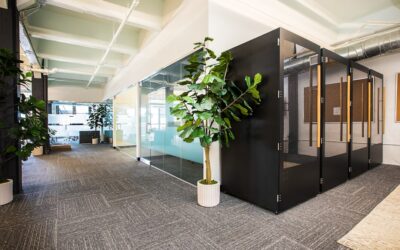
Modern carpet office products offer far more than the bland gray squares of decades past. Design options have expanded dramatically:
Pattern styles:
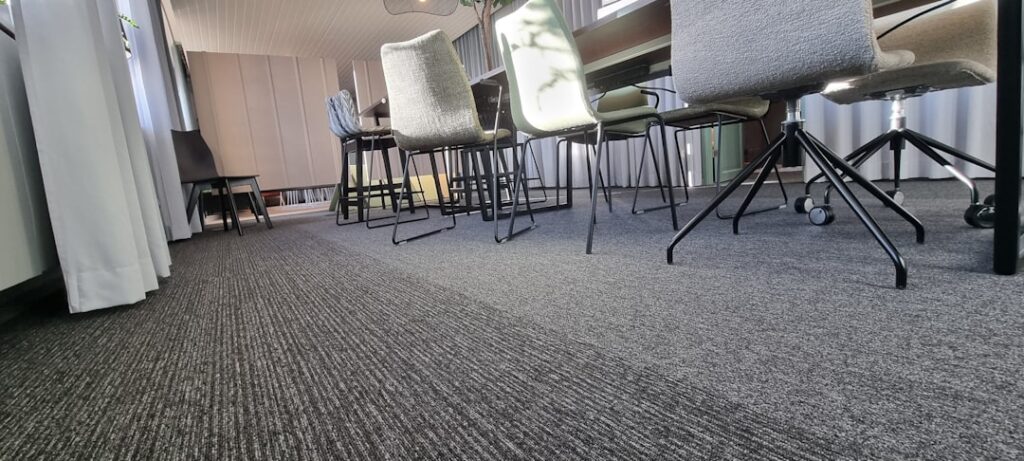
- Linear and directional: Subtle lines or stripes that create visual flow down corridors and through open spaces
- Organic and abstract: Nature-inspired patterns that break up the grid, popular in creative and tech workplaces
- Geometric: Bold angular patterns for feature areas, lobbies, and collaboration zones
- Solid and heathered: Classic textures that blend unobtrusively into any design scheme
Installation patterns (carpet tiles):
- Monolithic: All tiles oriented the same direction for a broadloom-like seamless look
- Quarter-turn: Each tile rotated 90 degrees from its neighbor, creating a subtle checkerboard texture
- Brick: Tiles staggered like bricks for a more dynamic visual
- Random (non-directional): Tiles installed in any orientation — works best with patterns designed for random installation
Leading commercial carpet manufacturers like Interface, Milliken, Shaw Contract, and Mohawk Group offer online design visualization tools where you can upload your floor plan and experiment with different carpet styles, colors, and installation patterns before ordering.
Maintenance and Cleaning Schedule
Proper maintenance is what separates carpet office installations that last 15 years from those that look worn in 5. Follow this commercial carpet maintenance schedule:
Daily:
- Vacuum high-traffic areas (corridors, entrances, break rooms)
- Spot-clean spills immediately with approved carpet cleaner
Weekly:
- Vacuum entire carpeted area including under desks and low-traffic zones
- Inspect for emerging stains or damage
Monthly:
- Rotate carpet tiles in high-wear areas with tiles from lower-traffic zones (one of the major advantages of modular carpet)
- Deep-spot-treat any stubborn stains
Quarterly to semi-annually:
- Professional hot-water extraction cleaning (steam cleaning) of the entire carpeted area
- Apply protectant spray to high-traffic areas after deep cleaning
Annually:
- Full professional deep cleaning
- Assess overall carpet condition and plan any tile replacements for worn areas
- Budget for replacement of heavily worn tiles (typically 5 to 10 percent per year in high-traffic zones)
Keep a stock of replacement tiles from the original order — 5 to 10 percent of the total installed quantity. This ensures color-matched tiles are available when replacements are needed. Dye lots vary between production runs, so tiles purchased later may not match exactly.
Frequently Asked Questions
How long does office carpet last?
Commercial-grade nylon carpet tiles typically last 10 to 15 years with proper maintenance in a standard office environment. Broadloom in heavy-traffic areas may need replacement in 7 to 10 years. Private offices and conference rooms with lighter traffic can see 15 to 20 years of service. The modular tile advantage is that individual worn tiles can be swapped, extending the overall installation’s usable life.
Are carpet tiles better than broadloom for offices?
For most modern offices, yes. Carpet tiles offer easier replacement of damaged sections, simpler access to under-floor cabling and utilities, less installation waste, and more design flexibility. Broadloom is better only in specific scenarios like executive offices where a seamless appearance is the top priority and under-floor access is not needed.
How much does it cost to carpet a small office?
A small office of 500 square feet costs $1,500 to $4,000 for mid-range carpet tiles fully installed. Budget tiles bring the cost down to $1,000 to $2,000. Premium options can reach $5,000 to $7,000. These estimates include materials, installation labor, and basic furniture moving. Old carpet removal, if needed, adds $250 to $750.
Does office carpet reduce noise?
Significantly. Commercial carpet reduces impact noise by 20 to 30 decibels and absorbs airborne sound 10 to 15 times more effectively than hard flooring. In open-plan offices, this translates to a noticeably quieter workspace. Carpet with thicker cushion backing provides the most acoustic benefit. Pairing carpet with acoustic ceiling tiles creates the strongest noise reduction combination.
What color carpet is best for an office?
Medium tones in gray, taupe, or blue-gray are the most practical and popular choices. Medium colors hide dirt better than very light or very dark shades. Multi-tonal patterns and heathered textures are particularly effective at concealing soil and stains between professional cleanings. Avoid solid white, cream, or black — they show every imperfection and require much more frequent cleaning to look presentable.