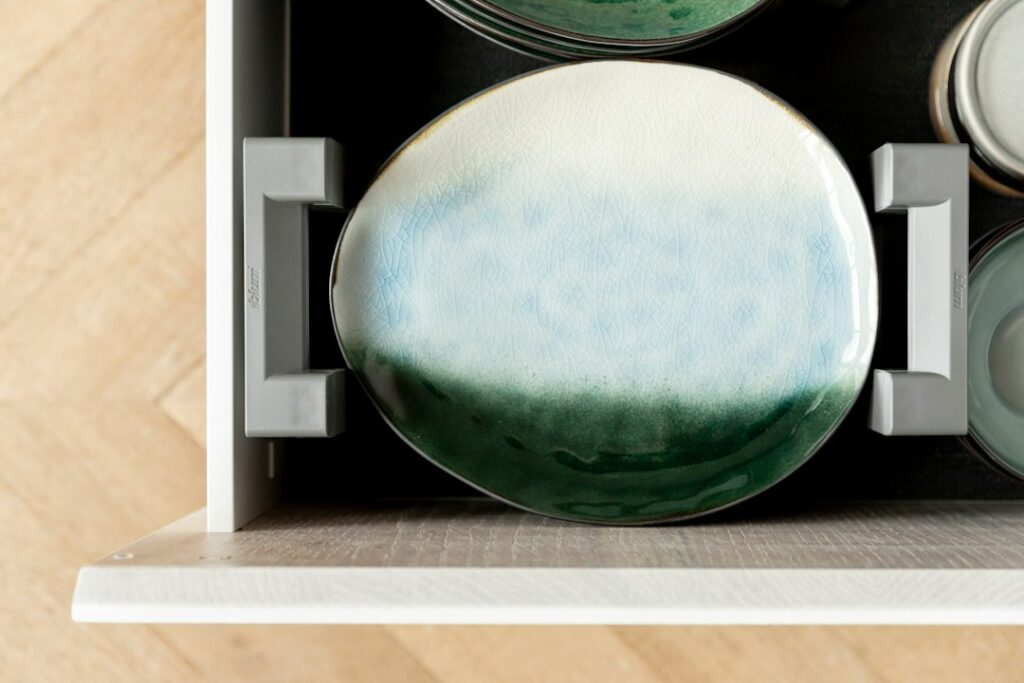
The reason kitchen cabinets revert to chaos within three months of any organizing project is almost always the same — homeowners organize by appearance instead of by zone. Pretty matching containers feel rewarding on day one but break down the first time someone is cooking dinner with one hand and reaching for the colander with the other. Lasting organizing kitchen cabinets systems start with how you actually cook, then layer in storage products that respect those workflows. This guide walks through zone planning, the products worth buying, and the ones that waste money.
Part of our Kitchen Remodeling guide — explore the full guide →
Step 1: Map Your Kitchen Zones
Professional kitchen designers organize around five zones, each anchored to a specific task:
- Prep zone: Counter near sink. Cutting boards, knives, mixing bowls, peelers, colanders
- Cooking zone: Around the cooktop and oven. Pots, pans, lids, oils, spices, utensils
- Storage zone: Pantry and dry goods. Canned items, baking ingredients, snacks
- Cleaning zone: Around the sink and dishwasher. Dish soap, sponges, dishwasher detergent, trash
- Serving and dining zone: Near the table or pass-through. Plates, glasses, flatware, serving pieces
Items belong in the zone where they’re used. A garlic press belongs near the cutting board, not in a drawer next to the silverware.
Step 2: Empty and Edit Before Organizing
Pull everything out of every cabinet. Sort onto the dining table or floor. Apply three filters: have I used this in the past 12 months, do I have a duplicate, and would I buy this again today. The answer to even one “no” sends the item to a donation box or trash.
Average household kitchens accumulate 25-40% items that go unused for years. Removing them is the single highest-leverage step in any organizing project — no storage product compensates for too much stuff in too little space.
Storage Products That Earn Their Money
A handful of organizers genuinely improve daily function:
- Pull-out shelves for base cabinets ($25-$80 each) — eliminate the cave problem
- Drawer dividers ($15-$45) — keep utensils organized without daily reset
- Cabinet door organizers for spices, foil, plastic wrap ($15-$40)
- Tiered shelf risers for can goods and glassware ($10-$25)
- Lazy Susans for corner cabinets ($30-$120 for high-quality units)
- Vertical dividers for baking sheets and cutting boards ($15-$35)
- Under-shelf hanging baskets ($12-$25)
- Pot lid organizers ($20-$40) — solve the lid avalanche problem
Skip nesting bins that hide what’s inside, decorative jars that require label-making and refilling, and any product that requires permanent installation in a rental.
Solving the Tupperware Drawer Problem
Plastic food storage containers consistently rank as the most chaotic part of most kitchens. Three approaches that work:
- Switch to a single brand and size system — OXO, Glasslock, or Snapware. Eliminate mismatched lids
- Store containers nested with lids in a separate vertical-divided section
- Limit total quantity to what fits in one drawer or shelf — ruthlessly
A drawer with 8 containers and 8 matching lids is functional. A drawer with 35 containers and 22 lids is broken regardless of how it’s organized.
Pantry Organization That Sticks
Pantry chaos comes from two sources: items expiring at the back of deep shelves, and similar items scattered across multiple shelves. Solutions:
- Pull-out drawers for any shelf deeper than 14 inches
- Tiered risers so back-row labels are visible
- Lazy Susans for oils, vinegars, and condiments
- Bins grouped by category (snacks, baking, breakfast) rather than by container shape
- A “use first” basket at eye level for items approaching expiration
Date items with a Sharpie or label gun when they enter the pantry. The 30 seconds it takes pays back in eliminated waste.
Cabinet-by-Cabinet Strategy
Different cabinets call for different organizing approaches:
- Upper cabinets near the dishwasher: Daily-use plates, glasses, mugs at the most accessible heights
- Upper cabinets above the cooktop: Cooking oils, spices in heat-resistant containers, but avoid storing anything heat-sensitive directly above
- Lower cabinets near the cooktop: Pots, pans, lids on pull-out shelves or vertical dividers
- Lower corner cabinets: Lazy Susan for everyday items, or a magic-corner pull-out for premium accessibility
- Under-sink cabinet: Cleaning supplies in a slide-out caddy with leak-protective tray
- Drawers near sink: Knives in dividers (never loose), prep utensils, kitchen towels
Maintenance: How to Make It Last
Reset weekly during normal cleanup. Once a quarter, do a 15-minute audit: anything in the wrong zone goes back, anything broken or duplicated leaves. Once a year, do a full pull-and-edit. Skip these intervals and chaos returns within 90 days.
Avoid the temptation to keep items “just in case” — the bread machine that comes out twice a year, the fondue set from 2007, the avocado slicer used once. These are the biggest space-wasters in most kitchens. Donate, store in a basement, or sell.
Small Kitchen Hacks
For kitchens under 80 sq ft of cabinet space, these tactics matter most:
- Use the inside of every cabinet door for hooks, racks, or organizers
- Add a pegboard to one wall for utensils, lids, and small tools
- Magnetic knife strips free up drawer space
- Stack baking sheets vertically rather than flat
- Choose dual-purpose items (cast iron skillet replaces both regular skillet and pizza stone)
- Move rarely-used appliances to a closet, basement, or garage
Thoughtful organizing kitchen cabinets systems can recover 30-40% of usable storage in a small kitchen without buying any new cabinetry.
Frequently Asked Questions
Where should I start when organizing my kitchen cabinets?
Start with the cabinet you use most — usually the one nearest the dishwasher or the one holding daily plates and glasses. Edit ruthlessly, then organize by zone.
What’s the best organizer for kitchen cabinets?
Pull-out shelves for base cabinets and drawer dividers for utensil drawers deliver the highest impact per dollar. Lazy Susans solve corner cabinets.
How do I organize a small kitchen with limited cabinets?
Use cabinet doors for vertical storage, install over-the-sink drying racks, mount magnetic strips for knives, and ruthlessly eliminate rarely-used items.
Should I store dishes near the dishwasher or near the table?
Near the dishwasher saves more steps overall — you unload more often than you set the table. Glasses near the sink for water access.
How often should I reorganize my kitchen cabinets?
Weekly reset during regular cleanup, quarterly 15-minute audit, annual full pull-and-edit. This rhythm prevents the gradual drift that wrecks any organizing system.