
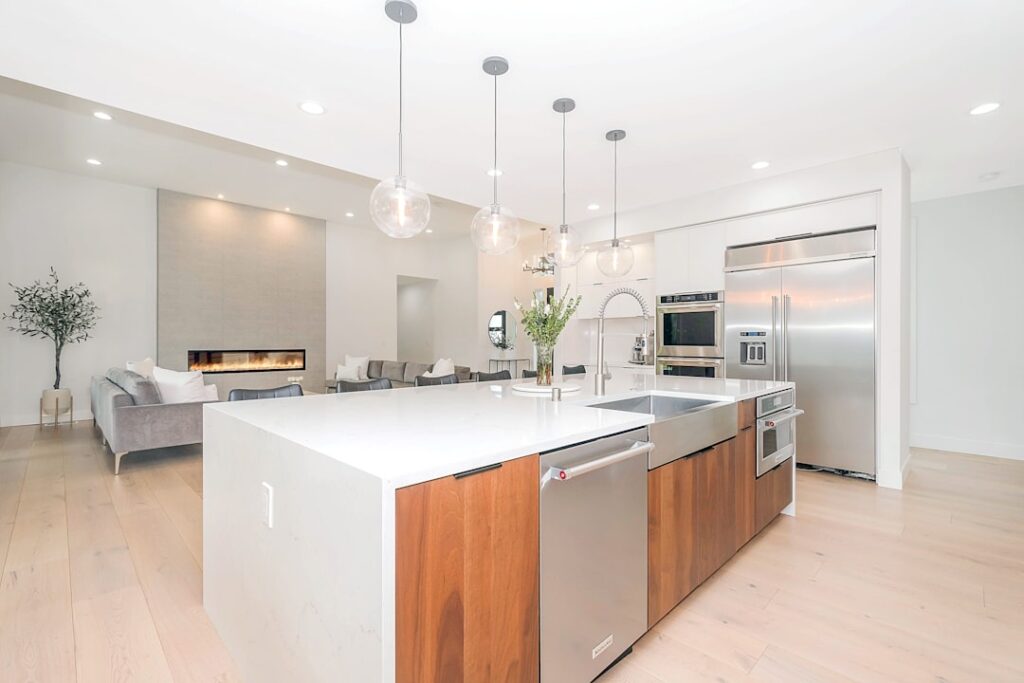
Most homeowners pick their outdoor kitchen materials the same way they choose an indoor kitchen: by looks. Then two winters later the cabinet doors have swollen shut and the countertop is spider-cracked. The truth is that the right outdoor kitchen materials are chosen for freeze-thaw cycles, UV exposure, and standing water first, appearance second. Get the substrate and framing right and everything on top of it lasts. Get it wrong and no amount of stainless trim will save you.
Part of our Kitchen Remodeling guide — explore the full guide →
From humid Gulf Coast backyards to high-desert patios that swing 50 degrees between noon and midnight, the materials that hold up are surprisingly consistent. Here is what belongs in each part of the build and roughly what you will pay.
- Choosing Outdoor Kitchen Materials for the Frame and Base
- Countertop Surfaces That Handle Sun and Freeze
- Cabinet and Door Materials
- Flooring and Surrounding Deck
- Appliance Housings, Ventilation, and Fasteners
- Matching Materials to Your Climate
- Backsplash, Cladding, and Finishing Surfaces
- Sealing, Drainage, and Long-Term Maintenance
- A Realistic Budget by Tier
Choosing Outdoor Kitchen Materials for the Frame and Base
Everything starts with the skeleton. You have three realistic choices for the cabinet carcass and island structure: galvanized or stainless steel studs, concrete masonry units (CMU block), or a proprietary polymer framing system.
Steel stud framing runs about $8 to $14 per linear foot in material and assembles fast. Use 20-gauge minimum, and insist on galvanized or, better, 304 stainless if you live within about 10 miles of saltwater. CMU block is the tank of the group. An 8-inch block wall for a straight 8-foot island costs roughly $600 to $1,200 including mortar and rebar, and it will outlive the house. The downside is weight, a required footing, and slower construction. Polymer systems like fiber-cement-clad panels split the difference and shrug off water entirely, but expect $2,000 to $3,500 for an island-sized kit.
Whatever you frame with, never use standard wood studs or interior drywall. Moisture-resistant cement backer board, such as 1/2-inch HardieBacker, is the correct skin over any frame before you apply stone, tile, or stucco.
Countertop Surfaces That Handle Sun and Freeze
The countertop takes the most abuse: hot pans, spilled marinade, and relentless UV. Not every indoor favorite survives outside.
- Granite — the gold standard outdoors. Natural stone, UV-stable color, heat-proof. Sealed twice a year it laughs at weather. Installed cost runs $50 to $100 per square foot.
- Porcelain slab — 3/4-inch to 3/4-inch through-body porcelain (brands like Dekton and Neolith) is nearly zero-porosity, so it does not stain and will not fade. Expect $60 to $120 per square foot installed.
- Concrete — great custom looks and heat tolerance, but it must be sealed aggressively and can hairline-crack. Budget $65 to $135 per square foot for a poured, sealed slab.
- Tile over backer — the budget route at $15 to $40 per square foot. Use porcelain rated for exterior freeze-thaw, and grout with epoxy so joints do not crumble.
Skip marble and most quartz outdoors. Marble etches and stains; the resin binder in engineered quartz yellows and can soften in direct sun, and most manufacturers void the warranty for exterior use.
Cabinet and Door Materials
Cabinets face the same enemies as the frame plus daily opening and closing. Marine-grade 316 stainless steel is the premium answer at $3,000 to $8,000 for a full run, and it is what most high-end kitchens use. It will not rust near a pool or coast the way 304 eventually can.
Powder-coated aluminum is lighter, will never rust, and costs less, roughly $2,000 to $5,000 for a comparable layout. Polymer HDPE cabinetry, the same dense plastic used for marine dock boxes, is essentially maintenance-free and comes in real colors, not just gray. Whatever you choose, look for gasketed doors and stainless hardware, because cheap zinc hinges seize within a season.
Flooring and Surrounding Deck
The ground plane needs slip resistance when wet and enough thermal mass not to buckle. Textured porcelain pavers, 2 cm thick, are a strong default at $6 to $15 per square foot for the tile. They stay cooler underfoot than natural stone and clean with a hose.
Poured concrete with a broom or salt finish is the value pick, around $6 to $12 per square foot installed, and it doubles as the structural pad for a masonry island. Natural stone like travertine or bluestone reads high-end but runs $15 to $30 per square foot and can get uncomfortably hot in full sun. Avoid smooth polished tile anywhere grease and water land, and never install laminate or solid hardwood in an uncovered outdoor kitchen.
Appliance Housings, Ventilation, and Fasteners
Built-in grills and burners generate serious heat, so the pocket they sit in must be non-combustible. Line grill cutouts with cement board and leave the manufacturer-specified clearance, usually 1 to 3 inches, on every side. If the island has a solid roof or is under a covered lanai, a dedicated vent hood rated for outdoor use is not optional; carbon monoxide and grease-laden vapor need a path out.
Fasteners are the detail that separates a five-year build from a twenty-year one. Use only 304 or 316 stainless screws and anchors. A single carbon-steel screw will bleed a rust stain down a beautiful stone face within months. Seal every horizontal seam with a high-grade polyurethane or silicone sealant rated for exterior temperature swings.
Matching Materials to Your Climate
Climate should steer your final list more than any design magazine. In freeze-thaw regions across the northern half of the country, everything porous must be rated for it: porcelain over ceramic, epoxy grout over cementitious, and a sloped counter surface so water never pools and freezes in a joint. Along the coast, jump straight to 316 stainless and powder-coated aluminum and rinse surfaces with fresh water weekly to fight salt.
In hot, dry climates, UV is the silent killer. Choose color-stable stone and porcelain, and think twice about dark surfaces that can exceed 150°F in afternoon sun. Humid Southeast backyards demand mildew resistance, so favor closed-cell polymer cabinets and sealed grout that will not grow black lines.
Backsplash, Cladding, and Finishing Surfaces
The vertical faces of the island are your chance to add color and texture, but the same durability rules apply. Natural stone veneer, stacked ledgestone, and exterior-rated porcelain tile are all proven cladding choices. Stacked stone runs $10 to $25 per square foot installed and hides minor imperfections in the block or frame beneath it. Porcelain tile in a large-format plank looks contemporary and costs $8 to $18 per square foot installed.
For any backsplash behind a grill or burner, step up to a non-combustible material and set the clearance the appliance manual specifies. Skip peel-and-stick tile, thin ceramic wall tile rated only for interiors, and any product with a paper or gypsum backing. If you want a painted or stucco look, use an exterior acrylic stucco system over cement board, and expect to refresh the color coat every 7 to 10 years depending on sun exposure.
Sealing, Drainage, and Long-Term Maintenance
Materials only last if water can escape. Slope every countertop surface a slight 1/8 inch back-to-front so rain sheds instead of pooling in seams, and drill a couple of small weep holes in the base of any enclosed cabinet cavity so trapped water drains rather than sitting on a shelf. A masonry island should sit on a footing that drains, not on bare soil where frost heave can crack it.
Plan a maintenance rhythm from day one. Reseal granite and concrete counters twice a year with a penetrating stone sealer, roughly a $20 bottle that covers a typical island. Rinse stainless and stone monthly in coastal areas to fight salt. Inspect and re-caulk horizontal seams annually before winter. Ten minutes of upkeep a season is what keeps a well-built outdoor kitchen looking new instead of weathered.
A Realistic Budget by Tier
For a standard 10-foot L-shaped island, here is what the material choices translate to. A value build using CMU block, tile countertops, and a poured concrete pad lands around $4,000 to $7,000 in materials. A mid-range build with steel framing, granite tops, and powder-coated aluminum cabinets runs $9,000 to $15,000. A premium build with porcelain slab counters, 316 stainless cabinetry, and porcelain pavers can clear $20,000 before appliances.
Whatever tier you land on, spend the money on the parts you cannot easily redo later: the frame, the backer board, the fasteners, and the drainage. Doors and countertops can be swapped in a weekend a decade from now. A cracked footing or a rusted stud cannot. Choose your outdoor kitchen materials in that order and the build will still look sharp long after your neighbors have torn theirs out.


