The most common kitchen renovation mistake I see is a pantry door that’s too narrow to roll a Costco bulk pack through, or so tall it doesn’t fit under an 8-foot ceiling without losing a header inch. Picking the right pantry door size starts with knowing what’s standard, what’s available pre-hung at Home Depot or Lowe’s, and what requires a custom order from Masonite or Jeld-Wen. This guide walks through dimensions, swings, materials, and the structural framing math you’ll need before drywall goes back up.
Part of our Kitchen Remodeling guide — explore the full guide →
Standard Pantry Door Widths
Pre-hung interior doors come in 1/4-inch nominal sizes. The standard widths suitable for pantries are 24 inches, 28 inches, 30 inches, 32 inches, and 36 inches. For a walk-in pantry, 30 inches is the working minimum and 32 inches is the comfortable standard. Anything narrower than 28 inches means you’ll turn sideways to carry a 25-pound bag of flour.
For a reach-in pantry behind a single door, 24 inches and 28 inches are common. For double-door pantries with bifold or French panels, the typical pair sizes are 48 inches (two 24-inch leaves) and 60 inches (two 30-inch leaves). Always verify the rough opening matches — the rough opening is door width plus 2 inches and door height plus 2.5 inches.
Standard Heights
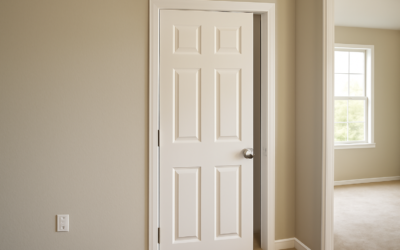
Interior door height defaults to 80 inches (the 6’8″ standard) for residential construction. For 9-foot and 10-foot ceilings, 84-inch and 96-inch doors deliver better proportions, though they cost 60% to 150% more. A 32-inch by 80-inch pre-hung pine pantry door from Masonite runs $159 to $249 at Home Depot.
An 84-inch tall version in the same width and material runs $320 to $480. The 96-inch full-height version is typically special-order at $580 to $1,100 because the lumber yard doesn’t stock 9-foot interior doors in volume.
Swing vs Pocket vs Barn Doors
A standard hinged door needs a swing arc equal to the door width. A 32-inch door consumes a 32-inch radius of floor space inside the kitchen. In tight galley layouts, that arc collides with island stools, the refrigerator door, or main-circulation walkways.
Pocket doors solve the swing problem by sliding into the wall cavity. A Johnson Hardware 1500 pocket door frame for a 32-inch door costs $145 to $240 plus the door slab. Verify your wall depth — a standard 2×4 wall holds the pocket frame, but plumbing or electrical inside that wall complicates the install. Barn doors hang from a track outside the wall and require 32 inches of clear wall space adjacent to the opening for the slab to slide.
Material and Style Choices
Solid-core MDF doors with primed paint-grade surfaces from Masonite West End run $180 to $340 for standard pantry sizes. Hollow-core flush doors from Jeld-Wen drop to $89 to $140 but transmit sound and feel hollow on close — fine for a reach-in pantry, less ideal for a walk-in adjacent to a busy kitchen.
For glass inserts, look at 5-lite, 10-lite, or full divided-lite designs. A clear-glass French-style pantry door at 32 inches by 80 inches from Reliabilt runs $280 to $420. Frosted or reeded glass adds privacy while letting light through — useful when the pantry doubles as overflow appliance storage.
Rough Opening Math
For a 32-inch wide door, frame the rough opening at 34 inches wide and 82.5 inches tall (assuming a 1.5-inch finished floor allowance). Use a 2×6 or 2×10 header above the opening depending on the load above and your local IRC R602 tables. Most non-load-bearing interior walls use a 2×4 header with cripples above, but verify with your inspector.
Pocket door rough openings double in width because half the wall holds the open door. A 32-inch pocket door needs a 66-inch by 86-inch rough opening with a properly framed header that spans the full pocket width. The Johnson Hardware kit includes split studs and a steel header strap, but the surrounding framing must be sized for the load above.
Hardware Specs
Hinges follow the door weight. A solid-core 32-inch by 80-inch door weighs roughly 50 to 75 pounds and needs three 4-inch ball-bearing hinges. Skip the 3.5-inch residential hinges on solid-core doors — they sag within two years. Pantry knobs or levers should sit 36 inches above finished floor per the IRC and the ADA accessibility guidelines.
For barn doors, the track system rating matters. National Hardware Soft-Close barn door kits handle 200-pound slabs at $180 to $320, more than enough for a 32-inch solid-core door. Check that the wall behind the track has continuous 2×6 blocking from stud to stud — anchoring into drywall alone will fail.
Walk-In Pantry Door Trends
Designer kitchens increasingly use 36-inch wide French-style double doors or single wide-stile doors with full glass. A 36-inch by 84-inch single full-glass pantry door from TruStile runs $680 to $1,200. Steel-frame “factory window” style doors from Crittall or Rejuvenation start at $2,400 and climb to $5,800 for custom sizes.
These work because the wider opening accommodates an island cart, a bag of dog food, and the homeowner walking through simultaneously. The trade-off is hinge-side wall space — a 36-inch door demands 36 inches of perpendicular wall to swing into.
Pre-Hung vs Slab
Pre-hung doors come with the frame, hinges, and threshold already assembled. They install in 90 minutes for an experienced carpenter. Slab doors (just the panel) require you to reuse an existing frame or build a new one. Slab pricing runs $120 to $260 cheaper than pre-hung but adds 3 to 4 hours of installation labor.
For a new construction or full pantry remodel, pre-hung is the faster path. For a refresh where the existing frame is square and the hinges are still solid, slab is the cost-saver. Match your pantry door size to the reality of your space, your ceiling height, and how often you’ll carry bulk groceries through that opening, and the door will work for the next 30 years.