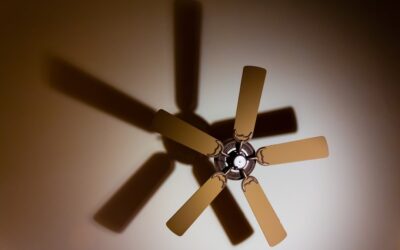
A covered porch that hits 95°F in July can drop to a comfortable 82°F with nothing more than moving air across your skin. The right patio fan creates that effect without running air conditioning into open space, and the sweet spot for most homeowners is a 52- to 60-inch wet-rated ceiling fan pulling 5,000 CFM or more. Get the rating wrong, though, and you will replace a rusted motor within two summers.
Part of our Decks & Outdoor guide — explore the full guide →
Wet-Rated Versus Damp-Rated
Every outdoor fan carries a UL listing of either damp or wet rated. Damp-rated fans tolerate humidity and occasional condensation but cannot handle direct rain. Install these only on fully covered porches where wind-driven rain is blocked by walls on at least two sides.
Wet-rated fans use sealed motors, stainless hardware, and ABS or PVC blades. They survive direct rainfall, pool decks, and pergolas with open slats above. If your installation is under a pergola, gazebo, or any roof with gaps, buy wet-rated. The price difference is only $40 to $80 between the two ratings.
Ceiling Mount Versus Wall and Pedestal
Ceiling fans move the largest volume of air and disappear visually into the ceiling plane. A 52-inch Hunter Key Biscayne ($240) or 60-inch Minka-Aire Xtreme H2O ($450) covers a 225 to 400 sq ft patio.
- Ceiling fan: Best coverage, needs 8 ft minimum ceiling, hardwired
- Wall-mount oscillating: Great for narrow porches, plug-in or hardwired
- Pedestal: Portable, no installation, less weather-proof
- Misting fan: Drops perceived temperature 15 to 20°F in dry climates
Pedestal fans like the Lasko 20-inch Cyclone ($45) work for renters, but the motor corrodes after 2 to 3 outdoor seasons unless you store them inside during winter.
CFM and Blade Pitch
CFM (cubic feet per minute) measures how much air the fan moves at top speed. Indoor fans push 2,500 to 4,000 CFM. A good outdoor fan needs 5,000 to 7,500 CFM to overcome breezes and the larger heat load of an outdoor space.
Blade pitch matters too. A 12-degree pitch is the minimum for effective airflow, 14 to 16 degrees is better. Cheap outdoor fans ship with flat 8- to 10-degree blades that look impressive but barely move air.
Ceiling Height and Downrod Length
Blades should sit 7 to 9 feet above the floor for both safety and maximum airflow. If your porch ceiling is 8 feet, a standard 4.5-inch downrod puts blades at 7 ft 3 in, which works. Vaulted porches at 12 feet need a 24- or 36-inch downrod to bring the fan into the living zone.
Sloped ceilings require a ball-swivel canopy rated for your angle. Most fans handle up to 18 degrees out of the box; steeper pitches need an accessory angled mount ($25 to $40).
Misting Fans for Dry Climates
In Arizona, Nevada, and inland California, a misting fan like the Lasko 3756 ($120) or the pro-grade Big Fogg high-pressure setup ($900) makes outdoor space usable through the summer. Evaporative cooling works because each gallon of water that evaporates absorbs 8,100 BTU of heat from the surrounding air.
Misters perform poorly in humid climates. Anywhere east of Texas and above 60% relative humidity, the mist just wets the furniture instead of evaporating. Stick with high-CFM airflow in the Southeast.
Installation Basics
Outdoor ceiling fans mount to a UL-listed fan-rated outlet box, not a standard lighting box. The fan-rated box supports 70 lb of dynamic load versus 50 lb static for a light. Expect to spend $180 to $350 for an electrician to install one if you do not already have a switched outlet box in place.
Wire with 14/2 or 12/2 Romex from an indoor switch, or use a pull chain model on a weatherproof outlet. Always install on a 15-amp or 20-amp circuit with GFCI protection — code in most jurisdictions requires GFCI on any outdoor circuit.
Control Options
Most outdoor fans ship with a remote that handles three speeds and light dimming. Smart models from Hunter SIMPLEconnect and Minka-Aire airRite integrate with Alexa and Google Home for voice control. A Lutron Caseta smart switch ($60) adds app control to any hardwired fan.
Pull chains still work well on smaller porches where you reach the fan by hand. They are the most reliable option over a decade because there is no remote or board to fail.
Common Problems and Fixes
Wobble is the top outdoor fan complaint. Use a blade balancing kit (free with most fans or $6 on Amazon) to rebalance blades if they have sagged. Loose canopy screws cause ceiling-level wobble that worsens over time — tighten them annually.
Motor hum usually means a failing capacitor, a $15 replacement part. Humming that develops after a heavy rain on a damp-rated fan means water intrusion, and that fan needs to be replaced with a wet-rated unit before it shorts a breaker.
Winterizing
Leave wet-rated fans in place year-round in most climates. In regions that see hard freezes with blowing snow, cover blades with a fabric fan cover ($20) or remove the blades and store them indoors to prevent ice loading that can bend them permanently.