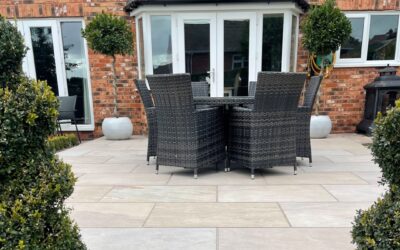
Most backyards look great in daylight and disappear at sunset because the only light source is a single 60-watt bulb above the back door. Layered, intentional lighting transforms a plain patio into a destination you actually use after 8 p.m. These patio lights ideas cover every layer, from overhead string lights to low-voltage path uplights, with specific products, lumen targets, and install costs that hit a real outdoor lighting plan rather than guesswork.
Part of our Decks & Outdoor guide — explore the full guide →
- Overhead String Lights for the Cafe Glow
- Low-Voltage Path Lights for Walkways
- Up-Lights to Highlight Trees and Architecture
- Solar Options That Actually Work
- Statement Fixtures for Defined Zones
- Smart Controls That Make Outdoor Lights Usable
- Outdoor-Rated Wiring and GFCI Protection
- Seasonal Layering and Holiday Add-Ons
Overhead String Lights for the Cafe Glow
The single highest-impact patio lighting upgrade is also the easiest. A 48-foot run of Brightech Ambience Pro string lights with 2700K LED filament bulbs ($79) hung in a zig-zag or perimeter pattern instantly creates the cafe-glow ceiling that defines the best outdoor rooms.
For a 12-by-16-foot patio, plan on 96 to 144 feet of strand to layer two overlapping zig-zag runs. Mount with screw-in cup hooks on a fence or pergola, or use 4-by-4 cedar posts (8-foot length, $18 each) anchored in 50-pound concrete blocks if you don’t have hard mounting points.
Low-Voltage Path Lights for Walkways
Anywhere people walk in the dark needs glare-free guidance. Low-voltage path lights run on a 12-volt transformer at the house and let you drop fixtures every 6 to 8 feet along a path or border bed. Volt Lighting and Kichler are the two pro brands that hold up for a decade. The Volt All-Star Path Light ($79 each) and Kichler Design Pro LED ($95) both cast a warm 2700K glow without blinding sightlines.
Wire with 12/2 direct-burial low-voltage cable ($60 per 100-foot roll) and a 300-watt Volt Top Dog transformer ($295). A 50-foot path with eight fixtures runs about $1,100 in materials and one focused weekend to install.
Up-Lights to Highlight Trees and Architecture
Nothing reads as more deliberately designed than uplit trees, columns, or stone walls. A 4-watt LED bullet light like the Volt G3 Bullet ($89) staked at the base of a 20-foot maple draws the eye upward and turns the canopy into a glowing sculpture.
Aim three to four bullets per mature tree from different angles for full canopy coverage. For house architecture, place lights 18 to 24 inches off the foundation aimed up the wall to graze stonework or board-and-batten siding.
Solar Options That Actually Work
Most solar lights are landfill-bound junk that fades in 8 months. A few brands have finally cracked the code with replaceable lithium batteries and 18650-cell construction. Brightown Outdoor Solar String Lights ($35 for 33-foot strand) and Beau Jardin Solar Pathway Lights ($60 for 8-pack) both hold up through 2 to 3 seasons in full-sun installs.
The catch with solar: you need at least 6 hours of direct sun on the panel daily for full evening run-time. Shaded patios should skip solar entirely and run a low-voltage line.
Statement Fixtures for Defined Zones
Beyond the broader washes, individual statement fixtures anchor specific zones. Hang a single Restoration Hardware bell jar pendant ($895) over an outdoor dining table from a pergola crossbeam. Add a pair of wall-mounted Hinkley Atwater sconces ($329 each) flanking a back door. A sculptural floor lamp like the Solar Lantern from West Elm ($249) marks a lounge corner.
- Dining zone: 1 pendant or chandelier centered over the table at 60 to 66 inches above
- Lounge zone: 2 to 4 floor lanterns or candle hurricanes for soft ambient layer
- Cooking zone: task lighting at 50 to 75 footcandles over the grill or prep counter
- Transition zones: path lights every 6 to 8 feet for safety
Smart Controls That Make Outdoor Lights Usable
The reason most patio lights go unused is the on-off switch is buried in the garage. Add a smart plug like the Kasa EP40 Outdoor ($25) and you can schedule the lights to come on at sunset and off at midnight without opening an app. Lutron Caseta also makes a 15-amp plug-in outdoor module ($65) that integrates with HomeKit and Alexa.
For more elaborate setups, a Lutron Caseta dimmer at the indoor wall switch lets you control a hardwired outdoor circuit from anywhere. The investment pays off because you’ll actually use the lights every evening rather than only on weekends.
Outdoor-Rated Wiring and GFCI Protection
Anything plugged in outdoors must be on a GFCI-protected circuit (NEC 210.8). Hardwired fixtures need wet-rated junction boxes (Bell weatherproof at $9) and outdoor-rated romex or UF cable buried at least 12 inches deep, or 6 inches if in conduit.
For most string light setups, you can avoid hardwiring entirely by plugging into a GFCI-protected outdoor outlet. Add a Sockit Box outdoor cover ($25) to keep the plug dry in rain. Skip these protections and you risk both code violations and a real shock hazard for guests.
Seasonal Layering and Holiday Add-Ons
The base patio lights ideas above are year-round. Layer in seasonal pieces without rewiring by sticking with the same 2700K color temperature so everything reads as harmonious. Add a string of warm white minis along a railing for fall, switch to color-changing Govee H7060 RGB bulbs ($75 a pair) for summer parties, or hang lanterns with battery candles like the Liown Moving Flame Pillar ($28 each) for winter gatherings.
The patio that looks great year-round has at least three light layers: overhead, ground-level path, and accent uplights. Hit those three layers and the space goes from utility yard to one of the favorite rooms in the house.