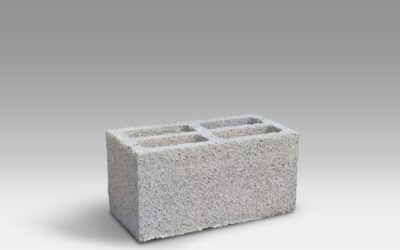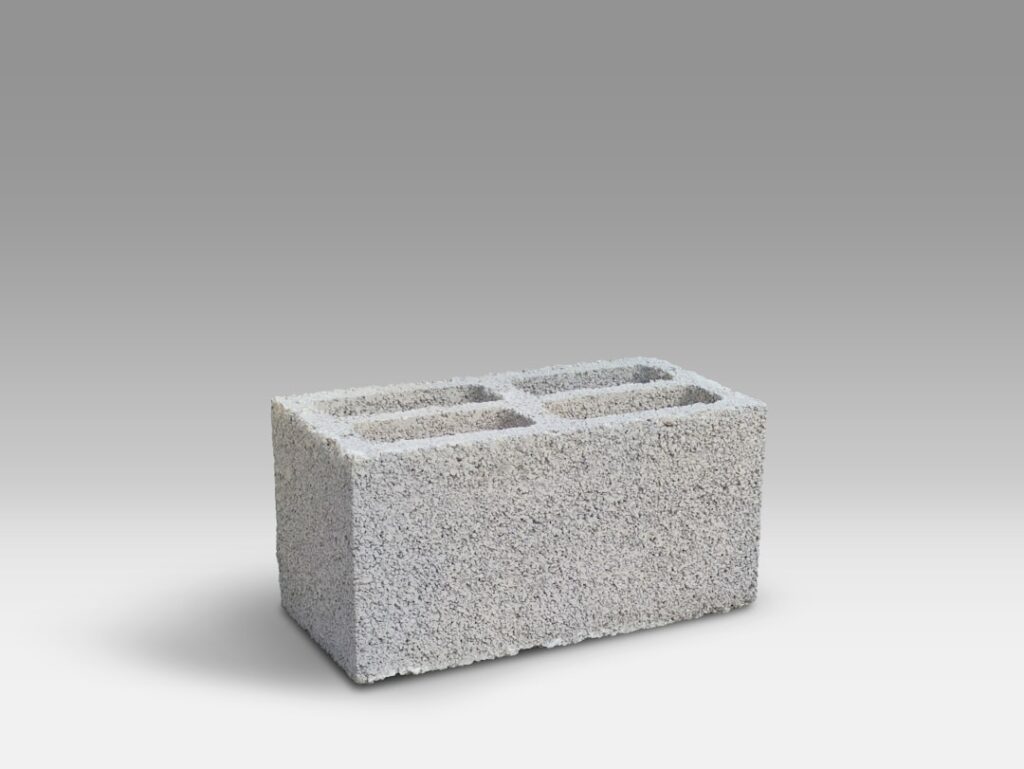
A standard “8-inch” block is not 8 inches — it measures 7-5/8 by 7-5/8 by 15-5/8 inches, sized so that a 3/8-inch mortar joint brings each unit to a tidy 8-by-8-by-16 module. That detail is the key to everything about concrete blocks: they are a modular system, and walls, footings, openings, and material orders all work out cleanly when you plan in 8-inch increments. Here is what the different block types do, what they cost, and how block walls actually get their strength.
Concrete Block, CMU, and “Cinder Block”
The industry term is CMU — concrete masonry unit. Modern blocks are molded from portland cement and dense aggregate, giving a heavy unit (33 to 38 pounds for a standard 8-inch hollow block) with compressive strength of 1,900 PSI or more per ASTM C90. True cinder blocks — made with coal cinders as lightweight aggregate — largely disappeared from production decades ago, though the name survives in every hardware-store conversation. If you are matching block in a pre-1950 basement, be aware old cinder units are weaker and more porous than anything sold today.
Lightweight CMU (expanded shale or slag aggregate) is also available, cutting weight by about 25 percent; masons like it for upper courses, and it meets the same C90 strength standard in most product lines.
Standard Sizes
Block widths run 4, 6, 8, 10, and 12 inches (nominal), all in the same 8-inch-high, 16-inch-long module. Where each width belongs:
- 4-inch: non-load-bearing partitions, veneer backing, and capping wider walls.
- 6-inch: light garden walls and interior bearing partitions.
- 8-inch: the workhorse — foundation walls, garage stem walls, retaining walls up to modest heights, and most structures.
- 10- and 12-inch: taller retaining walls and foundation walls carrying heavy backfill or multiple stories.
Estimating is simple: at 8 by 16 inches, each block covers 0.89 square feet, so figure 1.125 blocks per square foot of wall and add 5 to 10 percent for cuts and waste. A 4-foot-tall, 40-foot garden wall (160 square feet) needs about 190 blocks plus mortar.
Block Types and Shapes
Beyond the basic stretcher (the standard two-cell hollow block), a wall uses a family of special shapes:
- Stretcher: the field block, hollow cores, flanged ends.
- Corner and sash blocks: one flat finished end for corners and openings.
- Half blocks: 8-inch lengths that maintain the running bond at ends.
- Bond beam blocks: knocked-out webs create a horizontal channel for rebar and grout, tying the wall together at the top course and at intervals.
- Lintel blocks: U-shaped units that form reinforced beams over doors and windows.
- Solid blocks and caps: full-density units for bearing points and wall tops.
- Architectural faces: split-face, ground-face (burnished), scored, and glazed units for walls meant to be seen; split-face is the standard look on commercial buildings and nicer retaining walls.
Related but different: interlocking segmental retaining wall units (Allan Block, Versa-Lok types) stack dry without mortar, and are usually a better DIY retaining wall system than mortared CMU.
What Concrete Blocks Cost
At 2026 home-center and masonry-yard pricing, standard gray 8-inch stretchers run $1.80 to $3.50 each; 12-inch blocks $3 to $5; half and cap blocks $1.50 to $3; split-face and colored architectural units $3.50 to $6.50. Add mortar (one 80-lb bag of Type S lays roughly 35 to 40 blocks at $9 to $14 per bag), plus rebar and core-fill grout for reinforced walls.
Installed by a mason, block walls run $15 to $35 per square foot depending on height, reinforcement, footing needs, and finish — so that 160-square-foot garden wall is a $2,500 to $5,500 hire, versus roughly $700 to $900 in materials DIY. Laying block plumb, level, and in course is honest skilled labor; a first-timer should expect 50 to 75 blocks a day against a mason’s 200-plus.
How Block Walls Get Their Strength
A stack of hollow blocks has good compressive strength and almost no bending strength — reinforcement supplies the rest. Structural block walls start on a poured concrete footing (typically twice the wall’s width and below frost depth), with vertical rebar dowels cast into the footing. Vertical #4 or #5 bars run up through the cores at 16 to 48 inches on center per the design, and those cores are filled solid with grout — a soupy pea-gravel concrete — while bond beams add horizontal steel. Ladder-type joint reinforcement every other course controls cracking.
This is why “do I need to fill the cores?” has no single answer: a knee-high planter wall, no; a basement wall holding back eight feet of soil, absolutely, per an engineered schedule. Below grade, add damp-proofing or waterproofing membrane and drainage gravel with perforated pipe at the footing — most “leaky block basement” problems are drainage failures, not block failures.
Common Homeowner Uses (and Two Misuses)
Blocks excel at foundation and crawl-space walls, detached-garage stem walls, retaining walls under about 4 feet (taller requires engineering in most jurisdictions), raised garden beds, outdoor kitchen and fire-feature cores awaiting veneer, and shed foundations laid on a gravel bed. Solid caps or a poured bond beam finish the top; steps and stoops tie in nicely with formed work covered in our concrete steps guide, and anything you later bolt to a block wall — ledgers, gates, shelving — needs the right fastener from our concrete anchors guide.
Two cautions from the field. First, hollow blocks laid flat as deck or shed piers crush and crack under point loads — use solid units or poured footings. Second, dry-stacking a structural wall without mortar or surface-bonding cement is a collapse waiting for a frost heave; if you want mortarless, buy a system designed for it.
Laying Block: The Workflow in Brief
Watching a mason work reveals a rhythm worth copying. The wall starts with a chalk line snapped on the cured footing and a dry run — blocks set without mortar, joints gapped 3/8 inch with a plywood spacer, to confirm the modular layout works and cuts land where they will not show. Corners go up first, three or four courses high, checked plumb and level obsessively, because everything between them is laid to a mason’s line stretched corner to corner with line blocks. Each field block gets mortar buttered on its two ears, is beveled down onto the mortar bed against its neighbor, and is tapped to the line — never lifted and re-set, which breaks the bond. Joints get struck with a jointing tool when thumbprint-hard, giving the concave profile that sheds water.
Mix Type S mortar in small batches (one bag at a time in summer — it dies in about 90 minutes), keep the blocks dry before laying (wet CMU shrinks and cracks joints as it dries, the opposite of clay brick practice), and stop each day on a level course. A first-timer who respects the line, the level, and the 3/8-inch joint can build a respectable garden wall; the speed that makes it economical is the only thing that cannot be learned from an article.
Block or Poured Concrete?
Surface-bonding cement deserves a mention as the legitimate mortarless shortcut: blocks are dry-stacked on a mortar-leveled first course, then both faces get troweled with a fiberglass-reinforced coating (Quikrete Quikwall, about $30 per 50-lb bag covering 50 square feet per side). The cured shell delivers flexural strength comparable to conventionally mortared walls, and for sheds, garden walls, and root cellars it is meaningfully more DIY-achievable than learning to butter joints.
For foundations, poured walls win on lateral strength and speed where ready-mix and forming crews are cheap; block wins for small crews, remote sites, additions, and anywhere a truck cannot reach, since everything arrives on pallets and gets built by hand. For freestanding and landscape walls, block plus veneer delivers the most finished look per dollar. Either way the material outlasts its builder — a properly footed, reinforced, drained block wall is a 75-to-100-year structure.