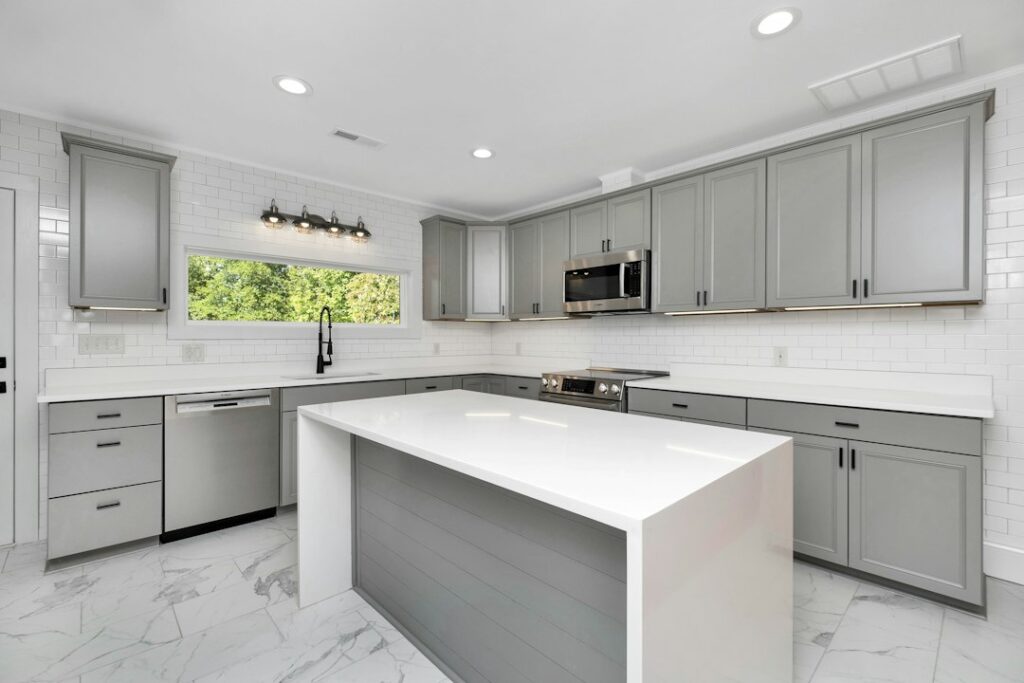
Hang a pendant a few inches too low and every guest at the island ends up talking around a glowing glass globe. Hang it too high and the light washes out, the fixture looks lost and the countertop sits in shadow. The standard pendant light height over an island is 30 to 36 inches from the countertop surface to the bottom of the fixture, measured with an 8 foot ceiling in mind. That range keeps light focused on the work surface while leaving clear sightlines across the kitchen.
From there, you adjust. Taller ceilings call for slightly higher hanging points, tall household members may want the top of the range, and large or opaque shades often sit a little higher than small, airy ones. Spacing and pendant count matter just as much, because even perfectly hung pendants look wrong if they crowd one end of the island or hang too close together.
- Standard Pendant Light Height Over an Island
- Adjusting Height for Tall or Vaulted Ceilings
- How Many Pendants and How to Space Them
- Tools and Materials
- Step-by-Step: Marking and Setting Pendant Height
- Electrical and Ladder Safety
- Troubleshooting Common Pendant Problems
- Cost Ranges
- When to Call a Licensed Electrician
- Frequently Asked Questions
Measure twice and set the height with a helper before the final electrical connection. Most pendants have adjustable cords or extra rod segments, but cutting cord short is permanent.
Standard Pendant Light Height Over an Island
The 30 to 36 inch rule is the industry baseline for a reason. A standard island countertop sits about 36 inches off the floor, so a pendant bottom at 30 to 36 inches above it lands roughly 66 to 72 inches above the floor. For most adults, that keeps the fixture just above or near eye level when standing and well above eye level when seated, so it lights the counter without blocking faces.
Choose a point within the range based on how you use the island:
- 30 to 32 inches: best for task-heavy prep islands and shorter households; more focused light on the counter.
- 33 to 34 inches: the comfortable middle for mixed cooking and dining use.
- 35 to 36 inches: good for tall family members, open-concept sightlines or wide shades.
Bar-height islands, with a raised counter around 42 inches, follow the same 30 to 36 inch rule measured from the raised surface. If the island has two levels, measure from the level the pendants hang over.
Adjusting Height for Tall or Vaulted Ceilings
When ceilings rise above 8 feet, many designers add about 3 inches of hanging height per additional foot of ceiling. The point is to keep the fixture in proportion with the room without pulling it so high that the light diffuses before reaching the counter.
| Ceiling height | Pendant bottom above counter |
|---|---|
| 8 ft | 30 to 36 in |
| 9 ft | 33 to 39 in |
| 10 ft | 36 to 42 in |
| 12 ft or more | 38 to 44 in, often with larger fixtures |
Treat these as soft guidelines. Plenty of homeowners with 10 foot ceilings still hang pendants at 34 inches and choose taller fixtures or longer stems to fill the vertical space. For vaulted or sloped ceilings, use a canopy with a sloped ceiling adapter so the stem hangs plumb, and measure each pendant’s drop individually since the ceiling height changes along the island.
Sightlines and open layouts
Stand at the sink, the range and the family room sofa, then look across the island. If a pendant blocks the view to a TV, window or another person, raise it an inch or two or switch to a smaller or clear glass shade. Seated sightlines also matter: from a stool, the pendant bottom should sit well above eye level so guests can see each other across the counter.
How Many Pendants and How to Space Them
Pendant count follows island length and fixture size. A practical starting point:
- Islands up to about 6 feet: 2 medium pendants or 1 linear fixture
- Islands 6 to 9 feet: 3 pendants, the most common arrangement
- Islands over 9 feet: 3 larger pendants, 4 small ones, or a long linear fixture
Spacing rules
- Leave at least 24 to 30 inches between the centers of neighboring pendants, and more for wide shades. A simple check is fixture diameter plus about 6 to 12 inches.
- Keep the outer edge of each end pendant at least 6 inches, and ideally 12 inches or more, in from the end of the island so the light stays on the counter.
- Center the group on the island, not on the room, unless the island is off-center and you want to align with a range hood or sink.
- Run pendants down the centerline of the island’s width so light falls evenly on both sides.
A quick sizing formula helps when choosing fixtures. Take the island length in inches, subtract 12, and divide by the number of pendants you want. For a 96 inch island with 3 pendants, that gives about 28 inches of space per pendant, so shades up to roughly 14 to 18 inches in diameter will look balanced with breathing room between them.
Choosing the shade
When shopping for a kitchen island pendant light, think about the light it throws as well as how it looks. Open-bottom metal or opaque shades push light down onto the counter and can hang toward the lower end of the range. Clear or seeded glass glows in every direction and reads lighter visually, so it handles a slightly lower drop without blocking views. Dimmable fixtures with warm white bulbs around 2700K to 3000K suit most kitchens.
Tools and Materials
- Tape measure and painter’s tape or a chalk line
- Step ladder rated for your weight plus tools
- Non-contact voltage tester
- Wire strippers, screwdrivers and wire connectors
- Ceiling boxes rated for the fixture weight
- Pendant fixtures with adjustable cord, chain or extra rod segments
- A helper to hold the fixture while you judge height
Step-by-Step: Marking and Setting Pendant Height
- Measure the island. Note its length, width and the counter height from the floor.
- Mark centers on the counter. Lay painter’s tape where each pendant will hang, following the spacing rules.
- Transfer marks to the ceiling. Use a plumb bob or laser level to mark the ceiling directly over each counter mark. If existing boxes are off, a licensed electrician can relocate them or you can use a swag canopy kit designed for that purpose.
- Turn off the breaker. Switch off the circuit at the panel and confirm power is off at the ceiling box with a non-contact voltage tester before touching any wires.
- Mock up the height. Have a helper hold the fixture at your target drop while you check it from standing, seated and across-the-room views.
- Adjust the cord or rods. Shorten or lengthen per the fixture instructions, leaving enough slack in the canopy for connections.
- Connect and mount. Make connections per the manufacturer’s diagram, secure the mounting bracket to a rated box and attach the canopy.
- Level and test. Restore power, check that all pendants hang at the same height, and fine-tune before tightening.
Electrical and Ladder Safety
Pendant lights are line-voltage fixtures, wired to standard 120 volt household circuits, unlike low-voltage under-cabinet strips that run through a transformer. Always turn off the breaker and confirm the power is off with a non-contact voltage tester before working. Never test or work on energized wires. If the island has no existing box, or you need a new circuit or switch, hire a licensed electrician; new circuits and boxes usually require a permit. Heavy fixtures need boxes rated for their weight.
Ladder safety matters too. Set the ladder on a level floor, not on the island countertop, keep three points of contact, and never stand on the top step or top cap. With 10 foot or higher ceilings, use a taller ladder or a stable platform rather than overreaching, and have someone steady the ladder while you handle the fixture.
Troubleshooting Common Pendant Problems
- Glare in your eyes when seated: the pendant is too low or uses a bare bulb. Raise it, add a diffuser or switch to a frosted bulb.
- Counter looks dim: pendants are too high or the shades scatter light upward. Lower them within the range or add recessed lights for task lighting.
- Fixtures look crowded: spacing is too tight. Drop to fewer, larger pendants or a linear fixture.
- Pendants hang at uneven heights: measure from the counter, not the ceiling, since ceilings are rarely perfectly flat.
- Fixture sways or tilts: the canopy is loose or the ceiling is sloped. Tighten the bracket or add a sloped ceiling adapter.
Cost Ranges
Island pendants range widely. Basic fixtures can cost under $100 each, while designer glass or metal pendants often run a few hundred dollars apiece. If the boxes are already in place, an electrician typically charges a modest fee per fixture to hang and connect them. Adding new boxes, running wire through a finished ceiling or adding a dimmer switch raises the cost, sometimes into the several hundred to over a thousand dollar range depending on access and patching.
When to Call a Licensed Electrician
Swapping a pendant onto an existing, correctly placed box is a manageable DIY task for many homeowners. Call a licensed electrician when you need new ceiling boxes, a new circuit or switch, dimmer wiring for multiple fixtures, or when the house has aluminum wiring or old cloth-insulated wire. A pro can also confirm boxes are rated for heavier fixtures and that the work meets local code and permit rules.
Get the pendant light height over an island right, space the fixtures evenly, and the island becomes a well-lit workspace that still feels open and social.
Frequently Asked Questions
How high should a pendant light be over an island?
Hang the bottom of the pendant 30 to 36 inches above the countertop for an 8 foot ceiling. Add about 3 inches for each additional foot of ceiling height.
How far apart should pendant lights be over an island?
Space pendant centers at least 24 to 30 inches apart, and keep each end pendant at least 6 inches in from the island edge, more if the shades are wide.
Should island pendants be 2 or 3 lights?
Islands up to about 6 feet usually look best with 2 pendants, while islands 6 to 9 feet suit 3. Very long islands may use larger pendants or a linear fixture.
Is the pendant height measured from the floor or the countertop?
Measure from the countertop surface to the bottom of the fixture. That keeps all pendants consistent even if the ceiling is slightly uneven.
Can I install island pendants myself?
If boxes already exist in the right spots, many homeowners can, with the breaker off and power confirmed off with a non-contact voltage tester. New boxes or circuits need a licensed electrician.