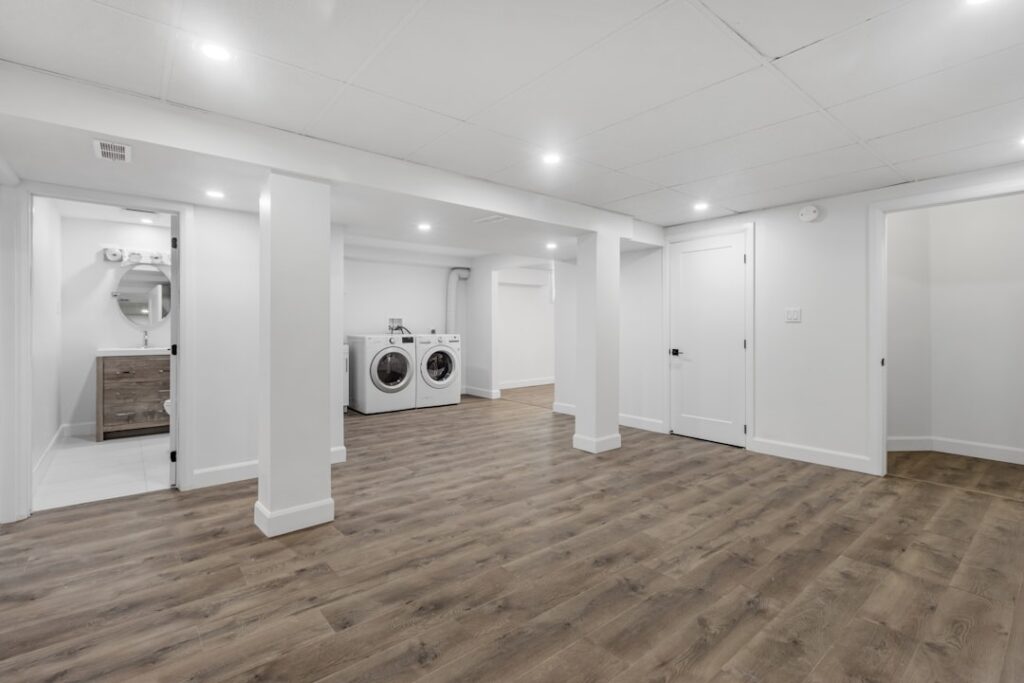
Running a portable unit in the basement gets old fast — emptying buckets, listening to a noisy compressor, and watching the relative humidity bounce between 55% and 70%. A permanent dehumidifier for basement spaces solves all three problems by drawing condensate to a floor drain or condensate pump, running quieter than a fridge, and holding RH within a 3% band. Expect to spend $1,500 to $3,400 installed for a quality whole-basement unit rated for 70 to 155 pints per day.
Why Basements Need a Dedicated Unit
Below-grade walls leak water vapor through concrete pores even when they look dry. The EPA recommends keeping indoor RH between 30% and 50% to suppress mold growth, dust mites, and material warping. A portable 50-pint dehumidifier can hit that target in a sealed bedroom, but it stalls in an 1,800 sq ft basement with cold concrete walls pulling moisture all summer.
A permanent unit ducts the cold, damp air through a refrigerated coil, drops it 20 to 30°F, condenses out 8 to 12 gallons per day in July, then returns the dried air across the slab. The result is a basement that smells like a basement should — neutral, dry, and cool.
Sizing the Unit to Your Square Footage
Pint capacity is rated at 80°F and 60% RH per AHAM standards. Basements run cooler — usually 65 to 72°F — so derate by roughly 20%. Use these benchmarks for an unfinished basement with no major water intrusion:
- Up to 1,000 sq ft: 70-pint unit (Aprilaire E70, $1,299 list)
- 1,000 to 1,800 sq ft: 100-pint unit (Aprilaire E100 or Santa Fe Compact70, $1,599-$1,899)
- 1,800 to 3,000 sq ft: 130-pint unit (Santa Fe Advance100, $2,099)
- Over 3,000 sq ft or wet conditions: 155-pint unit (Santa Fe Ultra155, $2,499)
Finished basements with carpet, drywall, and air sealing need 20% less capacity. Crawl space integration or known seepage areas need 20% more.
Standalone vs Ducted Installations
Standalone units sit on the slab, plug into a 115V or 230V outlet, and pull air directly from the basement. They cost $1,500 to $2,500 installed and work great for open layouts. Ducted units tie into existing HVAC trunk lines or use dedicated 6-inch flex duct to push dry air into bedrooms, closets, and finished rooms upstairs. Budget $2,800 to $3,400 installed.
If your basement has multiple finished rooms with doors, ducting matters. A single intake near the unit cannot pull humid air from a closed-off media room 30 feet away.
Top Brands Worth Considering
Santa Fe (Therma-Stor) builds the most respected units in the category. Their Ultra series runs 21 hours per day in summer humidity and pulls 6.5 pints per kWh — nearly double the efficiency of a Home Depot portable. Aprilaire dehumidifiers sell through HVAC contractors and integrate with smart thermostats. The E080 carries a 5-year compressor warranty and a MERV 8 filter as standard.
Skip Honeywell whole-house units rebadged from lower-tier manufacturers. The compressors fail around year four, and parts are hard to source. Quest and Anden are solid alternatives if your contractor offers them.
Drainage and Condensate Handling
Every permanent dehumidifier needs continuous drainage. The three options:
- Gravity drain to a floor drain or sump pit — cheapest, requires the unit to sit higher than the drain
- Condensate pump — $75 to $150 for a Little Giant VCMA-20ULS, pushes water up 20 vertical feet
- Tied to AC condensate line — clean if the line runs nearby, but check that the trap and pitch handle the added flow
Use 3/8-inch ID vinyl tubing with hose clamps at every fitting. Avoid kinks where the line crosses joists. A clogged drain backs water into the unit and triggers the float switch, shutting the compressor off in the middle of August.
Electrical and Code Requirements
Most 70-pint units run on a standard 115V/15A circuit. The 100-pint and larger Santa Fe units pull 8.5 to 11 amps and should not share a circuit with the freezer or sump pump. The IRC and IECC do not specifically regulate dehumidifiers, but local jurisdictions in flood zones may require GFCI protection within 6 feet of a sump pit. Check before the contractor finishes rough-in.
If you live in a state under the EPA RRP rule and the basement was finished before 1978, any contractor cutting ductwork through painted walls needs lead-safe certification. This is rarely an issue for unfinished basements but becomes one in older row houses with painted block.
Installation Costs and Timeline
A licensed HVAC contractor needs 4 to 7 hours for a standalone install: unboxing, leveling on isolation pads, running the condensate line, wiring the outlet if needed, and commissioning at the recommended 50% RH setpoint. Labor runs $85 to $130 per hour depending on region. Ducted installs add 4 to 8 hours for cutting trunk lines, sealing joints with mastic, and balancing supply registers.
DIY install is possible for the standalone version if you can manage 200 pounds on a hand truck and tap a condensate line. Save $400 to $700 in labor, but you give up the contractor warranty registration that some brands tie to professional installation.
Operating Costs and Maintenance
A 100-pint Santa Fe pulling 5 amps at 115V costs about $1.40 per day during peak summer humidity. Annual electric runs $180 to $260 in the Midwest and Northeast. Clean the MERV 8 filter every 3 months — a $25 replacement — and have the coil inspected every 2 years. Compressors typically last 10 to 14 years, and replacement units are rebuildable rather than disposable.
Set the dehumidistat to 50% RH year-round. Lowering it to 40% doubles the energy bill without measurable comfort benefit, and any reading below 35% in summer means the sensor is miscalibrated. Most units offer an Auto Defrost mode that pauses the compressor when the coil ices over below 60°F ambient. Leave it on — manual defrost cycles burn out compressors twice as fast.
Common Installation Mistakes
Three errors repeat across DIY and contractor installs alike. First, locating the unit in a closet without return air clearance — a Santa Fe needs at least 18 inches of side clearance and 24 inches of front clearance for proper airflow. Second, running the condensate line uphill without a check valve, causing siphoning back into the unit. Third, sharing a 15-amp circuit with the freezer, which trips the breaker the first time both compressors start simultaneously. Each mistake is fixable but costs a service call to diagnose.