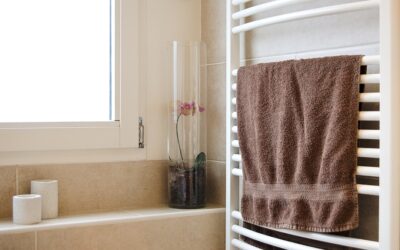
The first time you wrap up in a warm towel after a shower, the $200 you spent on a heated rack feels like a steal. A plug-in towel warmer beats the hardwired version for one big reason: no electrician, no permit, no opening the wall. The trade-off is wattage choice, bathroom outlet location, and the difference between a unit that warms two towels in 15 minutes versus a cheap rack that barely takes the chill off.
- Why Plug-in Beats Hardwired for Most Homes
- Wattage and Heat Output by Towel Capacity
- Top Pick Under $200
- Mid-Range Pick: $200 to $400
- Premium Pick Over $400
- Bathroom Outlet Rules You Need to Follow
- Wall Mounting vs Freestanding Trade-offs
- Power Consumption and Operating Cost
- Maintenance and Safety
- What to Skip
- Bottom Line
Why Plug-in Beats Hardwired for Most Homes
Hardwired towel warmers require a 120-volt circuit ending in a switched junction box, typically on a 15-amp dedicated line per NEC 210.11. That means a permit, a licensed electrician at $85 to $145 per hour, and 3 to 6 hours of labor. Add the warmer cost, and you’re at $1,200 to $2,400 installed for what amounts to a heated rack.
Plug-in units run $89 to $620 and need only an outlet within cord reach. Most modern bathrooms have GFCI receptacles already required by NEC 210.8(A)(1). Plug it in, mount the rack to the wall with the included hardware, and the install takes 25 to 40 minutes for any DIYer with a drill.
Wattage and Heat Output by Towel Capacity
Wattage is the single best predictor of how fast and warm a towel warmer gets. Compact units rated 70 to 110 watts hold one to two hand towels and heat to surface temperatures of 95 to 115 degrees F in about 15 minutes. These are good for guest baths and powder rooms.
Mid-size warmers at 130 to 170 watts handle two bath towels and reach 120 to 140 degrees F in 12 to 18 minutes. This is the popular pick for primary bathrooms.
Premium units at 180 to 250 watts can warm four bath towels or two bath sheets and hit 140 to 165 degrees F. These are built for families of four or master suites where multiple people shower in sequence.
Top Pick Under $200
The Brookstone Heated Towel Stand sells for $129 to $169 on Amazon and at Macy’s. It’s a freestanding unit with two rails for two bath towels, rated at 130 watts, and reaches operating temperature in 12 minutes. The footprint is 18 inches wide by 13 inches deep so it fits in tight bathrooms.
Build quality is mid-tier with painted steel construction. Don’t expect it to last 15 years, but at the price point it’s the easiest entry to heated towels. The 6-foot cord plugs into any standard GFCI outlet.
Mid-Range Pick: $200 to $400
The Warmrails Hyde Park Wall-Mounted Towel Warmer at $179 to $239 features five horizontal rails, 220 watts of heating power, and a chrome or brushed nickel finish. It mounts with included anchors and the cord drops to a wall outlet below. Surface temperature tops out at 140 degrees F.
The mounting brackets accommodate stud or anchor installation, but the manufacturer recommends finding studs for any unit over 12 pounds. Loaded with two soaking-wet bath towels, the rack weighs about 16 pounds, well within drywall-only limits for the included toggle anchors.
Premium Pick Over $400
The Amba Sirio S2933P sells for $449 to $589 in polished chrome, brushed nickel, or matte black. It’s a 200-watt hardwire-or-plug-in convertible unit with 11 rails on a 30 x 33 inch frame. Surface temperature reaches 149 degrees F and the unit is rated IP54 for splash resistance.
Amba is the gold standard for towel warmers in luxury bathrooms. The stainless-steel construction carries a 10-year warranty and the polished finishes hold up to bathroom humidity without spotting. Pair with the optional digital timer for scheduled morning warmup.
Bathroom Outlet Rules You Need to Follow
All bathroom receptacles in dwellings installed after 2008 require GFCI protection per NEC 210.8(A)(1). If your bathroom outlet was installed before that and isn’t GFCI, replace it with a Leviton or Eaton GFCI receptacle for $19 to $34 before plugging in any towel warmer. This protects against shock hazard near water.
Local jurisdictions add restrictions on cord-and-plug devices in bathrooms. Some cities require the outlet to be on a dedicated bath circuit not shared with lighting. Check with your building department or just call your local AHJ (Authority Having Jurisdiction) before installing.
Cord length matters too. Most plug-in towel warmers ship with 60 to 84 inch cords. The cord can’t pass through walls or be hidden behind cabinetry per NEC 400.8. If your outlet is too far away, use an in-wall cable kit and convert the rack to hardwired with a junction box.
Wall Mounting vs Freestanding Trade-offs
Wall-mounted units save floor space but lock the position. Once you drill anchors into tile or drywall, moving the warmer leaves visible holes. Pick wall-mount only if you’re certain about layout.
Freestanding warmers offer flexibility. You can move the rack between bathrooms, store it in a closet during summer, or take it to a vacation home. The trade-off is footprint, typically 14 to 22 inches wide of floor space dedicated to the unit.
Hybrid units like the Sherwood Heated Towel Rack include both wall-mount and freestanding modes with reversible base plates. These give the best long-term flexibility at a modest $30 to $50 price premium.
Power Consumption and Operating Cost
A 130-watt warmer running 8 hours a day at $0.15 per kWh costs $4.68 per month or $56 per year. A 200-watt unit running the same schedule costs $7.20 per month, $86 per year. Running 24/7 doubles the cost to $112 to $172 annually.
Add a smart plug like the TP-Link Kasa or Amazon Smart Plug for $8 to $14 to schedule operation during peak shower hours, typically 6 to 9 a.m. and 7 to 10 p.m. This cuts run time to 6 hours a day and operating cost in half.
Maintenance and Safety
- Wipe rails monthly with a damp microfiber cloth to prevent lint buildup
- Inspect cord and plug every 6 months for fraying or scorch marks
- Never cover with wet bath mats or clothing that drape over heating elements
- Keep at least 4 inches clearance from flammable curtains or wallpaper
- Unplug during extended vacations or shutoffs longer than 30 days
If the unit trips the GFCI repeatedly, stop using it and contact the manufacturer. Repeat trips signal a wet-element problem that’s a shock and fire hazard. Most manufacturers honor warranty replacement within the first 12 months.
What to Skip
Cheap unbranded warmers under $60 on marketplace sites often skip UL or ETL listing, the safety certifications required for plug-in electrical devices in US bathrooms. Confirm the listing mark on the unit and packaging before buying. Insurance claims can be denied for fires traced to non-listed electrical equipment.
Heated drying racks marketed for camping or RV use aren’t rated for residential bathroom moisture. Pick a product rated specifically for bathroom installation and verify the IP rating is at least IPX4 for splash protection.
Bottom Line
A plug-in towel warmer is one of the highest-satisfaction bathroom upgrades for the dollar. Match the wattage to your towel count, verify GFCI protection on the outlet, and pick a unit with a 5 to 10 year warranty. Brookstone for budget, Warmrails for mid-range, Amba for premium. Done right, the warmer outlasts the bathroom remodel and earns daily appreciation for years.