When a pocket door starts dragging, jumping the track, or refusing to close flush, the problem almost always lives overhead. The pocket door rail is the horizontal track and roller system that carries the door’s full weight, and it is the single most important component in whether the door glides silently or fights you every time. Understanding how the rail works makes both new installations and repairs far less intimidating.
Part of our Windows & Doors guide — explore the full guide →
What the Rail Does
A pocket door hangs from the top, unlike a hinged door supported at the side. The rail is an aluminum or steel track mounted inside the header, and two roller hangers ride along it while the door slides into a hollow wall cavity called the pocket.
Because everything hangs from this track, the rail bears 100 percent of the door’s weight. That is why a bent track or a worn roller shows up immediately as sticking, sagging, or a door that will not sit plumb.
Types of Pocket Door Rails
Not all tracks are equal, and choosing the right one starts with the door’s weight.
- Steel ball-bearing track: The premium standard, with sealed roller carriages rated for 150 to 400 pounds. Smooth, quiet, and long-lasting.
- Aluminum track with nylon rollers: Common in budget kits, fine for lightweight hollow-core doors under 75 pounds.
- Heavy-duty commercial track: For solid-core, glass, or oversized doors, rated up to 500 pounds with dual-wheel hangers.
Match the track rating to your door and always leave headroom. A solid-core door pushing the limit of a light track will wear the rollers out fast.
Sizing the Rail to Your Door
The track must be roughly twice the door’s width so the door can slide fully into the pocket while the header supports the far end. A standard 32-inch door needs a rough opening and track assembly close to 64 inches wide.
Height matters too. Standard kits handle doors up to 80 or 96 inches tall, but the rollers stay the same; only the frame changes. Confirm the door thickness as well, since 1-3/8-inch and 1-3/4-inch doors use different hanger brackets.
Installing a Pocket Door Rail
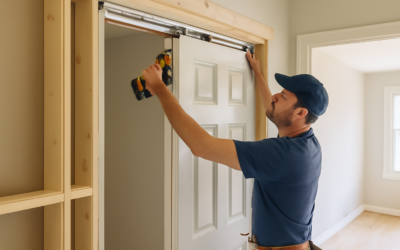
Most rails come as part of a frame kit with split studs and the header track pre-attached. Set the frame in the rough opening, then level and plumb it carefully; this step determines everything that follows.
Work through it in order. Shim the frame until the track sits dead level, fasten it to the header and studs, then hang the door from the roller brackets and adjust the height bolts until the door clears the floor by about half an inch and sits flush against the jamb. A door that binds usually just needs a quarter-turn on those adjustment bolts.
Fixing a Sagging or Sticking Door
Before you assume the whole track is bad, diagnose the real cause. A sagging door often just needs the height-adjustment nut on the roller hanger tightened, which raises that corner back into alignment.
If the door jumps the track or grinds, inspect the rollers for flat spots and the track for bends or debris. Vacuum the channel, then run a dry silicone lubricant along the rail; avoid oil-based sprays that attract dust and gum up over time. Replacing a worn roller carriage is far cheaper than replacing the entire rail, and many kits sell the hangers separately.
Retrofit vs. New Construction
Installing a pocket door in an existing wall means opening the drywall and often rerouting wiring or plumbing inside the pocket cavity, so budget for that. In new construction or a remodel with the wall already open, dropping in a rail kit is straightforward.
Either way, remember that nothing can be mounted in the pocket wall afterward, no heavy shelves or towel bars, because a screw through the cavity will jam the door. Plan fixture locations before the drywall goes up.
Choosing Quality Hardware
The rail is not the place to save a few dollars. A quality steel ball-bearing track from a name-brand kit costs $60 to $150 more than a bargain aluminum set, but it prevents the maddening sag-and-stick cycle that cheap tracks develop within a year or two.
Look for sealed roller bearings, adjustable hangers, and a weight rating comfortably above your door. Invest in the track and the door will reward you with years of silent, effortless sliding, which is the whole point of choosing a pocket door in the first place.
Soft-Close and Upgrade Options
Modern rail kits offer features that transform how a pocket door feels. A soft-close mechanism catches the door in the last few inches of travel and eases it gently to a stop, eliminating the slam and the bounce-back that plague basic tracks. It is a small upgrade that makes a daily difference.
Self-closing dampers pull the door fully shut from a partly open position, useful for bathrooms and closets. Some premium systems even add a soft-open feature at the pocket end. These add-ons typically cost $30 to $80 over a standard kit and can sometimes be retrofitted to an existing quality track, though it is easier to specify them at install.
Troubleshooting a Noisy Rail
A rail that squeaks or rumbles is usually telling you something specific. A high-pitched squeak often means dry rollers, cured with a quick pass of dry silicone lubricant. A grinding rumble points to debris in the channel or a flat-spotted roller that needs replacing.
If the door drags at one end, the track may have bowed under the door’s weight, common when a heavy door was hung on an underrated rail. Check the track for a visible sag with a straightedge; a bent aluminum track cannot be reliably straightened and should be replaced with a properly rated steel one before the door damages the wall.