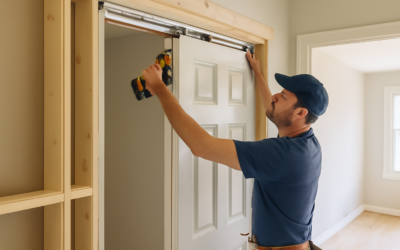
In a small bathroom, the swing of a conventional door can swallow ten square feet of usable floor and bang into the vanity or toilet. A bathroom pocket door solves that by sliding sideways into a hollow pocket built inside the wall, disappearing entirely when open. This guide covers how pocket doors work, where they make sense, what they cost, how they are installed, and the privacy and maintenance details that separate a smooth-gliding door from a frustrating one.
Part of our Bathroom Remodeling & Flooring guide — explore the full guide →
- How a Pocket Door Works
- Why Choose One for a Bathroom
- New Construction vs Retrofit
- Choosing the Right Hardware Kit
- Installation Overview
- Privacy Locks and Pulls
- Cost Expectations
- Common Problems and How to Prevent Them
- Soundproofing and Moisture Concerns
- ADA and Aging-in-Place Benefits
- Maintenance Tips
How a Pocket Door Works
Instead of hinging on the jamb, a pocket door hangs from rollers riding along a track mounted at the top of the opening. When you slide it open, the door glides into a cavity, the pocket, framed inside the adjacent wall. The wall on that side must be essentially hollow to receive the door, which is why pocket doors are built into a special split-stud frame. Nothing rides on the floor except an optional guide, so there is no threshold to trip over and no floor track to collect grime.
Why Choose One for a Bathroom
The bathroom is the ideal room for a pocket door for several reasons:
- It reclaims the floor area a swinging door would sweep, often the difference between a cramped and a comfortable powder room.
- It removes the awkward choreography of opening a door that clears the toilet or sink by inches.
- It suits accessibility upgrades, giving wheelchair users a wider clear opening without a door swing to maneuver around.
- It creates a clean, modern look, especially with a frosted-glass or slab-style panel.
For an en suite or a tight hallway bath, the space savings alone justify the project for many homeowners.
New Construction vs Retrofit
Installing a pocket door is dramatically easier during new construction or a full remodel when the wall is already open. In a retrofit, you must open the wall, remove the existing studs in the pocket area, and reframe with a pocket door kit. The critical question is what is inside that wall. If the pocket wall carries plumbing, electrical, or HVAC, or is load-bearing, the job grows complicated and may require rerouting utilities or adding a header, which is a job for a professional. Because bathrooms are full of pipes and vents, always investigate the wall before committing.
Choosing the Right Hardware Kit
The frame and track kit is the heart of the system, and buying quality here prevents years of grief. Reputable brands such as Johnson Hardware and Cavity Sliders make kits with steel split studs and smooth ball-bearing rollers. Match the kit to your door size, typically 24, 28, 30, or 32 inches wide, and confirm it is rated for your door’s weight, especially for heavy solid-core or glass panels. Soft-close dampers are a worthwhile upgrade that stop the door from slamming into the pocket. Cheap builder-grade kits with plastic rollers are the source of most pocket-door complaints, so spend a little more up front.
Installation Overview
A typical retrofit follows this sequence:
- Remove the old door, trim, and the drywall on the pocket side down to the studs.
- Remove the existing king and jack studs in the pocket zone and verify the wall is non-load-bearing.
- Assemble and level the pocket frame kit, then fasten the header track dead level, this is the most important step, as an out-of-level track lets the door drift open or closed on its own.
- Hang the door on its rollers, adjust the height, and set the floor guide.
- Re-drywall over the pocket, using only short screws mapped away from the door path so nothing punctures into the pocket and scratches the door.
- Install jamb trim, the strike, pull, and privacy lock, then finish and paint.
Expect a full day or two for a confident DIYer, longer if utilities need rerouting.
Privacy Locks and Pulls
Bathrooms need a real privacy lock, and pocket doors use specialized hardware because there is no room for a standard knob. Look for a pocket door privacy latch with a turn-piece inside and an emergency slot outside that a coin or flat tool can release. Flush pulls sit flat against the door face so they clear the pocket, and an edge pull, a spring-loaded finger pull on the leading edge, lets you draw the door back out of the pocket. Buy the lock set matched to your door thickness, usually 1-3/8 or 1-3/4 inches.
Cost Expectations
Budget varies widely by scope. The hardware kit runs $100 to $400, and the door itself $75 to $500 depending on material. In new construction where the wall is open, total installed cost might be $500 to $1,000. A retrofit that requires opening and reframing a finished wall commonly runs $1,000 to $2,500, and considerably more if plumbing or electrical must move or a load-bearing wall needs a header. Getting a couple of contractor quotes is wise before you assume a retrofit is cheap.
Common Problems and How to Prevent Them
Pocket doors earn a bad reputation only when installed poorly. Watch for these issues:
- Sticking or jumping the track from a cheap kit or an out-of-level header; quality hardware and careful leveling prevent it.
- A door that drifts because the track was not set perfectly level.
- Sound and moisture transfer, since a pocket door seals less tightly than a swing door; a solid-core panel and a bathroom exhaust fan help.
- Hard-to-reach repairs if a roller fails, because the door lives inside the wall; buying serviceable, well-reviewed hardware minimizes the odds.
- Screws puncturing into the pocket during drywall work and scratching the door face.
Soundproofing and Moisture Concerns
Because a pocket door does not seal against a stop the way a hinged door does, bathrooms present two specific challenges: sound and moisture. Sound leaks through the gap around the panel and the pocket opening, so if privacy from noise matters, choose a solid-core door, add a bulb or brush seal along the jamb, and consider acoustic caulk when framing the pocket wall. Moisture is the other issue, since steam from a shower can migrate into the wall cavity. A strong bathroom exhaust fan vented outdoors is the real fix, and running it during and after showers keeps humidity from reaching the pocket framing. In a full bathroom with a shower or tub, position the door away from direct spray and make sure the wall has proper vapor management, just as you would for any bathroom wall.
ADA and Aging-in-Place Benefits
Pocket doors are a favorite in universal-design and aging-in-place remodels for concrete reasons. A pocket door provides a wider, unobstructed clear opening with no swing to maneuver around, which is exactly what a wheelchair or walker needs. For accessibility, frame the rough opening so the finished clear width is at least 32 inches, and choose D-shaped or loop pulls rather than small recessed finger pulls, which are hard to grip for anyone with limited hand strength. Pairing a pocket door with lever hardware and a comfort-height layout turns a cramped, hard-to-navigate bathroom into one that works for every stage of life.
Maintenance Tips
Upkeep is minimal. Every year or so, vacuum any dust from the exposed track and wipe the rollers, then apply a dry silicone lubricant, never oil, which attracts grit. Check that the floor guide is intact and the door still glides freely. If the door starts to sag or rub, most kits have an adjustment nut on the roller hangers that raises or lowers the door without removing it. A quality pocket door treated this way glides smoothly for decades.
A bathroom pocket door is one of the highest-impact upgrades for a small bath, turning wasted swing space into usable room while giving a clean, modern look. Invest in a quality steel frame kit, set the header perfectly level, choose a proper privacy latch, and confirm what is inside the wall before you cut. Do that and you get a door that quietly disappears when you want it gone and seals your privacy when you need it.