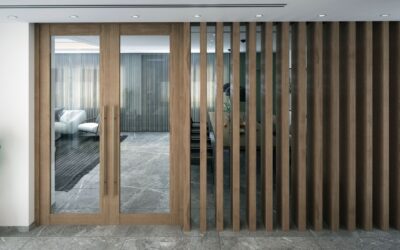
Two swinging doors on a wide opening eat a startling amount of floor space, and that’s exactly the problem a double pocket door kit solves. Instead of doors that swing into the room, a pair of panels slides apart into hollow pockets inside the walls on each side, disappearing completely when open. It’s the classic solution for closing off a dining room, a primary suite, or a home office in an open floor plan without sacrificing a single square foot of usable space.
Part of our Windows & Doors guide — explore the full guide →
What Comes in a Double Pocket Door Kit
A quality kit contains the split-jamb frame that builds the two pockets, a header track sized for the opening, and the roller hardware and hangers that carry each door. Some kits include the split studs; better ones use steel-reinforced or solid split jambs that resist the warping that plagues cheap systems. The doors themselves are almost always sold separately, letting you match them to your interior style.
Look for a kit rated for the weight of the doors you plan to hang. Standard residential kits handle panels up to 125 pounds each, while heavy-duty commercial-grade hardware carries 200 pounds or more, which matters for solid-core or glass doors.
Sizing and Rough Opening Requirements
The single most important number is the rough opening, and pocket doors are demanding here. A double pocket door needs a rough opening roughly twice the combined door width plus the pockets. As a rule, plan for a rough opening width of about double the door width plus one inch, and a height of the door height plus around 4.75 inches for the track.
For a common pair of 30-inch doors, you’ll frame a rough opening near 61 inches wide. That means each pocket needs about 30 inches of clear, uninterrupted wall on either side, free of plumbing, electrical, ductwork, or a light switch. Verify what’s inside those walls before you commit, because relocating a drain line can dwarf the cost of the door itself.
Common Kit Sizes
- Two 24-inch doors: Rough opening around 49 inches wide
- Two 30-inch doors: Rough opening around 61 inches wide
- Two 36-inch doors: Rough opening around 73 inches wide
New Construction vs. Retrofit
Installing a double pocket door is dramatically easier during framing or a full remodel when the wall is open. In new construction, you set the kit, frame around it, and hang drywall in a few hours. Retrofitting into a finished wall is a bigger job: you’ll remove drywall on both sides across the full opening, confirm the wall isn’t load-bearing (or add a proper header if it is), and reroute anything living inside it.
If the wall is load-bearing, a structural header must carry the load above the wide opening, which usually means consulting an engineer or experienced contractor. This is the step DIYers most often underestimate.
Installation Overview
With the rough opening framed to spec, the process follows a predictable order.
- Mount the header track level across the top of the opening, shimming as needed
- Set and plumb the split-jamb pocket frames on each side, fastening to the floor and header
- Hang the roller hangers on each door and lift the doors onto the track
- Adjust the roller height so both doors are plumb and meet cleanly in the center
- Install the split jambs, door guides at the floor, and pull hardware
- Hang drywall over the pockets using only short screws that won’t pierce the door path
That last point trips up plenty of installers. A single overlong drywall screw into the pocket will gouge your door every time it slides, so mark the pocket zone and keep fasteners short.
Choosing the Right Hardware
Roller quality separates a door that glides silently for decades from one that binds and rattles within a year. Sealed ball-bearing rollers on a steel track are worth the upgrade. For the meeting point, add a set of double-door pulls with a privacy latch if the room needs to lock, plus soft-close dampers that catch each door and ease it shut instead of letting it slam.
Cost Expectations
Budget accordingly depending on scope.
- Kit and hardware: $150 to $400 for a quality double frame and rollers
- Doors: $100 to $400 each depending on material and glass
- DIY total: $400 to $1,200 for a straightforward retrofit
- Professional install: Add $500 to $1,500 in labor, more if structural work is needed
Common Mistakes to Avoid
The failures are predictable and preventable. Skipping the split-jamb reinforcement leaves flimsy pocket walls that flex when you hang art. Framing the rough opening even a half-inch out of square guarantees doors that won’t meet in the center. And forgetting to plan for the wall’s contents forces a mid-project scramble to move wiring. Measure twice, check inside the walls, and buy a steel-reinforced kit.
Is a Double Pocket Door Right for You?
If you have a wide opening, walls with clear pocket space, and the desire to reclaim floor area that swinging doors waste, a double pocket door kit is an elegant, high-impact upgrade. It rewards careful measuring and honest assessment of what’s inside your walls. Get the rough opening and hardware right, and you’ll have a clean, quiet, disappearing partition that makes the whole room feel larger.