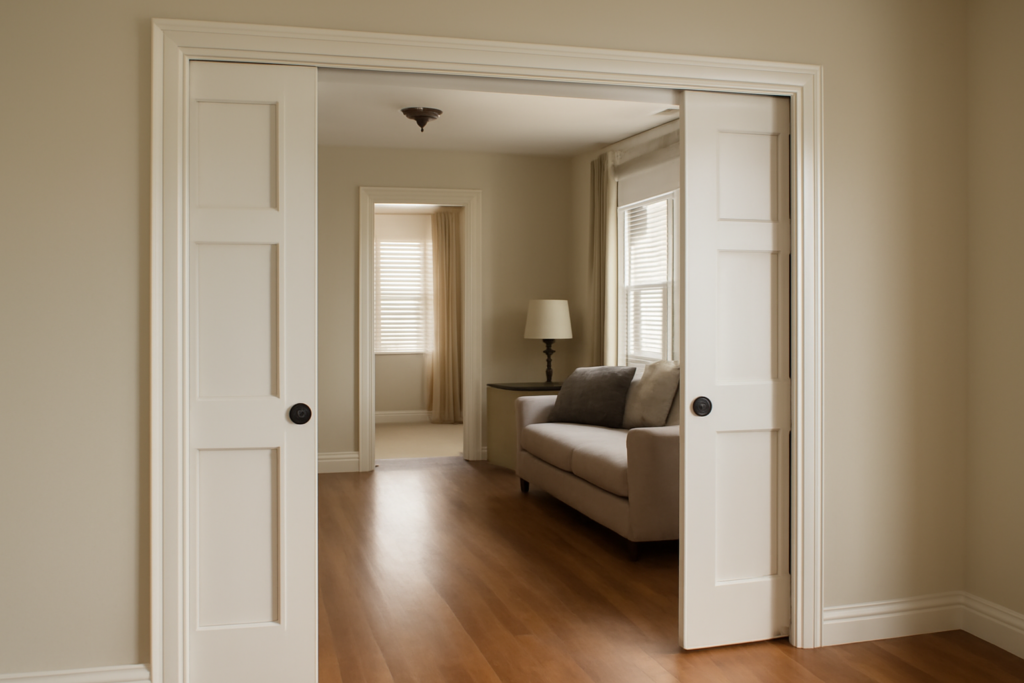
When a swinging door eats up floor space you cannot spare, a double pocket door is often the smartest fix. Two panels slide in opposite directions into hollow cavities inside the wall, meeting in the middle to close and disappearing entirely when open. The result is a wide, clean opening, commonly five to eight feet, with no door arc to plan furniture around. Homeowners use them for primary bedroom entries, home offices, dining rooms, and to separate a great room from a kitchen.
Part of our Windows & Doors guide — explore the full guide →
This guide covers how the system works, the framing and wall thickness it requires, realistic costs, hardware choices, and the installation details that separate a whisper-smooth door from one that rattles, sticks, or sags within a year.
- How a Double Pocket Door Works
- Wall and Framing Requirements
- Typical Costs
- Choosing Hardware That Lasts
- Installation Overview
- Common Problems and Fixes
- Design Advantages and Trade-offs
- Where Double Pocket Doors Work Best
- Sound and Privacy Considerations
- Is a Double Pocket Door Right for You?
- Frequently Asked Questions
How a Double Pocket Door Works
Each panel hangs from rollers that ride an overhead track mounted inside a steel-reinforced frame called the pocket. When you slide a panel open, it slides sideways into the hollow wall cavity built to receive it. In a double, or “converging,” configuration, two separate pockets sit on opposite sides of the opening, and the panels travel toward each other to close. A pull or edge latch lets you draw them shut, and many systems include a soft-close damper so the panels glide to a stop instead of slamming.
Because the panels vanish into the wall, you cannot hang anything, run plumbing, or place an electrical box in that section of wall. That single constraint drives most of the planning decisions.
Wall and Framing Requirements
The pocket needs a wall at least as long on each side as the door is wide. A pair of 36-inch panels making a 72-inch opening therefore requires roughly 36 inches of solid pocket wall on each side, so plan for about 12 feet of continuous wall to house a 6-foot double opening. That is why pocket doors work beautifully in some rooms and are impossible in others.
Standard pocket frames are built for 2×4 walls, producing a finished wall about 4.5 inches thick. The split-jamb steel-and-wood frame kits from Johnson Hardware or the all-in-one units from L.E. Johnson and Cavity Sliders bolt together to create the two hollow cavities. Because both faces of that wall are essentially furring over a steel frame, you cannot mount heavy cabinets, grab bars, or a wall-hung TV on the pocket section. If you need wiring for a switch, it must route around the pocket, which your electrician should confirm before framing closes up.
Typical Costs
A double pocket door project has three cost buckets: the frame kit, the door panels, and labor.
- Frame kits: A quality converging double-pocket frame kit runs $250 to $600, more for commercial-grade or 100-plus-pound-rated hardware.
- Panels: Hollow-core doors start near $40 each; solid-core doors, which feel and sound far better, run $120 to $300 each; glass or specialty panels can exceed $500 apiece.
- Labor: Installing into a new, open wall costs roughly $400 to $900 in labor. Retrofitting into an existing finished wall means opening drywall, possibly relocating wiring, and rebuilding the wall, which pushes total project cost to $1,500 to $4,000 or more.
All-in, budget around $700 to $1,500 for a double pocket door during new construction or a remodel where the wall is already open, and considerably more for a retrofit into a load-bearing or wired wall.
Choosing Hardware That Lasts
The single most important upgrade is the roller and track quality. Cheap builder-grade rollers are the usual reason a pocket door starts to drag or jump the track. Look for frames rated for the actual weight of solid-core panels, ball-bearing steel rollers, and an adjustable hanger bolt so you can fine-tune panel height after installation. Soft-close dampers, once a luxury, are now widely available and dramatically improve the feel of a double door where the panels meet.
For the meeting point, a double door uses either a pair of edge pulls or a mortise privacy latch designed for converging panels. If the door is for a bathroom or bedroom, specify a privacy-latch kit up front; retrofitting a lock into a hung pocket panel is fussy.
Installation Overview
Even if you hire out the job, understanding the sequence helps you catch problems early.
- Rough opening: Frame a header sized to span the full double opening plus both pockets. This header often needs to be engineered because it spans a wide gap; a structural review is wise on load-bearing walls.
- Set the frames: Assemble and plumb both pocket frames, shimming until the split studs are dead vertical. A frame that leans even slightly will let panels drift open or closed on their own.
- Level the track: The overhead track must be perfectly level. Any slope makes gravity slide the panels toward the low end.
- Drywall and trim: Use the shorter screws supplied with the kit so you never puncture a panel hiding inside the wall.
- Hang and adjust: Mount the panels on their rollers, then use the adjustment bolts to set an even reveal where they meet and a consistent gap at the floor.
Common Problems and Fixes
The complaints homeowners voice about pocket doors almost always trace back to installation shortcuts. A door that drags on the floor usually means the rollers need height adjustment or the track was not leveled. A door that will not stay closed points to an out-of-plumb frame. Rattling in the pocket is typically a missing or worn guide at the bottom of the opening; inexpensive nylon floor guides keep the panel from swinging as it slides.
Because the rollers live inside the wall, repairs are harder than on a swinging door, which is exactly why buying a quality frame and having it installed correctly the first time pays off. Many modern kits now include a removable access panel or a design that lets you drop a panel out for service without demolishing drywall; ask about serviceability before you buy.
Design Advantages and Trade-offs
The upside is dramatic. A double pocket door opens a room fully to an adjacent space, floods it with light and air, and removes the visual and physical bulk of two swinging slabs. Closed, it reads as a clean, symmetric wall feature. Glass panels turn it into a light-sharing partition between an office and a hallway.
The trade-offs are real too. Sound isolation is weaker than a solid swinging door because of the gaps around a sliding panel, though a solid-core panel with brush weatherstrip narrows the difference. You permanently give up the pocket walls for hanging or mounting anything. And a retrofit into an existing wall is genuine construction, not a weekend swap.
Where Double Pocket Doors Work Best
Certain rooms are made for this hardware. A primary bedroom that opens to a sitting area or a spa-style bathroom benefits from the wide, symmetric opening a double door creates, letting the spaces flow together when open and closing off for privacy at night. Dining rooms that connect to a kitchen are another classic application, since a double door lets you hide holiday cooking mess during the meal, then throw both panels open for an airy, connected feel the rest of the year.
Home offices carved out of a larger room are increasingly common, and a glass-panel double pocket door borrows light from the main space while muffling video-call noise. Even a butler’s pantry or a home library gains a sense of occasion from a pair of panels that vanish into the walls. The common thread is a room where you want the option of full openness and full closure without a permanent door swing eating into the floor plan.
Sound and Privacy Considerations
Because two sliding panels meet in the middle, a double pocket door has more edges to seal than a single door, and sound leaks through gaps more than through a solid slab. If the door separates a bedroom or bathroom where quiet matters, specify solid-core panels, add brush or bulb weatherstripping at the meeting stiles and along the jambs, and choose a mortise privacy latch that pulls the panels tightly together when closed. These upgrades will not match the dead silence of a heavy swinging door, but they close most of the gap and are well worth the modest added cost on any bedroom or bath installation.
Is a Double Pocket Door Right for You?
Choose a double pocket door when you have the wall length, want a wide barrier-free opening, and value the space you reclaim from a door swing. It shines in open-concept homes, primary suites, and rooms that flex between open and private. Invest in a heavy-rated frame, solid-core panels, and soft-close hardware, and have the frame set plumb and the track set level. Get those fundamentals right and a double pocket door delivers decades of smooth, space-saving service while looking like a deliberate architectural feature rather than an afterthought.
Frequently Asked Questions
How much wall do you need for a 48-inch double pocket door?
A 48-inch double pocket door uses two 24-inch panels, so each side needs at least 24 inches of pocket wall. Plan on roughly 8 feet of clear, continuous wall in total, plus a little extra for framing at the ends. That stretch of wall must be free of plumbing, ductwork, and electrical boxes.
Can you use glass French doors as double pocket doors?
Yes. Glass-paneled French doors are a popular choice for double pocket openings because they share light between rooms. Glass panels are heavier than hollow-core doors, so choose a frame and rollers rated for their weight, and use safety glazing, which building codes require for glass in doors. Brush seals at the meeting stiles help reduce rattling and drafts.
What is the difference between a converging and a bypass double pocket door?
Converging, or bi-parting, pocket doors have two pockets on opposite sides of the opening, and the panels meet in the middle. A bypass double pocket door stacks both panels on parallel tracks so they slide into one pocket on the same side. Bypass systems need a thicker wall to hold two panels side by side but use less wall length.
Can both panels of a double pocket door open at the same time?
Yes, with synchronizing hardware. Some converging pocket door kits offer a sync add-on that links the two panels with a cable, so pulling one panel moves the other the same distance. Without it, each panel slides independently. Synchronized systems need a carefully leveled track and plumb frame to run smoothly.