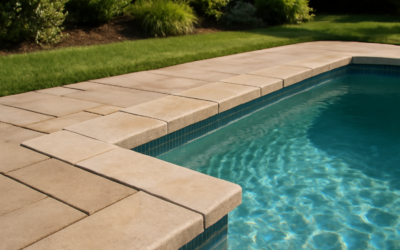
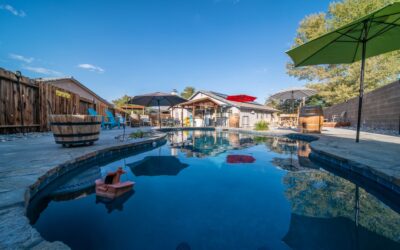
The edge that caps your pool wall does more work than any other piece on the deck. It takes the abuse of wet feet, pool chemicals, blazing sun, and the occasional dropped cooler, all while being the first thing your eye lands on. Porcelain pool coping has quietly become my go-to recommendation for that edge because it holds up to everything a backyard can throw at it while staying cool and comfortable underfoot. In this guide I will break down the profiles, the slip and heat performance, real costs, and how it gets installed so you can decide if it belongs around your pool.
Part of our Tile & Grout guide — explore the full guide →
What Pool Coping Actually Does
Coping is the finished cap that sits on top of the pool’s structural bond beam, bridging the gap between the pool shell and the surrounding deck. It caps the raw concrete edge, hides the waterline tile joint, and directs splash-out away from the pool structure rather than letting water seep behind the shell. Done right, it also gives swimmers a comfortable, grippy ledge to grab and pull themselves out.
For decades that edge was poured concrete, brick, or natural stone like travertine and limestone. Porcelain is the newer player, and it earns its place because it solves the two biggest complaints about stone: it does not absorb water and stain, and it does not need annual sealing. That combination is why I keep specifying it on remodels.
Coping Profiles: Bullnose and Drop-Edge
The profile is the shape of the coping’s outer edge, and it changes both the look and the feel of the pool. A bullnose profile has a rounded, radiused edge that is gentle on hands and thighs when you climb out. It is the classic, softer look and the safest choice for homes with kids because there is no sharp corner to catch a knee.
A drop-edge profile, sometimes called an ogee or a rebated edge, has a lip that hangs down over the pool wall, creating a crisp shadow line and a more contemporary, architectural feel. Drop-edge units are typically porcelain pieces manufactured with an L-shaped return, so the vertical face conceals the bond beam completely. Both profiles are widely stocked in porcelain in a common 12 by 24-inch format with the finished edge on one long side.
There is also a straight or square-edge profile for the most modern designs, but I steer families away from it around a swimming pool because a sharp 90-degree corner at the waterline is unforgiving. If you want the clean modern look with a little mercy, a micro-radiused bullnose splits the difference nicely.
Slip Resistance and Barefoot Comfort
Slip resistance is where porcelain pool coping really has to prove itself, because a pool edge is wet by definition. Look for coping rated with a high DCOF, ideally 0.42 or higher, and for outdoor pool use I push clients toward the R11 or R12 slip ratings you see on structured, textured surfaces. Those grippy finishes bite even when the deck is soaked and covered in sunscreen.
The trade-off with an aggressive texture is that it can feel rough on bare feet and is a little harder to scrub. In practice, a good R11 porcelain coping is a comfortable middle ground: grippy when wet, still pleasant to walk on dry. Avoid polished porcelain anywhere near the water. Save the glossy stuff for indoor floors.
Heat and UV Performance
Anyone who has hopped across a dark stone deck in July knows heat matters. Porcelain in lighter colors, sand, gray, and off-white, stays noticeably cooler than dark travertine or bluestone under direct sun, which keeps the coping walkable at midday. Darker porcelain absorbs more heat, so if your pool bakes in full afternoon sun, lean toward lighter tones.
On the UV front, porcelain is essentially bulletproof. The color is fired into the body of the tile at over 2,000 degrees, so it will not fade, chalk, or yellow after years of sun exposure the way some sealed or dyed surfaces can. It is also freeze-thaw stable when the material is rated frost-proof, which matters if your winters drop below freezing. A quality porcelain coping absorbs less than 0.5 percent water, so there is no moisture inside to freeze and spall the edge.
Cost Per Linear Foot
Coping is priced by the linear foot, and porcelain lands in a reasonable middle of the market. Expect the porcelain coping material itself to run $15 to $40 per linear foot, with drop-edge and custom-profile pieces at the higher end because of the extra fabrication. Bullnose stock pieces sit at the lower end.
Installed, including demolition of the old coping, mortar, labor, and grout, most homeowners pay $40 to $80 per linear foot. A typical residential pool has roughly 70 to 90 linear feet of coping, so a full replacement often falls between $3,000 and $7,000 depending on your region and how much prep the bond beam needs. Compared with travertine at $30 to $60 installed but with lifetime sealing costs, porcelain’s zero-maintenance nature usually wins over a ten-year horizon.
Installing Porcelain Coping Over Concrete
Most porcelain pool coping goes down over the existing concrete bond beam using a polymer-modified thinset mortar rated for exterior and submerged-adjacent use. The installer grinds and cleans the beam, dry-lays the pieces to plan the layout and cuts, then sets each unit in a full bed of thinset with the finished edge slightly overhanging the pool wall to create a proper drip line.
Two details separate a job that lasts from one that fails. First, the expansion joint: a flexible, backer-rod-and-sealant joint must run between the coping and the pool shell so seasonal movement does not crack the units. Second, the grout: use a high-performance or epoxy grout at the joints because standard cement grout struggles against chlorine and constant wet-dry cycling. Cutting porcelain also demands a wet saw with a diamond blade rated for porcelain, since the material is dense and will chew up a cheap blade.
This is a project many handy homeowners can do, but the tolerances are tight and a mistake sits at eye level around your whole pool. If your beam is out of level or you are running a drop-edge profile, I would hire a tile setter who has done pools before.
Porcelain vs. Travertine and Natural Stone
Travertine and natural stone still have their fans, and I get it, the organic look is beautiful. But stone is porous. It stains from leaves, sunscreen, and metals in the water, and it needs resealing every one to three years to stay that way. Skip the sealing and you get a blotchy, weathered edge within a few seasons.
Porcelain sidesteps all of that. It never needs sealing, resists chemical stains, and holds its color for decades. The main knock against it is that individual pieces can chip on a hard impact and cannot be sanded smooth the way stone can, and the manufactured look is a touch more uniform than natural stone’s variation. For most families who want a great-looking edge they can forget about, porcelain pool coping is the smarter long-term buy, and that is the honest recommendation I give in the field.
Is It Right for Your Pool?
If you value low maintenance, consistent color, and a cool, slip-safe surface, porcelain coping is hard to beat. If you are chasing a rustic, one-of-a-kind stone character and do not mind the upkeep, natural stone may still call to you. Either way, insist on a frost-proof, R11-rated product, a proper expansion joint, and epoxy grout. Nail those three, and your coping will look sharp and stay safe for the life of the pool.
Prefer to explore on your own?
See how new flooring looks in your actual room in seconds — free, no signup.
Try the free Floor Studio →