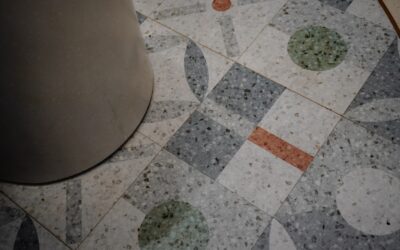
Seamless, monolithic, joint-free — these are the buzzwords contractors use when they pitch a poured floor, and they describe a category that includes everything from $3 per sq ft garage epoxy to $45 per sq ft custom terrazzo. Poured flooring types share one defining trait: they arrive as a liquid, cure into a solid, and leave behind a continuous surface without tile grout lines or plank seams. Knowing which chemistry fits your space matters far more than picking a color. Each system has a service environment where it shines and another where it fails fast.
The Major Poured Floor Categories
- Epoxy resin: Industrial and residential workhorse, $3 to $12 per sq ft installed
- Polyaspartic and polyurea: Fast-cure topcoats, $5 to $9 per sq ft
- Urethane cement: Heavy-industrial systems for food plants and breweries, $9 to $18 per sq ft
- Methyl methacrylate (MMA): Cold-temperature installs, $10 to $20 per sq ft
- Decorative terrazzo: Aggregate-and-resin, $18 to $45 per sq ft
- Cementitious overlays: Microtopping and self-leveling, $4 to $14 per sq ft
Epoxy: The Default Choice
Epoxy is the most common poured flooring because it balances cost, durability, and aesthetic options. A typical 100% solids epoxy at 8 to 16 mils cures in 18 to 24 hours and tolerates chemical spills, vehicle traffic, and constant foot wear. Color flakes, metallic pigments, and quartz broadcasts let you customize the look without changing the base chemistry.
The weakness is UV stability. Standard epoxy yellows under direct sunlight within 12 to 24 months, which is why outdoor installs and sunroom floors should always finish with a UV-stable polyaspartic topcoat.
Polyaspartic and Polyurea Topcoats
These fast-cure systems install in a single day and tolerate sub-freezing temperatures during application — a major win for unheated garages and exterior pads. They resist UV yellowing, stay flexible enough to span minor concrete cracks, and accept the same color flakes that epoxy does.
The pot life is brutally short. Many polyaspartics flash off in 15 to 25 minutes once mixed, so this is not a DIY-friendly system. Hire a crew with the right squeegees, rollers, and experience pacing the install, or you will end up with lap marks and pinholes everywhere.
Urethane Cement for Brutal Service
If the floor will see boiling water, animal fats, lactic acid, or 250 degree thermal shock, urethane cement is the answer. Sikafloor PurCem and BASF Ucrete are the gold-standard systems used in dairy plants, breweries, and commercial kitchens. They cost more than epoxy but tolerate conditions that destroy every other resin in months.
For residential and light-commercial work, this is overkill. Unless you are pouring a home cheese cave or a kitchen prep area for catering, stick with epoxy or polyaspartic.
Terrazzo: The Designer Pour
Modern epoxy terrazzo combines an aggregate of marble chips, glass, or recycled stone with a pigmented resin matrix. The result is a heirloom floor that lasts 50+ years with minimal maintenance. Hospitals, airports, and high-end retail use terrazzo because it cleans easily, hides traffic patterns, and accepts unlimited custom patterns through divider strips.
The price tag is the main barrier. Materials alone run $9 to $18 per sq ft, and installation requires specialty grinders that not every flooring contractor owns. Budget $25 to $45 per sq ft turnkey for residential work, and expect a 2 to 3 week install timeline on a typical foyer or kitchen.
Pros of Going Poured
- Seamless surface eliminates grout lines that trap dirt and bacteria
- Customizable color, sheen, and aggregate mix to fit any aesthetic
- Long service life — 15 to 50+ years depending on the system
- Easy cleaning with mild detergent and a microfiber pad
- Chemical and stain resistance that no carpet or wood can match
- Adds 1/8 to 1/4 inch to floor height, minimal transition issues at doorways
Honest Drawbacks
Poured floors transmit cold and noise. Without radiant heat underneath, a resin floor in a Minnesota basement reads like walking on a 55 degree surface in February. Throw rugs and area carpets are almost mandatory in residential spaces.
Repair is also tricky. A scratch in hardwood can be sanded out. A divot in epoxy requires a chemical bond patch that may show against the surrounding cured resin. Choose colors and finishes that hide flaws — flake and quartz systems are far more forgiving than solid-color pours.
Substrate Preparation Is Everything
Every resin system fails when the prep is wrong. The concrete subfloor needs to be diamond-ground to a CSP-2 or CSP-3 profile, fully degreased, and dried below 4 lb per 1,000 sq ft per 24 hours of moisture vapor emission. Skip any one of those steps and the resin will bubble, fish-eye, or delaminate within a year.
For older slabs, plan on a moisture mitigation primer like Koster VAP-I 2000 or Mapei Planiseal VS before the main system. The extra $1.50 to $2.50 per sq ft beats tearing up a failed floor at $4 per sq ft.
Maintenance That Maximizes Lifespan
Sweep or dust-mop daily in high-traffic zones. Damp-mop weekly with a neutral pH cleaner like ProEpoxy Spray Cleaner or a 1:40 dilution of Dawn dish soap. Avoid acidic cleaners, which etch some resin chemistries, and avoid harsh solvents that can soften the top coat.
Plan a topcoat refresh every 5 to 10 years on high-traffic floors. A fresh polyaspartic clear at 4 to 6 mils restores the sheen and reseals microscratches without a full tear-out. Budget $1.50 to $3.00 per sq ft for that refresh — cheap insurance on a 30-year floor.
Prefer to explore on your own?
See how new flooring looks in your actual room in seconds — free, no signup.
Try the free Floor Studio →