
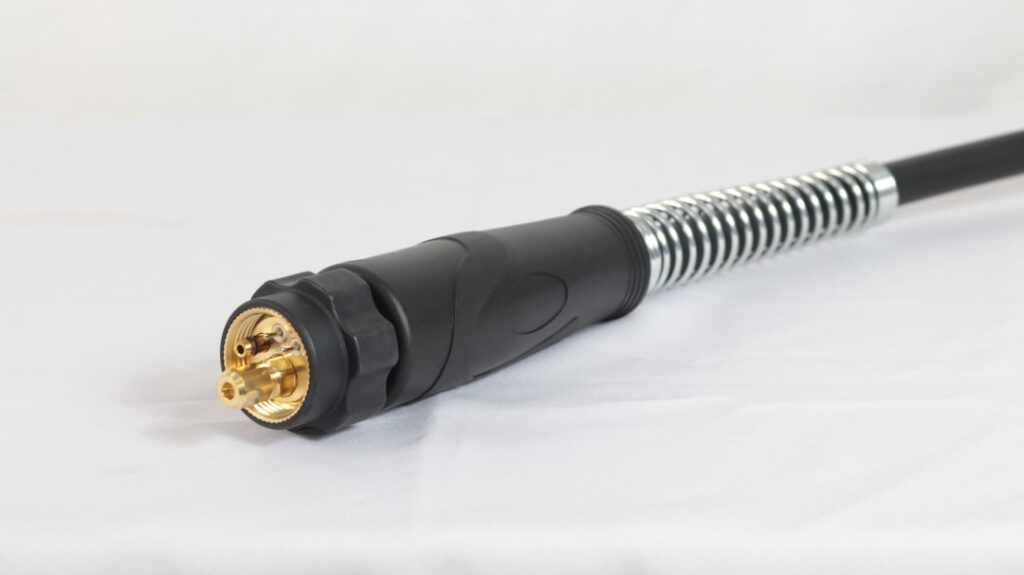
The pressure washer spray gun is the part you actually hold and control, and it takes more wear than any other component on the machine. When it leaks, sticks, or cracks, the whole unit becomes miserable to use even if the pump is perfect. Choosing the right pressure washer spray gun and knowing how its fittings work lets you replace a worn one for $20 instead of buying a new washer, and it lets you upgrade to a more comfortable, higher-flowing gun.
A spray gun is essentially a high-pressure on/off valve with a trigger. Water enters from the hose, and squeezing the trigger opens the valve to send it out to the wand and nozzle.
- How a Spray Gun Works
- Trigger Gun vs Pistol Grip vs Comfort Grip
- Understanding the Fittings
- Matching PSI and GPM
- Top Picks and Prices
- Common Problems and Fixes
- Adding Extensions and Accessories
- Care and Winterizing
- Understanding the Wand and Lance
- The Five-Nozzle Color System
- Testing a New Gun Before Full Use
- Bottom Line
How a Spray Gun Works
Inside the gun, the trigger presses a plunger against a spring-loaded valve. At rest, the valve is closed and no water passes. Squeeze it, and the valve opens to let pressurized water flow to the lance. Release, and the valve snaps shut, which is why a good gun stops flow instantly and holds pressure without dribbling.
Because that valve cycles thousands of times and seals against high pressure, its internal seat and O-rings are the parts that eventually wear and leak. On most consumer guns the valve is sealed, so a worn gun is replaced rather than rebuilt.
Trigger Gun vs Pistol Grip vs Comfort Grip
Guns come in a few ergonomic styles. The difference matters most during long cleaning sessions.
- Standard trigger gun: the pistol-grip on most machines; simple and cheap
- Comfort/ergonomic grip: padded, contoured handle that reduces hand fatigue on big jobs
- Trigger-lock guns: include a safety lock to prevent accidental discharge
- Insulated/high-flow guns: larger internal passages for high-GPM gas machines
If you clean for more than 20 minutes at a stretch, a comfort-grip gun is a worthwhile upgrade. Hand fatigue from squeezing a stiff trigger is the most common complaint on long driveway or siding jobs.
Understanding the Fittings
A spray gun has two connections, and matching them is the whole game when buying a replacement.
- Inlet (hose side): commonly M22-14mm threaded or 3/8-inch quick-connect on gas machines
- Outlet (wand side): usually a 1/4-inch quick-connect plug, sometimes M22
Before ordering, identify both ends of your current gun and both mating parts. A photo of each fitting prevents a mismatch. Many universal guns ship with an M22-to-quick-connect adapter so they fit either standard, which is the safest choice if you are unsure.
Matching PSI and GPM
A spray gun is rated for a maximum pressure, and using an underrated gun is dangerous. Always buy a gun rated above your machine’s output.
- Electric washers (up to 2,000 PSI): most consumer guns are fine
- Mid gas (2,000-3,200 PSI): choose a gun rated 3,000+ PSI
- Heavy gas (3,300-4,400 PSI): use a gun rated 4,000+ PSI with high-flow internals
GPM matters too on powerful machines. A gun with narrow internal passages chokes a high-flow pump, so match a 3+ GPM gas washer with a high-flow gun rated for that volume.
Top Picks and Prices
Universal guns from several makers fit most machines. Prices in USD reflect the 2026 season.
- Simpson Universal Spray Gun: about $25-$40, rated to 4,500 PSI, includes adapters
- Tool Daily Heavy Duty Gun: around $20-$30, ergonomic, common quick-connect fittings
- M MINGLE Trigger Gun with extension: roughly $25-$35, bundled with a short lance
- YAMATIC High-Flow Gun: about $30-$45 for high-GPM gas units
- OEM replacement (brand-specific): $30-$60 through the manufacturer
A quality universal gun is usually the better buy than the OEM part, since it costs less and often includes both M22 and quick-connect adapters to fit almost any machine.
Common Problems and Fixes
Most gun trouble is one of three things.
- Leaking at the trigger: a worn internal valve; replace the gun, as the valve is not serviceable on consumer models.
- Stiff or stuck trigger: grit or corrosion in the valve; flush with clean water and, if it persists, replace.
- Leaking at a fitting: a missing or torn O-ring on the quick-connect, or under-tightened M22 threads; replace the O-ring or snug the connection.
Never operate a gun that leaks at the trigger under full pressure or one whose trigger sticks open, since a gun that will not shut off is a safety hazard.
Adding Extensions and Accessories
The gun’s quick-connect outlet is the gateway to a whole accessory system. Once you have a standard 1/4-inch quick-connect gun, you can attach:
- Variable-angle nozzles or a color-coded five-nozzle set (0, 15, 25, 40 degrees, and soap)
- A surface cleaner for driveways and patios
- Telescoping wands for second-story siding and gutters
- Foam cannons for car washing
- Angled and undercarriage lances
Standardizing on quick-connect makes swapping between these tools a one-second click, which is the biggest practical reason to keep your gun and wand on the universal system.
Care and Winterizing
A spray gun lasts for years with minimal care. After each use, turn off the machine and squeeze the trigger to release stored pressure, which relieves strain on the valve. Before winter, run pump antifreeze or blow the water out so nothing freezes and cracks the housing. Keep the quick-connect O-rings lightly greased with silicone and store the gun indoors out of the sun.
Understanding the Wand and Lance
The spray gun connects to a wand (also called a lance), and together they determine reach and nozzle options. It helps to know the common wand types when you build out your setup.
- Standard straight lance: 15-16 inches, the default for most cleaning
- Telescoping wand: extends to 12-24 feet for second-story siding, gutters, and soffits
- Angled/gutter wand: a U-bend to reach up and over into gutters and under eaves
- Undercarriage wand: a flat lance for cleaning under vehicles and decks
- Short trigger-gun lance: a compact combo for tight, close work like wheels
All of these connect to a standard 1/4-inch quick-connect gun, which is the main reason to standardize your gun on that system. Once you do, any wand and nozzle in the ecosystem clicks straight on.
The Five-Nozzle Color System
Most spray guns pair with a set of color-coded quick-connect nozzles, and choosing the right one protects both your cleaning results and the surface.
- Red (0 degrees): a pinpoint jet, extremely aggressive; rarely needed and can damage surfaces
- Yellow (15 degrees): heavy stripping for concrete and stubborn grime
- Green (25 degrees): the general-purpose all-rounder for most washing
- White (40 degrees): a gentle wide fan for cars, siding, and delicate surfaces
- Black (soap/65 degrees): low-pressure tip that draws detergent from the tank
Keep the green and white tips within reach for everyday work, and treat the red 0-degree tip with caution, since it concentrates all the machine’s force into a tiny point that can etch concrete or cut through wood and skin.
Testing a New Gun Before Full Use
After installing a replacement gun, do a quick function check before a real job. Connect the water, run the machine, and squeeze the trigger to confirm a clean on and instant shutoff with no dribble. Watch the fittings for weeping, which points to a missing O-ring or an under-tightened M22 thread. Confirm the trigger returns crisply and locks (if it has a safety catch). A two-minute test catches a bad seal before you are halfway up a ladder cleaning siding.
It is also smart to keep the original gun as a backup once you install a replacement. A spare gun costs you nothing extra since you already own it, and having one on the shelf means a leaking trigger never sidelines the machine mid-project. Store it somewhere dry with the fittings capped so grit stays out of the internals.
Bottom Line
A pressure washer spray gun is a cheap, easy replacement that transforms a leaky, frustrating machine back into a pleasure to use. Match both fittings and buy a gun rated above your machine’s PSI, choose a comfort grip if you clean for long stretches, and standardize on quick-connect so every nozzle and accessory clicks right on. A $25 universal gun with adapters solves nearly every gun problem homeowners run into.


