
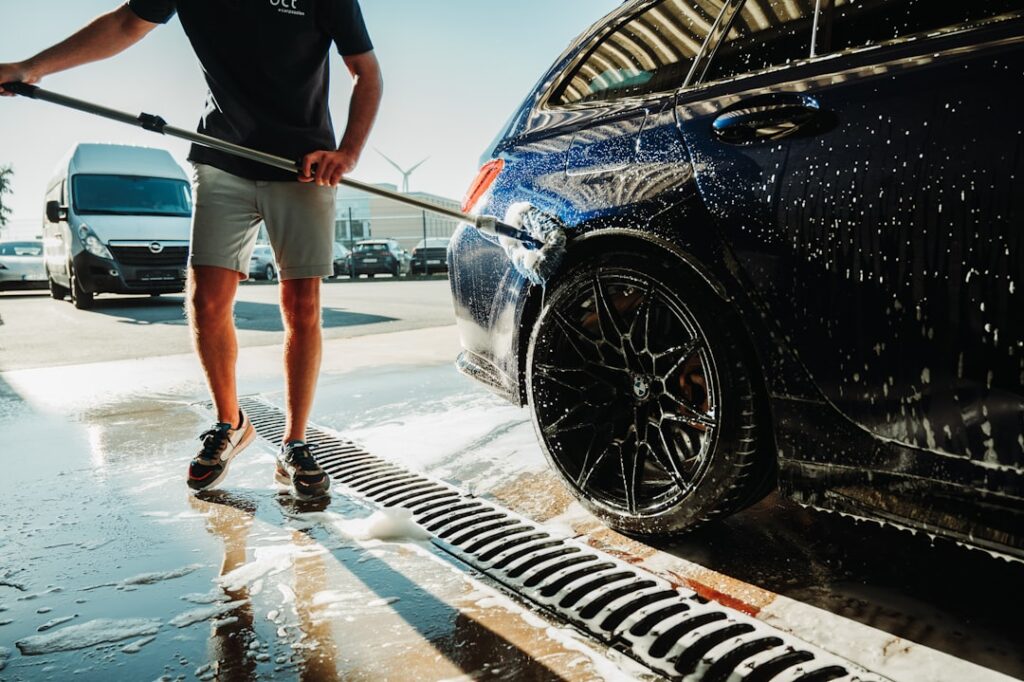
If you have ever spent two hours zig-zagging a spray wand across a driveway and still ended up with tiger stripes, a pressure washer surface cleaner attachment will change how you clean flat surfaces forever. This spinning-bar disc glides over concrete, pavers, and patios to deliver an even, streak-free clean in a fraction of the time. Picking the right pressure washer surface cleaner attachment comes down to matching it to your machine’s power and your typical cleaning area.
The tool works by enclosing two or more spinning nozzles inside a shroud. The nozzles rotate on an arm, laying down overlapping passes that eliminate the streaking you get from a single wand nozzle, while the shroud contains overspray and flying debris.
- How a Surface Cleaner Works
- Match It to Your Machine's PSI and GPM
- Diameter: Bigger Is Not Always Better
- Housing Material and Build
- Top Picks and Prices
- How to Use It for a Streak-Free Finish
- Maintenance
- Where It Shines and Where It Does Not
- Understanding the Nozzles Inside
- Common Problems and Fixes
- Surface-Specific Technique
- Bottom Line
How a Surface Cleaner Works
Water enters through the handle and splits to two or four nozzles mounted on a rotating bar inside the housing. The reaction force from the angled jets spins the bar, so the nozzles sweep a full circle as you walk forward. Because every square inch gets hit at the same distance and angle, the result is uniform with no wand marks.
Casters or a skirt hold the nozzles at the perfect height off the surface, taking the guesswork out of standoff distance. You simply push it along at a slow, steady walk and overlap each pass by a few inches.
Match It to Your Machine’s PSI and GPM
This is the step people skip, and it is the most important. A surface cleaner is sized to a pressure range, and an oversized cleaner on a weak machine spins slowly and cleans poorly. GPM (gallons per minute) drives the spin and cleaning speed even more than PSI.
- Electric washers (1,300-2,000 PSI, 1.2-1.6 GPM): use a small 10-12 inch cleaner rated for electric machines
- Light gas (2,000-2,800 PSI, 2.0-2.5 GPM): a 14-15 inch cleaner works well
- Mid gas (2,800-3,500 PSI, 2.5-3.0 GPM): 15-16 inch cleaners hit their stride here
- Heavy gas (3,500-4,400 PSI, 3.5-4+ GPM): 20-24 inch commercial cleaners cover ground fast
Never exceed the cleaner’s maximum PSI rating, and check that your GPM meets its minimum. A 20-inch cleaner on a 1.6 GPM electric barely turns; a 12-inch cleaner on a 4 GPM gas unit works but wastes the machine’s capacity on a narrow path.
Diameter: Bigger Is Not Always Better
Cleaning width determines how fast you finish, but a wider disc demands more flow and is harder to maneuver.
- 10-12 inch: light-duty, best for electric machines, small patios, and steps
- 15-16 inch: the sweet spot for most homeowner gas washers and typical driveways
- 20-24 inch: pro-grade, fast on large lots but heavy and thirsty on flow
For a standard two-car driveway and a mid-range gas washer, a 15-inch model is the practical best pick. It clears the area quickly yet still tucks into corners and up walkway edges.
Housing Material and Build
Surface cleaners come in plastic, aluminum, and stainless steel housings. Plastic is lightest and cheapest but can crack; stainless and aluminum resist corrosion and last for years of heavy use. Look for stainless nozzle arms and dual swivel bearings, which are the parts most likely to wear.
Casters versus a brush skirt is another choice. Casters roll smoothly on flat concrete; a nylon brush skirt handles slightly uneven pavers and contains spray better but drags more. Many homeowners prefer casters for driveways and skirts for textured patios.
Top Picks and Prices
Prices in USD reflect the 2026 season for common consumer models.
- Simpson 15-inch Universal: around $75-$100, stainless, fits most gas washers to 3,700 PSI
- Sun Joe SPX-PWSC 10-inch: about $40, sized for electric machines
- Karcher 15-inch T-Racer: roughly $80-$120, integrates with Karcher bayonet fit
- BE Whirl-A-Way 14-inch: about $70-$90, a durable homeowner favorite
- Commercial 20-inch stainless: $130-$200 for large-property use
Confirm the connection type before buying. Most use a 1/4-inch quick-connect plug that mates to your gun’s lance, but some need an M22 adapter. Keep a brass adapter on hand to bridge any mismatch.
How to Use It for a Streak-Free Finish
- Sweep or blow off loose debris first so grit does not scratch under the shroud.
- Pre-treat stains with a concrete degreaser or a sodium hypochlorite cleaning solution for oil and organic growth.
- Connect the cleaner to your wand and confirm the nozzles spin freely by hand.
- Start at one edge and walk at a slow, steady pace, keeping the disc flat on the surface.
- Overlap each pass by 2-3 inches to avoid missed strips that show up as lines when dry.
- Work in one direction, then do a light perpendicular pass on stubborn areas.
- Rinse with the open wand to flush loosened dirt off the surface and out of joints.
Consistent walking speed is the secret. Moving too fast leaves haze; pausing too long can etch soft concrete or strip sealer. Practice your pace on an inconspicuous corner first.
Maintenance
A surface cleaner needs little care but rewards a quick post-use routine.
- Flush clean water through it after each use to clear grit from the swivel
- Check and clear the nozzles; a clogged jet makes the bar spin unevenly and leaves arcs
- Grease the swivel bearing annually per the maker’s instructions
- Store indoors so the plastic shroud and bearings do not degrade in the sun
Where It Shines and Where It Does Not
A surface cleaner excels on flat, hard, horizontal surfaces: concrete driveways, garage floors, sidewalks, pool decks, and paver patios. It is not the tool for walls, cars, vinyl siding, or delicate wood decks, where a fan-tip wand at lower pressure is safer. Keep the standard wand handy for vertical and detailed work.
Understanding the Nozzles Inside
The spinning bar carries two or four nozzles, and their orifice size is matched to your machine at the factory. This is why a surface cleaner is rated for a pressure and flow range rather than being truly universal. If a nozzle clogs or you replace one with the wrong size, the bar spins unevenly or the pressure drops.
Better surface cleaners use replaceable quick-connect nozzles inside, letting you swap in the correct orifice if you change machines or if one wears. Note the nozzle numbers stamped on them (for example, a 25040 is a 25-degree, size 4.0 orifice) so you can order exact replacements. Keep the two or four nozzles identical to each other, or the disc lays down uneven passes.
Common Problems and Fixes
Surface cleaners are simple, but a few issues crop up regularly.
- Bar spins slowly or not at all: a clogged nozzle, low GPM from the machine, or a gummed swivel bearing; clear the nozzles and flush the swivel
- Streaks or arc marks: one nozzle is partially blocked or a different size than the other; inspect and match them
- Uneven clean depth: the disc is not held flat, often a bent caster or worn skirt; level it out
- Water leaking from the top swivel: a worn swivel seal; rebuild kits are available for better models
- Machine bogs down: the cleaner is too large for your GPM; step down a size
Surface-Specific Technique
Different surfaces demand slight adjustments to protect them while still cleaning well.
- Concrete driveway: casters roll smoothly; a full-pressure pass is fine on cured concrete
- Pavers: a brush skirt bridges the joints better; go slower to avoid blasting out the joint sand, and re-sand afterward
- Stamped or sealed concrete: reduce pressure or raise the disc slightly so you do not strip the sealer
- Wood decks: generally skip the surface cleaner and use a fan tip at low pressure, since the spinning jets can gouge soft wood
- Pool decks and pavers with growth: pre-treat with a diluted sodium hypochlorite solution and let it dwell before cleaning
On soft or aged concrete, always test a hidden corner first. High-flow surface cleaners can etch weak surfaces if you pause or overlap too heavily.
Bottom Line
For anyone who cleans concrete more than once a year, a pressure washer surface cleaner attachment is the highest-value accessory you can buy. Match its diameter to your machine’s GPM, keep the nozzles clear, and walk at a steady pace, and you will finish a driveway in 20 minutes with a factory-even, streak-free result the wand alone can never match.


