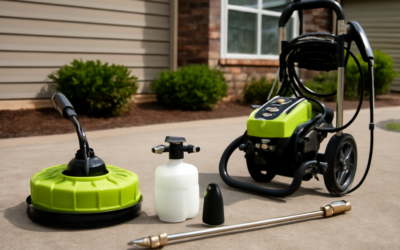
Anyone who has tried to clean a driveway with a bare pressure washer wand knows the pain: zebra stripes, an aching back, and an hour of walking backward. A pressure washer floor attachment, also called a surface cleaner, solves all three problems at once. It’s a spinning disc that houses two or more nozzles under a shroud, spreading the water evenly and cleaning a wide path in a single pass. Once you use one, you’ll never go back to swinging a wand across concrete.
How a Surface Cleaner Works
Inside the housing, a rotating bar carries two or three nozzle jets. Your pressure washer feeds high-pressure water to the bar, which spins from the reactive force of the angled jets, exactly like a lawn sprinkler. As the disc sweeps, it delivers overlapping fans of water to the surface at a consistent height and angle. That consistency is the whole trick, it eliminates the striping you get when a handheld wand’s distance and angle wander with every stroke.
The shroud does double duty. It contains the spray so you don’t soak yourself and the siding, and it captures dislodged grime and water, directing the splash downward instead of at your legs. Casters or a low skirt keep the nozzles at the perfect standoff distance automatically.
Matching the Attachment to Your Machine
This is where people waste money. A surface cleaner must be matched to your pressure washer’s output, measured in PSI (pressure) and GPM (flow). Buy one rated above your machine and it’ll spin weakly and clean poorly; buy one rated below, and you risk damaging it.
- Electric washers (1,300-2,000 PSI): use a small 11- to 12-inch plastic-housing cleaner. Expect modest results on light dirt.
- Gas washers (2,000-2,800 PSI): a 14- to 15-inch cleaner is the sweet spot for driveways and patios.
- Prosumer gas (3,000-4,000 PSI): a 16- to 24-inch steel-housing unit tackles big areas fast.
Check the attachment’s minimum GPM too. Many 15-inch cleaners want at least 2.5 GPM to spin properly. Your washer’s flow, not just its pressure, determines how fast the disc turns and how well it cleans.
Picking the Right Size
Bigger isn’t always better. A 15-inch cleaner covers ground quickly, but on a small electric machine it starves for flow and bogs down. Match the diameter to your GPM: a 2.0 GPM electric unit is happiest with a 11-inch head, while a 4.0 GPM gas machine can drive a 20-inch disc. For most homeowners with a gas washer around 2,800 PSI and 2.5 GPM, a 15-inch unit like the Karcher T-Series or a Simpson 15-inch cleaner hits the balance between speed and power.
Also confirm the connector. Most attach with a standard 1/4-inch quick-connect, but some units use an M22 threaded fitting, and a few premium washers use proprietary bayonet mounts. Buy the matching adapter up front so you’re not stranded.
What You Can and Can’t Clean
Surface cleaners are built for flat, hard, horizontal surfaces. They excel on:
- Concrete driveways, garage floors, and sidewalks
- Brick and concrete-paver patios
- Stone and stamped-concrete pool decks
- Composite and pressure-treated wood decks (on a lower-pressure machine)
Be careful with softer materials. On wood decking, keep pressure under about 1,500 PSI and test a hidden area first, or you’ll fuzz the grain. Skip surface cleaners on painted or sealed surfaces you want to keep, and never use one on vertical walls, siding, or delicate stone like polished marble. For those, go back to the wand with the right nozzle tip.
Using It the Right Way
Technique still matters, even with the tool doing the heavy lifting. Sweep loose debris first so the nozzles don’t clog. Start the machine before you lower the cleaner to the surface, and keep the unit moving in slow, overlapping passes, roughly 50 percent overlap, at a pace of about one foot per second. Moving too fast leaves faint lines; too slow can etch soft concrete.
For stubborn oil stains or heavy algae, apply a concrete degreaser or a cleaner with sodium hypochlorite, let it dwell for 5 to 10 minutes, then run the surface cleaner over it. On a two-car driveway of roughly 600 square feet, a 15-inch cleaner will cut your cleaning time from over an hour with a wand down to about 20 to 25 minutes, and the finish will be uniform instead of striped.
Maintenance and Longevity
These tools are simple, but a little upkeep keeps them spinning. After each use, flush clean water through the unit to clear grit from the swivel and nozzles. The rotating swivel bearing is the wear point; on cheaper plastic units it can fail after a couple of seasons, while a quality unit with a serviceable swivel lasts for years. Keep spare nozzle jets on hand, a worn or clogged nozzle throws off the spin and the clean.
Check the caster wheels and the splash skirt for wear, since a dragging skirt scratches soft surfaces. Store the attachment indoors so the seals don’t dry out and crack in freezing temperatures.
Is It Worth the Money?
Absolutely, for anyone with more than a small patch of concrete. Entry-level plastic surface cleaners for electric washers start around $30 to $50. A solid mid-range 15-inch unit runs $60 to $120, and pro-grade stainless steel cleaners with dual swivels go for $150 to $400. Compared with the cost of hiring a pressure-washing service at $0.15 to $0.30 per square foot, a good pressure washer floor attachment pays for itself after one or two driveways. Add in the saved time and the streak-free finish, and it’s one of the easiest upgrades a homeowner can make to their outdoor cleaning routine.
Plastic vs. Steel Housings
The housing material tells you a lot about who a cleaner is built for. Plastic-housing units are lighter, cheaper, and perfectly fine for a homeowner cleaning a couple hundred square feet a few times a year. They flex a bit and the swivels tend to be sealed and non-serviceable, so when the bearing wears you replace the whole unit. Steel and aluminum housings are heavier, which actually helps them sit flat and clean evenly, and their swivels are usually rebuildable with a cheap seal kit. If you’ll clean regularly or you run a machine over 3,000 PSI, the steel unit is the better long-term buy.
One overlooked detail is the brush skirt around the perimeter. A dense bristle skirt keeps spray contained and lets you work right up against a garage door or a wall without soaking everything. A worn or missing skirt is the usual reason a cleaner starts spitting grit back at you.
If the disc spins slowly or not at all, the culprit is almost always flow, either your machine doesn’t deliver enough GPM for the head size, or a nozzle is clogged with sediment. Pop the jets out, clear them with a nozzle-cleaning wire, and confirm your washer’s rated flow. If you see streaks or missed lines, you’re moving too fast or overlapping too little; slow down and aim for that 50 percent overlap. And if water sprays out the sides, check the skirt height and the caster wheels, a cleaner riding too high loses containment and cleaning power at the same time.
Prefer to explore on your own?
See how new flooring looks in your actual room in seconds — free, no signup.
Try the free Floor Studio →