A bathroom counter takes a daily beating from water, cosmetics, cleaning products, and humidity, so the surface you choose has to be tougher than it looks. Quartz bathroom countertops have become the most popular upgrade for exactly that reason: they pair the rich look of natural stone with a nonporous, low-maintenance surface that handles bathroom abuse without complaint. Engineered from roughly 90 percent ground quartz bound with resins, these countertops never need sealing, resist stains, and stay hygienic in a wet environment. This guide covers what they cost, how to choose one, and how they compare to other stone options.
Part of our Countertops guide — explore the full guide →
- What Makes Quartz Different
- Why Quartz Excels in Bathrooms
- Quartz Bathroom Countertop Costs
- Choosing Colors and Finishes
- Edge Profiles and Sink Choices
- Quartz vs. Granite vs. Marble
- Caring for Quartz Bathroom Countertops
- Quartz in Small vs. Large Bathrooms
- Coordinating Quartz With the Rest of the Bathroom
- Are Quartz Bathroom Countertops Worth It?
What Makes Quartz Different
Quartz countertops are engineered stone, not slabs quarried whole like granite or marble. Manufacturers grind natural quartz, mix it with polymer resins and color pigments, and cure it under pressure into dense, uniform slabs. That process creates a surface with no pores, which is the key to its bathroom performance. Where natural stone must be sealed to keep liquids out, quartz simply does not absorb water, makeup, or toothpaste, so spills wipe away and nothing soaks in.
Why Quartz Excels in Bathrooms
The bathroom is a demanding environment, and quartz answers its challenges well:
- Waterproof and nonporous: Constant moisture and splashing are no problem.
- No sealing needed: Unlike granite and marble, quartz never requires annual sealing.
- Stain-resistant: Hair dye, cosmetics, and toothpaste come off easily.
- Hygienic: The sealed surface resists bacteria and mold growth.
- Durable: Hard and scratch-resistant under everyday bathroom use.
- Consistent looks: The pattern in your sample is what arrives on the slab.
Quartz Bathroom Countertop Costs
Bathroom counters are smaller than kitchen runs, which keeps quartz affordable even at its premium positioning. General price guidance:
- Material installed: roughly $50 to $120 per square foot for most quartz.
- Standard vanity top: a single-sink bathroom counter often totals $300 to $900 installed.
- Double vanity or premium designs: can run $900 to $2,000 or more.
- Prefabricated quartz vanity tops in standard sizes offer a budget-friendly route.
Because bathroom counters use relatively little material, quartz is more attainable here than in a large kitchen, making it an easy way to add a high-end finish.
Choosing Colors and Finishes
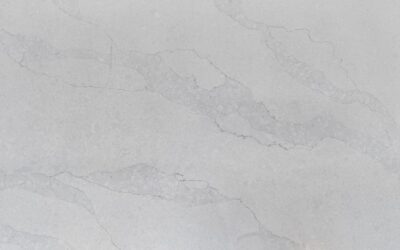
Quartz offers an enormous palette. Bright whites and light grays open up small bathrooms and read clean and modern. Marble-look quartz delivers dramatic veining without marble’s fragility, perfect for a spa feel. Warm beiges and taupes suit traditional spaces, and deep charcoals or blacks hide water spots while pairing with bold fixtures. Finishes range from a glossy polish that reflects light to a matte or honed surface for a softer, contemporary look. View a large sample in your bathroom’s actual lighting before deciding, since light shifts how color reads.
Edge Profiles and Sink Choices
Details set the tone of the finished vanity. Popular edge profiles:
- Eased or straight edge: Clean and modern, the most economical.
- Beveled: A subtle angled cut for definition.
- Bullnose: Softly rounded and family-friendly.
- Ogee: A decorative S-curve for traditional styling at higher cost.
For sinks, undermount bowls make wiping the counter easy with no rim to trap grime, drop-in sinks cost less, and integrated quartz or solid-surface bowls give a seamless, easy-clean look. Undermount and integrated options are the simplest to keep clean.
Quartz vs. Granite vs. Marble
Each stone has trade-offs in a bathroom. Granite is durable and unique but porous, so it needs periodic sealing and varies from slab to slab. Marble is stunning but soft and porous, prone to etching from acidic cosmetics and cleaners, which makes it high-maintenance in a bathroom. Quartz combines natural-stone beauty with no sealing, strong stain resistance, and excellent moisture performance, which is why it has overtaken both as the default choice for many bathroom remodels.
Caring for Quartz Bathroom Countertops
Maintenance is minimal. Wipe daily with mild soap and water or a gentle nonabrasive cleaner. Avoid harsh chemicals, abrasive pads, and bleach-heavy or high-pH products that can dull the resin over time. Quartz resists heat but is not heatproof, so rest hot styling tools like flat irons and curling wands on a heat guard rather than directly on the surface. With these simple habits, a quartz bathroom counter looks new for decades.
Quartz in Small vs. Large Bathrooms
The scale of your bathroom should influence the look you choose. In a small powder room or compact full bath, light-colored quartz with subtle or no veining keeps the space feeling open and bright, and a glossy finish bounces light around. In a large primary bathroom, you have room to make a statement with bold marble-look veining, a dramatic dark slab, or a double vanity in a single seamless run. Larger spaces also handle a longer backsplash or a full-height quartz wall behind the vanity, which reinforces the high-end feel. Either way, quartz scales gracefully because its consistent pattern looks intentional whether you have two feet of counter or twelve.
Coordinating Quartz With the Rest of the Bathroom
A vanity top does not exist in isolation, so coordinate it with your tile, cabinetry, and fixtures. A white or light gray quartz pairs cleanly with almost anything, which is why it is so popular for resale-friendly remodels. Warm-toned quartz complements wood-tone vanities and brass fixtures, while cool grays and crisp whites suit painted cabinets and chrome or matte black hardware. Pull a quartz sample alongside your tile and paint chips in the actual bathroom light before committing. Getting the undertones to agree is what makes a bathroom feel designed rather than assembled from separate decisions.
Are Quartz Bathroom Countertops Worth It?
For a bathroom, quartz is hard to beat. It shrugs off water, stains, and humidity, never needs sealing, stays hygienic, and offers a huge range of looks from crisp white to convincing marble. The upfront cost is higher than laminate or cultured marble, but the durability and low maintenance make it a smart long-term investment in a room where moisture punishes lesser materials. For most homeowners remodeling a bathroom, quartz bathroom countertops deliver the best balance of beauty, performance, and value.