
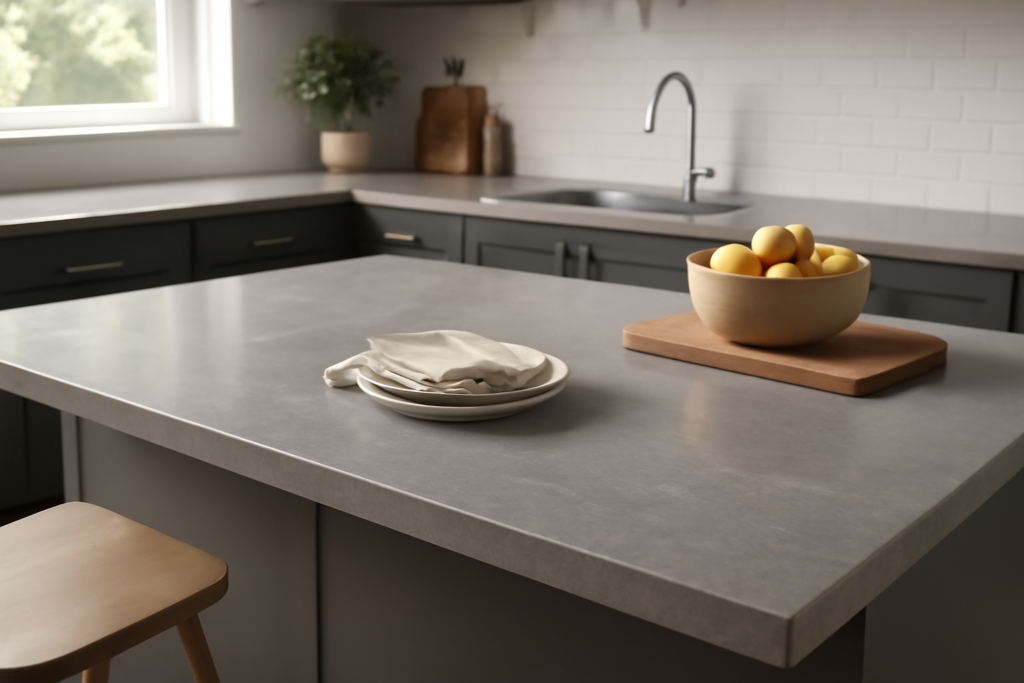
Walk into ten newly remodeled kitchens this year and you will likely find gray on at least seven of the counters. Gray quartz countertops have quietly become the safest, most versatile surface choice on the market, and for good reason: gray hides crumbs and water spots better than stark white, pairs with nearly any cabinet color, and reads as modern without chasing a trend that will date your kitchen in five years. The trick is knowing which shade and pattern fit your space, because “gray” covers everything from a cool concrete look to a warm greige with brown undertones.
Part of our Countertops guide — explore the full guide →
- What Makes Quartz Different From Granite or Marble
- Popular Shades of Gray Quartz
- How Much Do Gray Quartz Countertops Cost
- Durability and Daily Care
- Matching Gray Quartz to Your Kitchen
- Edge Profiles Worth Considering
- Finish Options Beyond Glossy
- Common Mistakes to Avoid
- Is Gray Quartz the Right Choice
- Getting the Balance Right With White and Gray Quartz
What Makes Quartz Different From Granite or Marble
Quartz countertops are engineered, not quarried. Manufacturers grind natural quartz crystals and blend them with roughly 7 to 10 percent resins and pigments, then compress the slurry under heat and pressure. The result is a non-porous surface that never needs sealing, resists staining from coffee and red wine, and offers far more consistency than natural stone. With granite, you inspect the actual slab before buying because no two pieces match. With quartz, the gray you pick from a sample largely predicts what arrives in your kitchen.
That consistency is a big part of why gray quartz dominates. A homeowner who falls in love with a soft dove-gray with subtle veining can order it knowing the seams will blend and the color will hold across a 10-foot island.
Popular Shades of Gray Quartz
Gray is not one color, and choosing the wrong undertone is the most common regret homeowners report. Break the options into a few families:
- Cool concrete grays: Flat, matte-looking surfaces that mimic poured concrete. They suit industrial and contemporary kitchens with black or white cabinets.
- Veined grays: White or light backgrounds with gray marble-style veining. These give the marble look without the upkeep and pair beautifully with shaker cabinets.
- Greige (gray-beige): Warm grays with tan undertones that flatter wood tones and cream cabinetry.
- Charcoal and dark gray: Dramatic, near-black surfaces that make a statement against white cabinets and brass hardware.
- Speckled grays: Fine flecks throughout, excellent at hiding everyday mess in a busy family kitchen.
How Much Do Gray Quartz Countertops Cost
Expect installed pricing to land roughly between $50 and $120 per square foot, with most mid-range gray quartz falling around $60 to $90 installed. Several factors push you toward one end of that range:
- Brand and collection: Premium designer lines with intricate veining cost more than standard solid grays.
- Slab thickness: A 3 cm slab costs more than 2 cm but needs no plywood backing at the edges.
- Edge profile: A simple eased edge is included; mitered, ogee, or waterfall edges add labor.
- Cutouts: Sink, cooktop, and faucet holes each add to the fabrication bill.
For a typical kitchen with about 40 square feet of counter, budget somewhere in the range of $2,500 to $4,500 installed for a quality gray quartz. Get at least three quotes, and confirm whether they include template, fabrication, and removal of the old top.
Durability and Daily Care
Quartz ranks among the toughest countertop surfaces you can buy. It resists scratches, chips, and stains far better than marble, and you never have to reseal it. That said, it is not indestructible. The resin binder can scorch, so always use a trivet under hot pots straight off the stove. A cutting board protects both the surface and your knives. For cleaning, mild dish soap and water handle almost everything; skip abrasive scouring pads and harsh degreasers, which can dull the finish over time.
One caveat worth knowing: prolonged direct sunlight can fade some quartz pigments, so gray quartz on an outdoor kitchen is a gamble unless the manufacturer specifically rates it for UV exposure.
Matching Gray Quartz to Your Kitchen
The cabinets set the tone. White cabinets with a light veined gray quartz read clean and timeless. Navy or deep green cabinets paired with a mid-gray counter feel current and grounded. For wood-tone cabinets, a greige quartz bridges the warmth without clashing. Flooring matters too: a cool gray counter over warm oak flooring can fight unless you repeat the cool tone somewhere, like the backsplash or hardware.
Hardware finish is the finishing touch. Brushed nickel and chrome lean modern with cool grays, while brass and matte black add contrast and warmth, especially against charcoal.
Edge Profiles Worth Considering
Edge choice subtly changes the whole vibe. An eased or pencil edge keeps things clean and contemporary. A beveled edge adds a touch of definition. For a high-end statement, a mitered edge thickens the look to two or three inches, and a waterfall edge runs the gray down the side of an island to the floor, a striking choice that does require extra slab material.
Finish Options Beyond Glossy
Most people picture quartz with a polished, reflective shine, but finish is a choice that changes the entire personality of a gray counter. A polished finish maximizes depth and makes veining pop, and it is the easiest to wipe clean. A honed or matte finish reads softer and more contemporary, hiding fingerprints and water spots better, though it can show smudges from oils and may need a little more attention. Some manufacturers also offer a textured or leathered finish that adds a subtle tactile dimension, particularly flattering on concrete-look grays. Request samples in different finishes before committing, because the same gray can look like two completely different stones depending on how it is surfaced.
Common Mistakes to Avoid
A few missteps trip up homeowners again and again. The first is choosing a gray off a two-inch chip without seeing it in the room, which hides the undertone shift between cool and warm grays under different light. The second is ignoring the backsplash; a busy veined quartz can clash with a busy tile, so let one element be the star. The third is forgetting about sink and seam placement, which a good fabricator will plan to keep visible joints minimal and away from high-traffic spots. Finally, do not skip the templating step or rush the slab inspection, since this is your chance to catch an undertone or veining you did not expect before it becomes a permanent fixture in your kitchen.
Is Gray Quartz the Right Choice
If you want a low-maintenance surface that looks high-end, forgives everyday messes, and works with whatever cabinet and wall color you choose now or repaint to later, gray quartz is hard to beat. Bring home large samples, view them in your own kitchen lighting at morning and evening, and look at full slabs before fabrication so the veining and undertone match your expectations. Done right, a gray quartz counter is the kind of decision you will still be happy with a decade from now.
Getting the Balance Right With White and Gray Quartz
Within the gray family, the most popular choice is a light background with gray movement. White and gray quartz reads brighter than a solid gray but softer than stark white, and the right balance depends on how much gray the pattern carries, the size of the room, and the light it gets. Thinking about proportion and scale before you visit the showroom saves you from a slab that looks great on a sample board and wrong at home.
Judging the White to Gray Ratio
Look at how much of the surface is white field versus gray veining or cloud. A slab that is mostly white with thin gray lines feels airy and suits small or dim kitchens. A pattern with heavy gray clouds covers more of the surface in mid tone, which hides crumbs and drips better in a busy family kitchen. Hold a full slab photo up next to your cabinet sample and squint: the overall impression should be the color you want the room to feel like from across the space. Check the edges of the slab too, since gray density often varies from one end to the other.
Matching Vein Scale to Room Size
Large, sweeping veins look best on long runs and big islands where the pattern has room to travel. In a compact kitchen with many short pieces and cutouts, oversized veins get interrupted constantly and can look chaotic. Fine, tight veining or a soft cloudy pattern reads better on small counters and narrow peninsulas. For a bathroom vanity, a subtle pattern keeps a small surface from feeling busy.
Coordinating Backsplash, Grout, and Fixtures
Pick the gray in the counter, not the white, as your guide for grout and accents. A grout color pulled from the mid gray of the veining ties the backsplash to the counter and hides grease better than white grout. Stainless steel appliances and sinks sit naturally beside white and gray quartz because both lean cool. For warmth, add wood shelves, a wood floor with neutral undertones, or warm metal lighting, and keep the backsplash simple if the counter already has a lot of movement.
Keeping Light Surfaces Looking Fresh
Light quartz shows some marks that darker slabs hide. Tea, turmeric, and colored drinks left for hours can leave faint stains, so wipe them promptly with mild dish soap. Heat from a pan set down directly can cause a yellowish or cloudy mark in the resin that cannot be cleaned away, so keep trivets beside the range. Gray metal marks from pots usually lift with a non-abrasive cleaner labeled safe for quartz. Avoid bleach and strong degreasers, which can dull the finish over time, and ask the fabricator for the specific care sheet that matches your slab.


