Homeowners come into showrooms every week asking for marble, and by the time I’ve walked them through what real marble actually requires, most of them leave with quartz marble countertops instead. This engineered stone mimics the veining and soft color palette of Carrara, Calacatta, and Statuario marble while skipping the etching, staining, and constant sealing that natural marble demands. It’s not a perfect substitute in every way, but for kitchens that get real daily use, it’s become the practical choice for homeowners who love the marble look but don’t want to babysit their counters.
Part of our Countertops guide — explore the full guide →
- What Quartz Marble Countertops Actually Are
- Quartz Marble vs. Real Marble Countertops
- Cost Comparison
- Durability and Everyday Performance
- Popular Quartz Marble Patterns and Brands
- Installation Timeline and Process
- Edge Profiles and Design Details
- Maintenance and Cleaning
- Resale Value and Buyer Perception
- Is Quartz Marble the Right Choice for You?
What Quartz Marble Countertops Actually Are
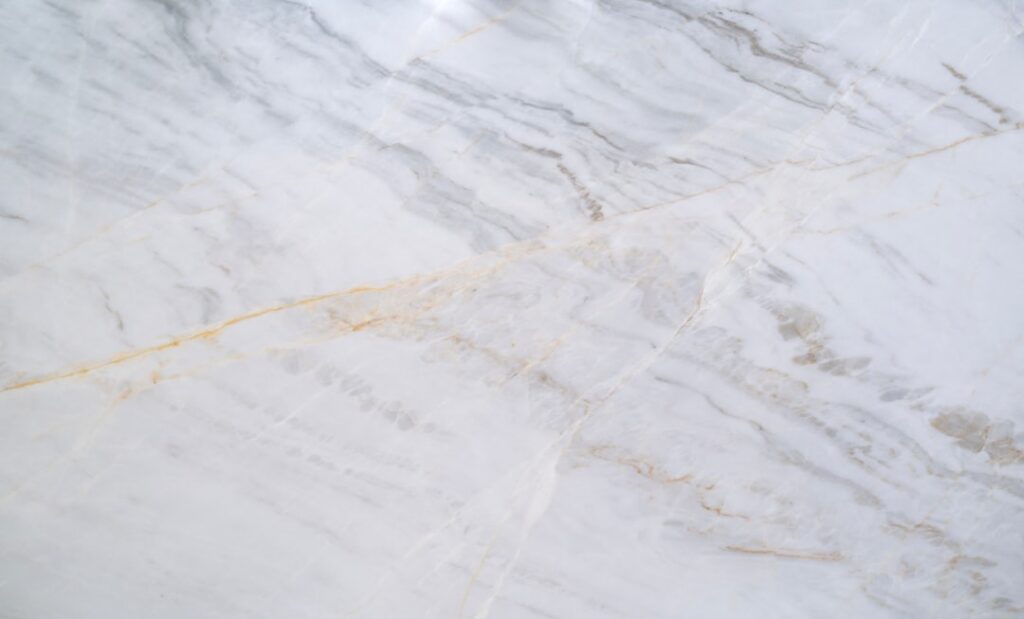
Quartz countertops are engineered from roughly 90% to 95% crushed natural quartz mineral, bound with polymer resins and pigments, then pressed and cured under heat. The “marble” designation refers to the pattern printed or layered into the slab during manufacturing, not the material itself, which contains no actual marble. Major brands including Cambria, Caesarstone, Silestone, and MSI’s Q Quartz all offer marble-look lines with names like Cambria’s Brittanicca, Caesarstone’s Calacatta Nuvo, and MSI’s Calacatta Miraggio. These lines use advanced printing and layering technology to replicate the soft gray veining of Carrara marble or the bolder gold-and-gray veining of Calacatta, often convincingly enough that it takes a close inspection to tell it apart from the real thing.
Quartz Marble vs. Real Marble Countertops
The core appeal is durability without sacrificing the look. Real marble is calcium carbonate, which reacts to acid, meaning lemon juice, wine, and even tomato sauce left too long will etch a dull spot into the polished surface permanently. Quartz doesn’t etch from acidic foods, since the resin binder isn’t reactive the way calcite is. Real marble also requires sealing every 6 to 12 months to resist staining, while quartz needs no sealing at all, since the resin already makes it non-porous.
Where real marble still wins is heat tolerance directly under a hot pan, and a slightly more organic, one-of-a-kind veining pattern that no engineered slab fully replicates, since each marble slab is genuinely unique. Quartz resin can scorch or discolor above roughly 300°F to 400°F if a hot pot sits directly on the surface without a trivet, whereas natural marble tolerates higher direct heat, though neither material is truly heatproof.
Cost Comparison
Quartz marble-look countertops typically run $50 to $100 per square foot installed, depending on the brand and pattern complexity. Cambria, a US-manufactured premium brand, often lands at $70 to $110 per square foot installed, while more budget-friendly lines from MSI or Wilsonart run $45 to $75 per square foot.
Real marble, by comparison, costs $75 to $250 per square foot installed depending on the quarry origin and pattern rarity, with premium Calacatta marble from Italy frequently exceeding $150 per square foot before installation. For a typical 40-square-foot kitchen countertop run, that’s a difference of roughly $1,200 to $6,000 between a mid-range quartz marble-look slab and a comparable real marble installation, once you include fabrication, edge profiles, and sink cutouts.
Durability and Everyday Performance
Quartz’s non-porous surface resists staining from coffee, red wine, oil, and food dye far better than unsealed marble, and even outperforms marble that’s been sealed on schedule. Scratch resistance is strong too; quartz sits around 7 on the Mohs hardness scale, similar to natural quartz crystal, making it more scratch-resistant than marble’s roughly 3 to 4 rating. That said, quartz isn’t indestructible. Direct, sustained heat exposure, sudden temperature shock from moving a pot from stovetop straight onto the counter, and impact from a dropped cast iron pan at a sharp edge can all cause damage, so trivets and cutting boards remain smart habits regardless of which countertop you choose.
Popular Quartz Marble Patterns and Brands
A few lines dominate the quartz marble-look market and are worth knowing by name when you’re shopping:
- Cambria Brittanicca Warm — soft gray-gold veining on a warm white base, one of the most requested Carrara-style patterns
- Caesarstone Calacatta Nuvo — bold gray veining on bright white, mimicking Calacatta Gold marble
- MSI Calacatta Miraggio — dramatic gold and gray veining across a large-format slab, popular for waterfall island edges
- Silestone Eternal Calacatta Gold — a warmer, more layered veining pattern with subtle gold flecking
- Wilsonart Calacatta Marble — a budget-friendly option often used in laminate-to-quartz upgrade projects
Slab sizes typically run 120 by 55 inches for standard format, or up to 126 by 63 inches for jumbo slabs, which matters if you want a seamless island top without a visible seam.
Installation Timeline and Process
From template to installation, a typical quartz marble countertop project takes 10 to 21 days. Templating happens after cabinets are installed and level, using a laser or digital template tool to capture exact dimensions, typically a same-day or next-day appointment once cabinets are ready. Fabrication at the slab yard takes 5 to 14 days depending on order volume and pattern-matching complexity, since bookmatched veining across a large island requires more careful slab layout. Installation itself is usually completed in a single day, 4 to 8 hours for a standard kitchen, including sink and cooktop cutouts, though a full seam and edge finish check should happen before the crew leaves.
Edge Profiles and Design Details
Standard edge profiles like a 1/4-inch eased edge or a bullnose come included with most fabricators, while premium profiles such as a mitered waterfall edge or a thick 3-inch stacked laminated edge add $15 to $40 per linear foot. A waterfall edge on an island, where the veining pattern continues down the side panel, is especially popular with quartz marble-look slabs since the printed pattern can be oriented to flow continuously, something far harder and more expensive to achieve with bookmatched real marble.
Maintenance and Cleaning
Daily care is straightforward: warm water, a few drops of mild dish soap, and a soft cloth handle nearly everything a kitchen counter encounters. Avoid abrasive scouring pads and highly alkaline or acidic cleaners, including undiluted bleach and oven cleaner, since repeated exposure can dull the resin’s sheen over years of use even though it won’t etch the way marble does. For dried food or hardened residue, a plastic putty scraper lifts debris without scratching the surface, and a dedicated quartz cleaner such as Weiman Quartz Clean & Shine or Cambria’s own care product restores the factory sheen if daily soap and water starts to look streaky.
Because quartz never needs sealing, there’s no recurring maintenance cost the way there is with marble, where annual or twice-yearly sealer applications run $150 to $400 for a professional service call, or $30 to $50 in DIY sealer product plus a half day of labor. Over a 10-year ownership period, that sealing cost alone can add $1,500 to $4,000 to the true cost of owning real marble, a figure worth weighing against quartz’s higher upfront price for some marble-look lines.
Resale Value and Buyer Perception
Appraisers and real estate agents generally treat quartz countertops, including marble-look patterns, as equivalent to natural stone in a home’s perceived value, since most buyers can’t tell the difference from a walk-through and appreciate the low-maintenance reputation once it’s explained. Kitchens with a well-known brand name like Cambria or Caesarstone often get called out specifically in listing photos and descriptions, which can be a modest selling point in competitive markets. Real marble still carries slightly more prestige in ultra-high-end luxury listings, but for the vast majority of residential resales, quartz marble-look countertops perform just as well at a lower installed cost.
Is Quartz Marble the Right Choice for You?
If you want the classic marble look in a kitchen that sees real daily use, spilled coffee, cutting boards skipped in a hurry, kids doing homework at the island, quartz marble countertops solve the practical problems that keep real marble owners nervous. Budget $45 to $110 per square foot installed depending on brand, plan on roughly two to three weeks from template to installation, and still use trivets and cutting boards even though the material resists most everyday damage. For homeowners who’ve fallen in love with a Carrara or Calacatta look but don’t want to reseal counters twice a year or worry about a wine glass left out overnight, quartz marble countertops are the sensible middle ground between beauty and maintenance-free living.