Engineered quartz has outsold granite in American kitchens every year since 2018, and once you price out the alternatives it is easy to see why. Quartz kitchen worktops, the term British homeowners use for what most Americans call quartz countertops, deliver the density of natural stone without the sealing, staining, and slab-to-slab gambling that granite demands. The catch is that “quartz” covers everything from $55 per square foot imported slabs to $150 per square foot designer material, and the differences are not always visible in a showroom sample. This guide walks through the decisions that actually determine what you pay and what you live with: thickness, edge profile, brand tier, and the fabrication process itself.
Part of our Countertops guide — explore the full guide →
- What Quartz Worktops Actually Are
- 2cm vs 3cm: The Thickness Decision
- Edge Profiles: Where Style Meets Budget
- Brands and Tiers: What You Are Really Paying For
- Pricing: What a Full Kitchen Actually Costs
- Templating, Fabrication, and Installation: The Timeline
- What to Check at the Slab Yard
- The Bottom Line
What Quartz Worktops Actually Are
Despite the name, these are not solid slabs of quarried quartz crystal. Engineered quartz is roughly 90 to 93 percent crushed natural quartz aggregate bound with 7 to 10 percent polymer resin and pigment, pressed under intense vacuum vibration and cured into slabs, typically 120 by 55 inches or the larger jumbo format of 130 by 65 inches. The result is a nonporous surface harder than granite on the working face, immune to wine and coffee stains, and consistent from one end of the slab to the other. That consistency is the quiet superpower: the sample you approve is essentially the countertop you get, which is never guaranteed with natural stone.
The resin is also the weak point. Sustained heat above roughly 300 degrees F scorches it, so trivets are mandatory, and strong solvents like oven cleaner will etch the finish. UV exposure yellows resin over time, which is why quartz belongs indoors, not on the patio kitchen.
2cm vs 3cm: The Thickness Decision
Slabs come in two standard thicknesses, 2 centimeter (about 3/4 inch) and 3 centimeter (about 1 1/4 inch). In most of the US, 3cm is the default for kitchens, and for good reason. It spans dishwasher openings and 12 inch overhangs without plywood buildup or corbels, it takes a cleaner edge profile, and its heft reads as premium. Expect 3cm material to cost $8 to $15 more per square foot than the same color in 2cm.
That said, 2cm has legitimate uses. On the West Coast, fabricators commonly install 2cm with a laminated mitered edge that mimics a thick profile while saving weight and money. It is also the smart pick for full-height backsplashes, bathroom vanities, and frameless-cabinet European designs where a slim 3/4 inch reveal is the intended look. Just know the engineering rules: 2cm quartz needs continuous plywood decking over cabinets in most installs and support for any overhang past 8 inches, while 3cm can typically cantilever 12 to 14 inches unsupported. If you want a breakfast bar without steel brackets, choose 3cm.
Edge Profiles: Where Style Meets Budget
Every fabricator includes a few standard edges in the base price, usually eased, quarter round, and half bullnose. An eased edge, a crisp square with the sharp corner slightly softened, is the overwhelming favorite in modern kitchens and costs nothing extra. Decorative profiles are where the upcharges live. Ogee edges typically add $10 to $20 per linear foot, a laminated double-thickness edge runs $20 to $40 per linear foot, and a full waterfall end panel, where the quartz flows down the side of an island to the floor, adds $1,000 to $2,500 per side once you count the extra material, the mitered seam work, and installation labor.
A practical note from the field: intricate profiles like ogee collect grime in their grooves and visually date faster than simple ones. On a veined marble-look quartz, complex edges also interrupt the pattern awkwardly. Eased or a small pencil round is the safe, timeless money.
Brands and Tiers: What You Are Really Paying For
The premium tier includes Cambria (American-made, lifetime warranty), Caesarstone, and Silestone by Cosentino. These run $80 to $150 per square foot installed and buy you the deepest color libraries, the most convincing marble-look veining, and strong warranties of 25 years to lifetime. The mid tier, roughly $70 to $100 installed, covers LG Viatera, Hanstone, Corian Quartz, and MSI’s Q Premium line, all solid products with slightly smaller design ranges. The value tier is imported slabs sold through wholesale stone yards under names you may never see advertised, commonly $55 to $75 installed. Plain whites and simple patterns from this tier perform essentially the same as branded equivalents; where budget slabs lag is in realistic veining, batch consistency, and warranty support.
Whatever the tier, verify the slab is certified by NSF for food contact and ask about silica content if your fabricator cuts on site; reputable shops now use wet cutting and air monitoring to protect their workers, and shops that take that seriously tend to be careful about everything else too.
Pricing: What a Full Kitchen Actually Costs
Installed pricing bundles the slab, templating, fabrication, and installation. Nationally, quartz worktops average $70 to $100 per square foot installed, with the full spread running $55 to $150. A typical kitchen needs 45 to 55 square feet, so budget $3,500 to $5,500 for a mid-tier installation. Add-ons stack up quickly: undermount sink cutouts run $150 to $250, cooktop cutouts $100 to $200, faucet and soap dispenser holes $25 to $50 each, and tear-out of existing counters $200 to $500. Removing a 4 inch quartz backsplash strip is cheap; a full-height quartz splash adds $30 to $60 per square foot of wall covered.
Get three quotes, and make sure each one itemizes the same scope. One fabricator’s “per square foot” price may include the sink cutout another lists separately, and that alone can hide a $400 swing.
Templating, Fabrication, and Installation: The Timeline
Once you sign, the fabricator schedules templating, a one-hour visit where a technician captures your cabinet layout with a laser templating system such as a Proliner, or with old-school corrugated strips. Cabinets must be fully installed, level, and permanent before this visit, and you need your actual sink, faucet, and cooktop specs on site, because every cutout is programmed from the template. Fabrication then takes 5 to 10 business days at most shops: the slab is cut on a CNC saw, cutouts milled, edges profiled and polished. Installation day itself usually runs 2 to 4 hours for an average kitchen. Seams are joined with color-matched epoxy and pulled tight with vacuum seam-setters; a good seam is flat, hairline, and placed away from sink cutouts where stress concentrates.
Plan for the plumber to return the following day, since most fabricators want the sink’s silicone and epoxy anchors to cure 12 to 24 hours before the disposal and drain lines go back in.
What to Check at the Slab Yard
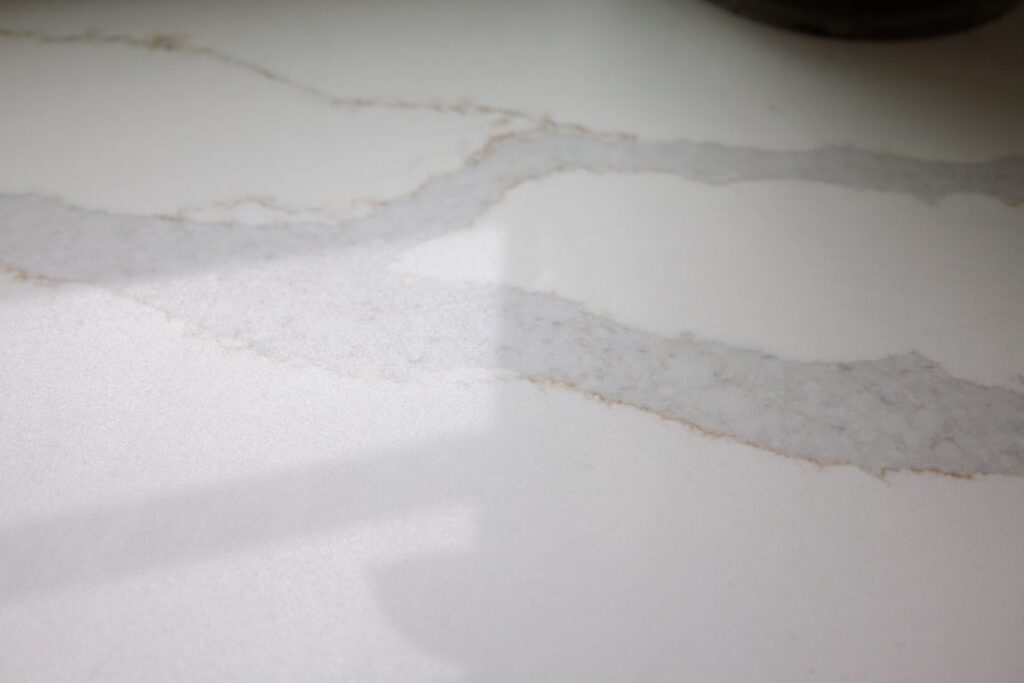
Never buy a patterned quartz from a 4 inch sample. Visit the yard and view your actual slabs on end, in good light, and check four things. First, batch numbers: if your kitchen needs two slabs, both should come from the same production run, since resin tint shifts subtly between batches. Second, pattern scale: bold veining that looks elegant on a 10 foot display can feel chaotic wrapped around a small L-shaped layout, so ask the fabricator to do a slab layout overlay showing where seams and veins will fall. Third, surface defects: sight down the slab for pitting, resin pooling, or dull patches in the polish. Fourth, the finish itself: polished is the standard, but honed and suede finishes are gorgeous and also show fingerprints and require slightly more wiping, a tradeoff worth seeing in person before committing.
The Bottom Line
Quartz kitchen worktops earn their market dominance: no sealing, no staining, predictable appearance, and a 25 year to lifetime service life for $55 to $150 per square foot installed. Spend your money where it shows, on 3cm thickness and a slab whose pattern you have approved in person, and save it where it does not, by skipping ornate edges and considering value-tier slabs for simple solid colors. Respect the two real limits, heat and harsh solvents, and the surface you template this month will still look new when you eventually remodel around it.