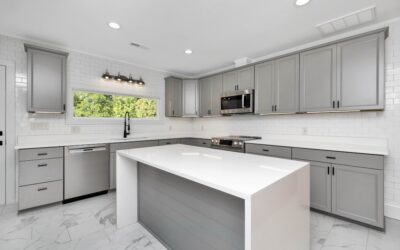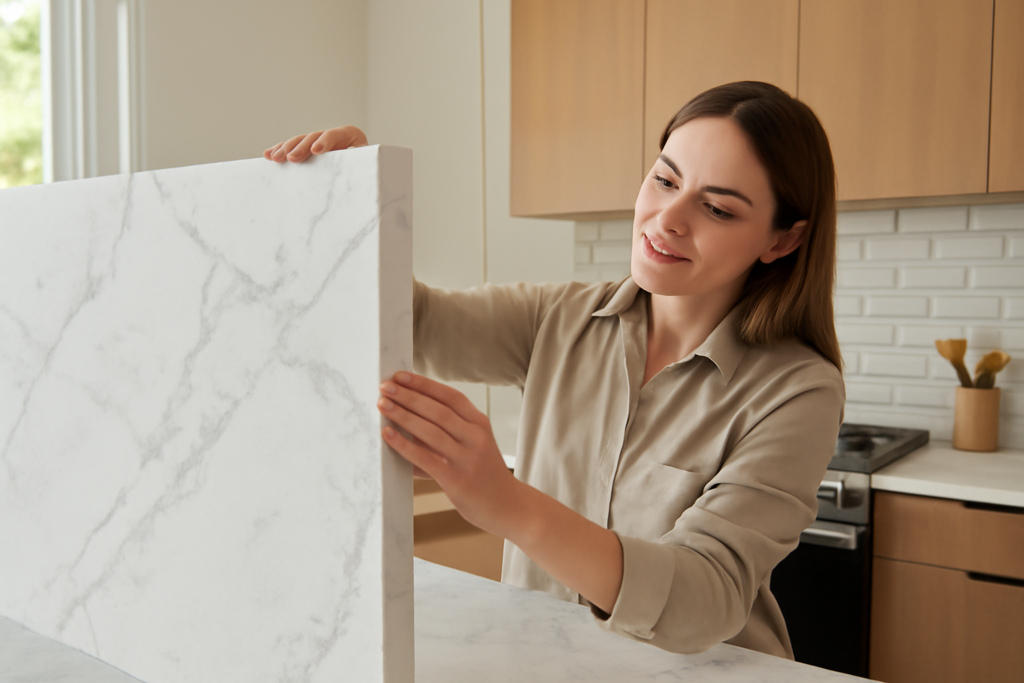
When you order a quartz countertop, what you are really buying is a quartz slab, a large engineered sheet that gets cut and fabricated to fit your kitchen. Understanding how slabs are sized, fabricated, and priced helps you shop smarter and avoid surprises. This guide walks through slab dimensions, thickness options, the fabrication process, how to choose a slab, and what it all costs.
Part of our Countertops guide — explore the full guide →
What a Quartz Slab Is
A quartz slab is a manufactured panel made from roughly 90 percent ground natural quartz combined with resins and pigments, compacted under heat and pressure into a dense, uniform surface. Unlike natural stone quarried from the earth, quartz slabs are engineered for consistency, which means the slab you see in the showroom closely matches what you will get in your kitchen.
Because they are non-porous, quartz slabs never need sealing and resist stains, bacteria, and everyday wear. That combination of durability and predictable appearance is why quartz dominates so many modern remodels.
Standard Slab Sizes
Quartz slabs come in large formats so fabricators can minimize seams. A common standard slab measures roughly 120 by 55 inches, while many manufacturers also offer jumbo slabs around 126 to 130 inches long and up to about 65 inches wide. The larger jumbo sizes are valuable for big islands and long runs where you want to avoid a visible seam.
Knowing slab dimensions helps you understand how many slabs your project needs. A large kitchen with an island often requires more than one slab, and the fabricator will plan the layout to balance material use against seam placement.
Thickness Options
Quartz slabs typically come in two thicknesses: 2 centimeters (about three-quarters of an inch) and 3 centimeters (about one and a quarter inches). The 3-centimeter slab is the most popular for kitchen counters because it is sturdy enough to span cabinets without plywood support and gives a substantial, premium look. The 2-centimeter option is lighter and often used for vertical applications, bathroom vanities, or with a laminated edge to mimic a thicker profile.
The Fabrication Process
Fabrication is where a raw slab becomes a finished countertop. After you select your slab, the fabricator templates your kitchen, often with a laser tool, to capture exact measurements. The slab is then cut with specialized saws and water jets, openings are made for the sink and cooktop, the chosen edge profile is ground and polished, and the pieces are dry-fit before final installation.
This process usually takes one to three weeks from template to install. Skilled fabrication matters enormously, since precise cuts, tight seams, and clean edges separate a professional result from a sloppy one. Always work with an experienced, reputable fabricator.
How to Choose a Slab
Whenever possible, view and select the actual slabs you are buying in person rather than relying on small samples. Keep these tips in mind:
- Look at the full slab under good lighting to see how veining and color flow across its surface.
- Check both slabs if your project needs more than one, so the patterns coordinate at seams.
- Ask the fabricator to mark where seams will fall and how they plan to book-match veined patterns.
- Reserve the specific slabs you like, since inventory moves quickly and lots vary.
A few minutes spent reviewing slabs prevents disappointment when the finished counter goes in.
Cost per Square Foot
Quartz slab pricing is usually quoted installed, by the square foot of finished countertop. Expect a general range of about $50 to $120 per square foot installed, with entry-level imports at the low end and premium designer slabs at the top. A typical kitchen often totals between $2,500 and $6,000, influenced by slab choice, edge profiles, cutouts, and local labor.
Because slabs are sold whole, you pay for material even from the portions trimmed away, so larger or oddly shaped layouts can use more slab than you expect. Ask your fabricator for an itemized quote.
Seams and How to Hide Them
Any kitchen larger than a single slab will have at least one seam, so understanding seam placement helps set expectations. A skilled fabricator positions seams in less conspicuous spots, such as near a sink or at an inside corner, rather than across the middle of an island. With solid-color quartz, seams can be nearly invisible, while heavily veined patterns require careful matching to keep the flow continuous. Ask your fabricator to show you on the template exactly where seams will fall before fabrication begins, since their placement is a design decision worth your input.
How Many Slabs You Need
Estimating slab quantity comes down to your countertop layout and the slab size. A small kitchen with a single run of counter may fit on one slab, while a kitchen with a large island often requires two or more, especially if you want to book-match the veining. Remember that you pay for the whole slab even though some material is trimmed away as waste, so complex layouts with many cutouts can use more slab than the finished square footage suggests. Your fabricator will lay out the pieces to balance material efficiency against the best pattern flow and seam placement.
Inspecting a Slab Before You Buy
Even though engineered quartz is manufactured for consistency, no two slabs are identical, and a careful inspection at the yard saves headaches later. View the slab standing upright under bright light, then step back to judge how the veining or fleck pattern flows across the full surface rather than fixating on one corner. Run your hand over the face to feel for any pitting, and check the edges for chips that occurred in shipping.
If your project spans more than one slab, ask to see them side by side and confirm they come from the same production lot, since dye batches can shift subtly between runs. Look at the slab in the orientation it will sit in your kitchen, because a pattern that reads beautifully vertically may look busy laid flat. Photograph the slabs you like with your phone so you can compare them at home, and get the specific slab numbers in writing so the fabricator pulls the exact ones you approved.
Caring for Your Quartz
Once installed, quartz is easy to live with. Clean it with warm water and mild dish soap, avoid harsh chemicals and abrasive pads, and protect it from direct heat with trivets. You never need to seal it. With that minimal care, a quality quartz slab will serve as a beautiful, durable centerpiece in your kitchen for decades.