Tile has dominated backsplashes for decades, but a growing number of kitchens are skipping the grout lines entirely. A quartz slab backsplash runs the same engineered stone from your countertop straight up the wall, creating one continuous, seamless surface with no grout to scrub and no tile pattern to date the room. It is a clean, modern look that also happens to be one of the most low-maintenance walls you can install behind a stove. The trade-off is cost and the fact that you cannot really DIY a heavy stone slab. Here is what to weigh before you commit.
Part of our Countertops guide — explore the full guide →
What Is a Quartz Slab Backsplash?
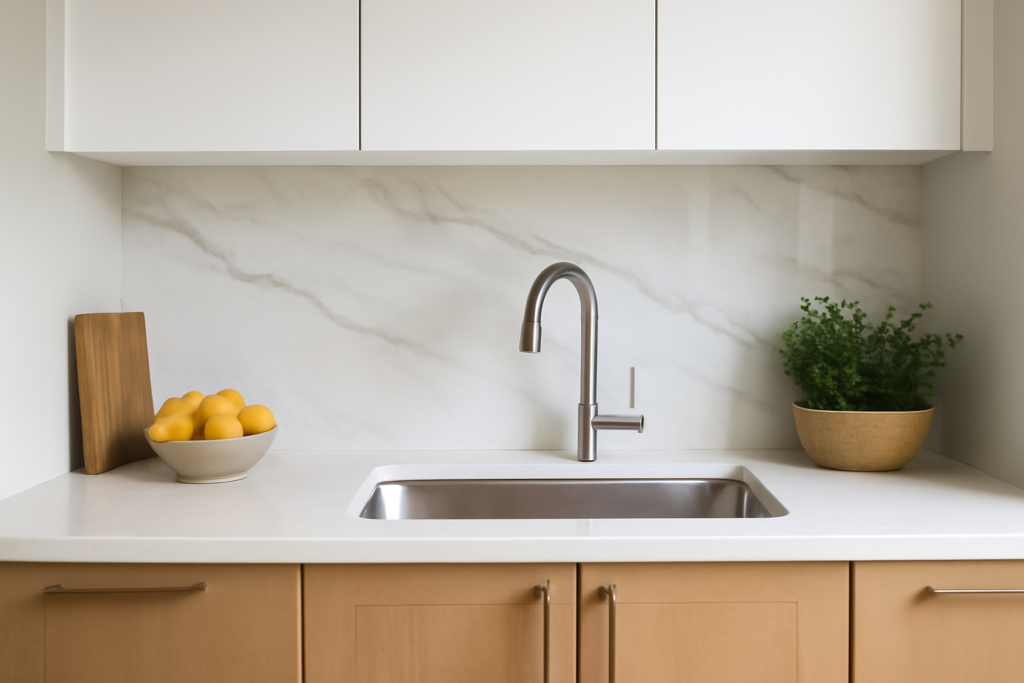
Instead of individual tiles, a slab backsplash uses large pieces of engineered quartz, the same material as many countertops, cut to fit the wall. Quartz is roughly 90 percent ground natural stone bound with resin and pigment, which makes it nonporous, consistent in color, and extremely durable. Because the slab matches your counter, the look is uninterrupted: the countertop appears to fold up the wall as a single sheet of stone.
You will hear two main configurations. A standard slab backsplash covers the usual few inches up to the upper cabinets. A full-height backsplash runs all the way from counter to the bottom of the wall cabinets, and on a feature wall behind the range it can climb to the ceiling or hood.
Standard Height vs. Full Height
The height you choose drives both the look and the budget.
- Standard 4-inch slab: A short backsplash matching the counter edge. Modest material cost and a tidy transition, but minimal visual impact.
- Mid-height slab: Runs from counter to the underside of the upper cabinets, the most popular full-slab choice for a clean modern kitchen.
- Full-height feature wall: Extends to the ceiling behind the cooktop or sink. Dramatic, especially with a bookmatched or veined quartz, but it uses the most material.
Quartz Slab Backsplash Cost
Pricing tracks closely with countertop pricing because it is the same material and labor. Installed quartz commonly runs about $50 to $120 per square foot depending on the color, edge work, and your region, with premium veined patterns sitting at the top of that range. A slab backsplash adds square footage to your counter order, so the wall typically costs in that same per-square-foot band.
Because it is sold and fabricated by the slab, a quartz backsplash usually costs more per square foot than a tile backsplash, where you might spend a fraction of that on materials. You are paying for the seamless look and the near-zero maintenance, not just the surface area. Ask your fabricator whether they can cut the backsplash from the same slab as your counters, which keeps the veining flowing and can reduce waste charges.
The Advantages
There are real, practical reasons this look has caught on beyond aesthetics.
- No grout lines: Nothing to discolor, crack, or scrub. A wipe with a damp cloth keeps it clean.
- Nonporous and hygienic: Quartz resists staining from sauces, oils, and splatter behind the range far better than porous stone or grout.
- Seamless match: The wall and counter read as one piece, which makes a small kitchen feel more unified.
- Durable: Engineered quartz shrugs off everyday knocks and heat from cooking, though you should never set a flaming pan directly against it.
The Drawbacks to Consider
No surface is perfect. Quartz contains resin, so prolonged direct heat, like a torch flame or a pan pulled straight off a burner pressed against the wall, can scorch or discolor it. Quartz is also not ideal in spots with constant strong UV exposure, since some colors can fade over years of direct sun. And the upfront cost is meaningfully higher than tile. Finally, a slab is heavy and effectively permanent; redesigning later means removing a fabricated stone piece, not popping off a few tiles.
Quartz Slab vs. Tile Backsplash
The honest comparison comes down to maintenance versus cost and flexibility. A tile backsplash is cheaper, DIY-friendly, and endlessly variable in pattern, but it brings grout lines that need cleaning and eventual resealing, and the grid look can date a kitchen. A quartz slab backsplash costs more and requires a fabricator, but it gives a seamless, grout-free, nonporous wall that wipes clean in seconds and matches your counters exactly.
Think about how you cook and how long you plan to stay. Heavy cooks who hate scrubbing grease out of grout behind the range gravitate toward slab. Homeowners who love changing up the look every few years, or who are on a tighter budget, often prefer tile. Many kitchens split the difference: a quartz slab on the high-use wall behind the cooktop and tile elsewhere, blending the easy-clean benefit where it matters most with tile’s lower cost on the rest.
Installation: Leave It to a Fabricator
This is not a weekend DIY project. Quartz slabs are heavy, must be templated precisely, and require special tooling to cut sink and outlet openings without cracking. A professional fabricator templates the wall, cuts the slab in the shop, and installs it with the same care as a countertop, sealing the seam where the backsplash meets the counter with color-matched silicone.
A few things to coordinate before install day: have your electrician relocate outlets if you want them hidden or placed under the cabinets for a cleaner wall, confirm the wall is flat since slabs do not flex to hide bows, and decide on outlet cutout locations early. Done well, a quartz slab backsplash is a one-and-done upgrade that looks current for the life of the kitchen and asks almost nothing of you in return. Plan it alongside your countertop order, lean on your fabricator’s expertise for the templating and seams, and you will end up with a clean, continuous wall that needs nothing more than an occasional wipe to stay looking new.