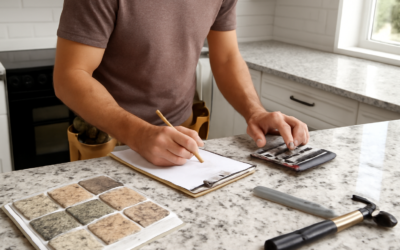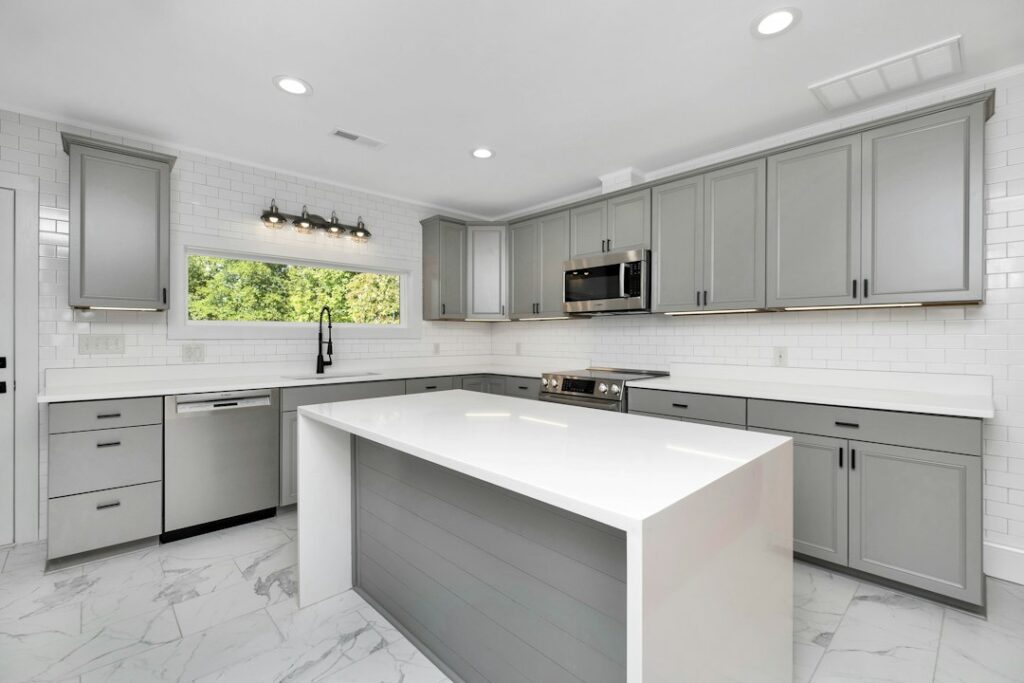
Homeowners often get a quote for quartzite and assume a decimal point slipped. The truth is that quartzite countertops cost more than most granite because the stone is harder to quarry, harder to cut and harder to polish, and every one of those steps shows up on the invoice. Expect a typical installed range of about $60 to $200 per square foot, with most mid-range kitchens landing between $80 and $130.
Part of our Countertops guide — explore the full guide →
For an average kitchen with about 40 to 50 square feet of counter space, that works out to roughly $3,500 to $7,500 for common colors, and $8,000 to $12,000 or more for rare, heavily veined slabs. The spread comes from slab grade and rarity, fabrication complexity, edge profiles, cutouts, and how far the slab has to travel.
- Quartzite Countertops Cost per Square Foot by Grade
- What Drives the Price Up
- Fabrication and Add-On Costs
- Installation and Sealing
- Regional and Seasonal Price Differences
- Sample Budgets for Common Kitchens
- How to Lower Your Cost Without Settling
- Verify You Are Paying for Real Quartzite
- Long-Term Value Compared With Other Surfaces
- Troubleshooting Quote Surprises
- When to Call a Pro
- Frequently Asked Questions
Knowing which line items move the price lets you trim cost without settling for a stone you do not love.
Quartzite Countertops Cost per Square Foot by Grade
Fabricators and stone yards usually group slabs into price tiers. The names vary by yard, but the pattern is consistent across the country.
| Tier | Typical look | Installed per sq ft |
|---|---|---|
| Entry | Gray, beige, mild movement | About $60 to $85 |
| Mid-range | White and cream with soft veining | About $85 to $130 |
| Premium | Bold veins, blue or green tones | About $130 to $175 |
| Exotic | Rare colors, bookmatched slabs | About $175 to $250+ |
When comparing quartzite countertops cost across showrooms, ask whether each quote is for slab only or fully installed. Slab-only pricing, often sold by the whole slab rather than by the square foot, can look cheaper until fabrication and installation are added.
What Drives the Price Up
Slab Rarity and Origin
Most quartzite comes from Brazil, with some from India, Madagascar and elsewhere. Shipping heavy slabs across an ocean is expensive, and colors that only come out of a single quarry command a premium. Blue, green and heavily veined white varieties cost more than neutral gray because supply is tighter.
Hardness and Fabrication Time
True quartzite rates around 7 on the Mohs scale, harder than granite. That hardness means diamond blades and polishing pads wear faster, and saws run slower. Many fabricators charge a premium of $10 to $30 per square foot for quartzite over granite simply for shop time.
Slab Thickness
Slabs come in 2 cm (about 3/4 inch) and 3 cm (about 1 1/4 inch). The 3 cm option typically costs 15 to 30 percent more but does not need a plywood subtop or a laminated edge to look substantial. A 2 cm slab often needs a mitered edge buildup, which adds labor.
Waste and Seam Layout
Large L-shaped or U-shaped kitchens can require two or three slabs. If the layout leaves a lot of offcut, you pay for that waste. Strong veining also limits how pieces can be arranged, since the fabricator has to match the pattern across seams.
Fabrication and Add-On Costs
The base square-foot price usually includes templating, basic cutting, a standard eased or pencil edge, and installation. Extras commonly look like this:
- Edge profiles: Eased and small bevel edges are usually included. Ogee, full bullnose and dupont profiles run about $15 to $50 per linear foot. Mitered waterfall edges can add $500 to $2,000 per end.
- Sink cutouts: An undermount sink cutout with polished interior edges is typically $150 to $400.
- Cooktop cutouts: About $100 to $300 each.
- Faucet and accessory holes: Around $25 to $75 each.
- Backsplash: A 4 inch matching splash usually runs $20 to $50 per linear foot; a full-height slab backsplash is priced like countertop square footage.
- Bookmatching: Pairing mirror-image slabs for an island can add $500 to $1,500 for careful layout and extra material.
- Removal of old counters: About $200 to $600 depending on material and haul-away.
- Plumbing reconnection: Many fabricators do not reconnect the sink or disposal. A plumber visit often costs $150 to $400.
Installation and Sealing
Installation is usually bundled into the fabricator price, but site conditions can add cost. Out-of-level cabinets need shimming, weak cabinet boxes may need reinforcement, and overhangs beyond about 10 to 12 inches on 3 cm stone need steel brackets or corbels, which typically add $100 to $500.
Sealing is the ongoing cost people forget. Quartzite is dense, but its porosity varies by variety, and some softer stones sold under the quartzite name are actually more absorbent. Most fabricators apply an initial impregnating sealer. After that, plan to reseal every one to three years depending on a simple water test: drip water on the surface, and if it darkens the stone within 10 to 15 minutes, it is time. A quart of quality penetrating sealer costs roughly $20 to $60 and covers a typical kitchen several times, or a pro reseal runs about $150 to $350.
Regional and Seasonal Price Differences
Where you live changes the number on your quote. Coastal metro areas with high labor costs and long port-to-shop trucking routes often run 15 to 25 percent above the national middle, while regions with many competing fabricators and nearby distribution yards tend to be cheaper. Rural homeowners sometimes pay extra trip charges for templating and installation if the nearest shop is more than an hour away.
Timing matters too. Fabricators are busiest in spring and early summer when remodels peak, and lead times can stretch to four to six weeks. Late fall and winter are often slower, and some shops are more flexible on pricing or will schedule faster. If you are not in a rush, ask whether booking in a slower month makes a difference. Slab inventory also shifts through the year as new containers arrive, so a color that looks scarce in one season may be plentiful a few months later.
Sample Budgets for Common Kitchens
Using mid-range stone at about $100 per square foot installed, here is how totals stack up:
- Small galley (25 sq ft): About $2,500 for stone, plus $300 to $600 in cutouts and edges, for roughly $2,800 to $3,100.
- Average L-shape (45 sq ft): About $4,500 base, plus $500 to $1,000 in extras, for roughly $5,000 to $5,500.
- Large kitchen with island (70 sq ft): About $7,000 base, plus a mitered waterfall and backsplash, for roughly $9,000 to $12,000.
- Bathroom vanity (8 to 12 sq ft): Often $800 to $1,800, and remnant pieces can cut that sharply.
How to Lower Your Cost Without Settling
- Visit the stone yard in person. Prices differ between yards for nearly identical stone, and you can pick the exact slab rather than paying for a premium grade sight unseen.
- Ask about remnants. For vanities, laundry rooms and small bars, remnant quartzite can be 30 to 60 percent cheaper.
- Choose 3 cm with a simple edge. A clean eased edge on thick stone looks high-end and avoids per-foot edge charges.
- Mix materials. Put the expensive veined slab on the island and use a quieter, cheaper stone on the perimeter.
- Simplify the layout. Fewer seams and cutouts mean less fabrication time and less waste.
- Get three written quotes. Make sure each lists slab cost, thickness, edge, cutouts, sealing and installation separately.
Verify You Are Paying for Real Quartzite
Some stones sold as quartzite are actually marble or dolomite, which are softer and etch with acids. That matters for value: you should not pay quartzite prices for a stone that will etch from lemon juice. Ask the yard for a sample and try two quick tests. First, try scratching it with a glass bottle edge; true quartzite will scratch the glass rather than the other way around. Second, place a few drops of lemon juice or vinegar on the sample for 10 minutes and wipe; real quartzite should not dull. Do these tests on a sample, never on a slab you have not purchased.
Long-Term Value Compared With Other Surfaces
The upfront price is only part of the picture. Well-sealed quartzite can last for the life of the house, resists heat far better than engineered quartz, and does not fade in direct sunlight, which makes it a good fit for kitchens with big windows or outdoor kitchens in covered areas. Laminate may need replacing in 10 to 15 years, and solid surface scratches more easily. Spread over 25 or 30 years, the yearly cost of quartzite is often lower than the sticker shock suggests, and real estate agents commonly list natural stone counters as a selling point.
Troubleshooting Quote Surprises
- Price jumped after templating: Final measurements often add square footage for overhangs and backsplashes. Ask for the template measurements in writing.
- Extra slab charge: Vein matching across a large island may require another slab. Ask whether a different seam location avoids it.
- Delivery or stair fees: Upper-floor installs and long carries can add $100 to $500.
- Sealer upcharge: Confirm whether initial sealing is included or billed separately.
When to Call a Pro
Quartzite is not a DIY material. Slabs weigh about 18 to 20 pounds per square foot at 3 cm, so a single island piece can top 500 pounds, and cutting it requires water-fed diamond tools and silica dust controls. Leave templating, fabrication and setting to a licensed, insured fabricator. You can save money by removing old counters yourself, handling the backsplash tile, or reconnecting fixtures if you are comfortable with basic plumbing. Shut off water at the supply valves first, and hire a licensed plumber if gas lines for a cooktop or new plumbing runs are involved.
Frequently Asked Questions
Is quartzite more expensive than granite?
Usually yes. Quartzite commonly runs $10 to $50 more per square foot installed than comparable granite because it is harder to fabricate and more of it is imported.
Is quartzite more expensive than quartz?
Mid-range quartzite and premium engineered quartz often overlap in price. Rare or heavily veined quartzite typically costs more than most quartz options.
How much does a quartzite slab cost before fabrication?
Whole slabs at the yard often range from about $1,500 to $5,000 or more each depending on size, thickness and rarity. Fabrication and installation are added on top.
How often does quartzite need sealing?
Most kitchens need resealing every one to three years. Use the water drop test, and reseal when water darkens the stone within 10 to 15 minutes.
Can I install quartzite countertops myself?
It is not recommended. The weight, specialized cutting tools and silica dust hazards make professional fabrication and installation the safe choice.