
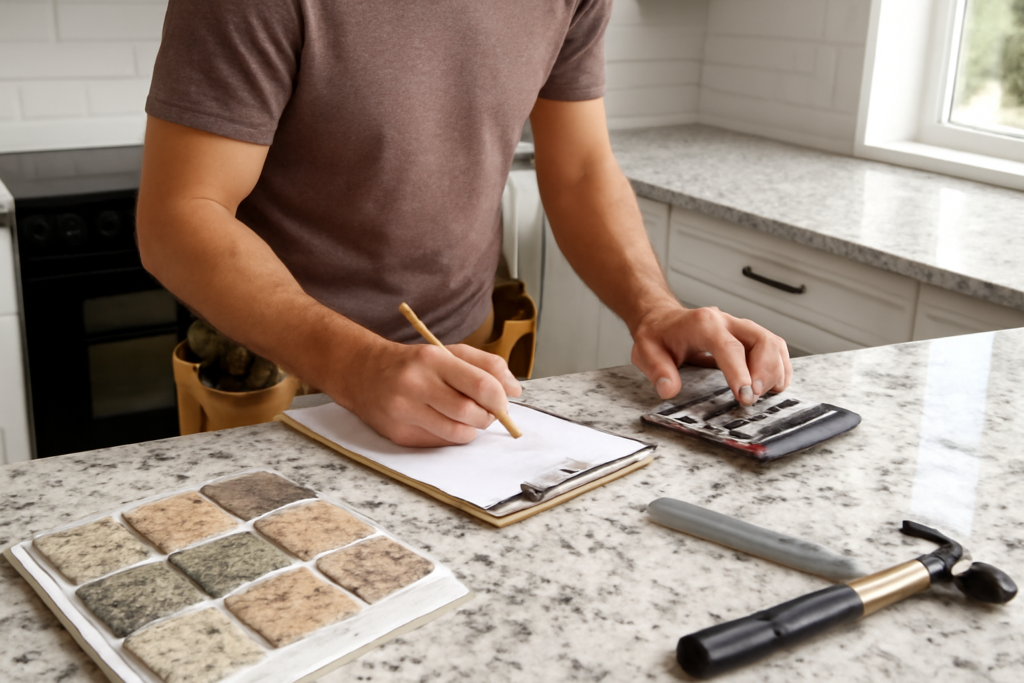
Granite still turns heads in a kitchen, but the number that stops most homeowners cold is the quote. The cost to install granite countertops runs roughly $40 to $100 per square foot installed, which puts a typical 40-square-foot kitchen somewhere between $2,000 and $4,500 for the whole job. That’s a wide range, and where you land inside it depends on the stone’s grade, your edge profile, how many seams and cutouts you need, and what your local fabricators charge for labor.
Part of our Countertops guide — explore the full guide →
I’ve walked plenty of homeowners through these quotes, and the sticker shock usually comes from not knowing what’s baked into the price. Granite isn’t a flat material cost. You’re paying for the slab, fabrication, template work, delivery, and a two-person install crew, plus the cutouts for your sink and cooktop. Break it down and the number makes a lot more sense, and you’ll spot where you can trim it.
- Average Cost Per Square Foot
- What's Included in a Typical Quote
- Factors That Drive the Price Up or Down
- Labor Costs Explained
- Additional Costs to Budget For
- How to Save Without Cutting Quality
- Is Granite Worth It Compared to Quartz?
- Sample Cost Breakdown for a Typical Kitchen
- Regional Price Differences
- Common Budgeting Mistakes to Avoid
- Frequently Asked Questions
Average Cost Per Square Foot
Installed granite typically breaks down like this by grade:
- Entry-level (Level 1): $40 to $60 per sq ft. Common colors, smaller crystal patterns, widely available slabs.
- Mid-grade (Level 2-3): $60 to $80 per sq ft. More movement, richer colors, thicker slabs.
- Premium/exotic (Level 4-5+): $80 to $200+ per sq ft. Rare colors, dramatic veining, imported one-of-a-kind slabs.
The per-square-foot figure almost always includes fabrication and standard installation from a full-service fabricator. Big-box stores like Home Depot and Lowe’s advertise low starting prices, often $45 per sq ft, but those are for the most basic colors with a straight edge and no upgrades.
What’s Included in a Typical Quote
A complete installed price usually covers the slab material, templating (measuring your cabinets precisely), CNC or hand fabrication, one standard sink cutout, an eased or bullnose edge, delivery, and installation with seaming and sealing. What often costs extra: additional cutouts, premium edges, extra seams on large kitchens, tear-out and disposal of your old counters, and plumbing reconnection.
Factors That Drive the Price Up or Down
Slab Grade and Color
This is the single biggest lever. A common speckled granite like Ubatuba sits at the low end, while a dramatic exotic like Blue Bahia can triple the material cost. Pick from your fabricator’s remnant or in-stock slabs to save real money.
Edge Profile
A standard eased or beveled edge is usually included. Upgraded profiles like ogee, waterfall, or a laminated bullnose add $10 to $30 per linear foot because they require more fabrication time.
Cutouts and Seams
Each undermount sink or cooktop cutout runs $100 to $250. Undermount sinks cost more to fabricate than drop-in because the edge must be polished. Larger kitchens need seams, and each one adds labor.
Kitchen Layout
An island, a raised bar, or a lot of corners means more cuts, more careful seaming, and sometimes a second slab to keep the pattern flowing, all of which add cost.
Labor Costs Explained
Installation labor typically runs $35 to $85 per hour per installer, and a standard kitchen install takes a two-person crew most of a day. Many fabricators bundle labor into the per-square-foot price, but if it’s broken out, expect $10 to $30 per square foot for fabrication and install labor alone. Tear-out of existing countertops adds $50 to $300 depending on material, and hauling away the old counters may be extra.
Additional Costs to Budget For
- Backsplash: a 4-inch granite backsplash runs $10 to $20 per linear foot; a full-height slab backsplash costs much more.
- Sealing: included in most installs, but resealing every 1 to 3 years costs $15 to $30 in DIY sealer.
- Plumbing: disconnecting and reconnecting the sink and faucet runs $150 to $350 if you hire a plumber.
- Cabinet reinforcement: heavy slabs on an island may need bracing, adding modest cost.
How to Save Without Cutting Quality
Shop remnants for a small kitchen or a bathroom vanity; fabricators sell leftover pieces at a steep discount. Stick with in-stock Level 1 and 2 colors, which look excellent and cost a fraction of exotics. Choose a standard edge and a drop-in sink to skip the upgrade fees. Get three quotes from local fabricators rather than defaulting to a big-box installer, since independents often beat chain pricing and give you access to more slabs. And handle your own old-counter demo if you’re handy, since tear-out is straightforward and saves a few hundred dollars.
Is Granite Worth It Compared to Quartz?
Granite and quartz land in a similar installed price range, roughly $40 to $100 per square foot, so cost alone rarely decides it. Granite is natural stone with unique patterns and handles heat well, but it needs periodic sealing. Quartz is engineered, non-porous, and maintenance-free but can scorch under a hot pan. If you want a genuine natural material and don’t mind resealing every couple of years, granite delivers strong value. Budget the full installed cost, add 10 percent for the extras above, and you’ll avoid surprises when the final invoice lands.
Sample Cost Breakdown for a Typical Kitchen
Numbers land better with a real example. Take a common 40-square-foot kitchen with an L-shaped counter and a modest island, one undermount sink, a standard eased edge, and a mid-grade Level 2 granite. Here’s roughly how the invoice shakes out in most metro markets:
- Granite slab material (Level 2), 40 sq ft: $2,000 to $2,800
- Fabrication and templating: $600 to $1,000
- Undermount sink cutout: $100 to $250
- Delivery and two-person installation: $400 to $700
- Old countertop tear-out and disposal: $100 to $300
- Sealing (first application): usually included
That puts the all-in figure around $3,200 to $5,000 for a job like this. Swap in an entry-level color and do your own demo and you can shave it toward $2,500; step up to an exotic slab with a waterfall edge and it climbs past $7,000 fast.
Regional Price Differences
Where you live moves the needle more than most homeowners expect. Labor and slab prices in high-cost metros like San Francisco, New York, Boston, and Seattle run 20 to 40 percent above the national average, so a job that’s $3,500 in Dallas or Atlanta can be $5,000 or more on the coasts. Rural areas sometimes cost less on labor but more on delivery, since the slab may travel hours from the nearest stone yard. Getting quotes from three local fabricators is the only reliable way to pin your real number, and independents in most markets undercut the big-box installers while offering a wider slab selection.
Common Budgeting Mistakes to Avoid
The advertised per-square-foot price is where people get burned. That $45 figure is almost always the base color with a straight edge and nothing else, so the quote balloons once you add real edges, cutouts, and tear-out. Budget for the extras from the start.
- Forgetting tear-out and disposal. Removing old laminate or tile isn’t free, and hauling it off costs extra.
- Ignoring plumbing reconnection. A plumber to hook the sink and faucet back up runs $150 to $350.
- Underestimating edge and cutout upgrades. An ogee edge across a big kitchen adds hundreds fast.
- Skipping the on-site measure. Never budget off cabinet dimensions alone; templating catches costly surprises.
Frequently Asked Questions
How long does granite last? Decades, often the life of the kitchen. Sealed and cared for, it resists scratches and heat and rarely needs replacement.
How often do I reseal? Every one to three years for most granite, more often for lighter, more porous stones. A water-bead test tells you when it’s due, and DIY sealer costs $15 to $30.
Can I install granite myself? Not recommended. Slabs are heavy, brittle, and easy to crack, and seaming and leveling take specialized tools. You can save money by handling tear-out yourself instead.
How long does installation take? After templating, fabrication runs one to two weeks, and the actual install is usually a single day for a standard kitchen.


