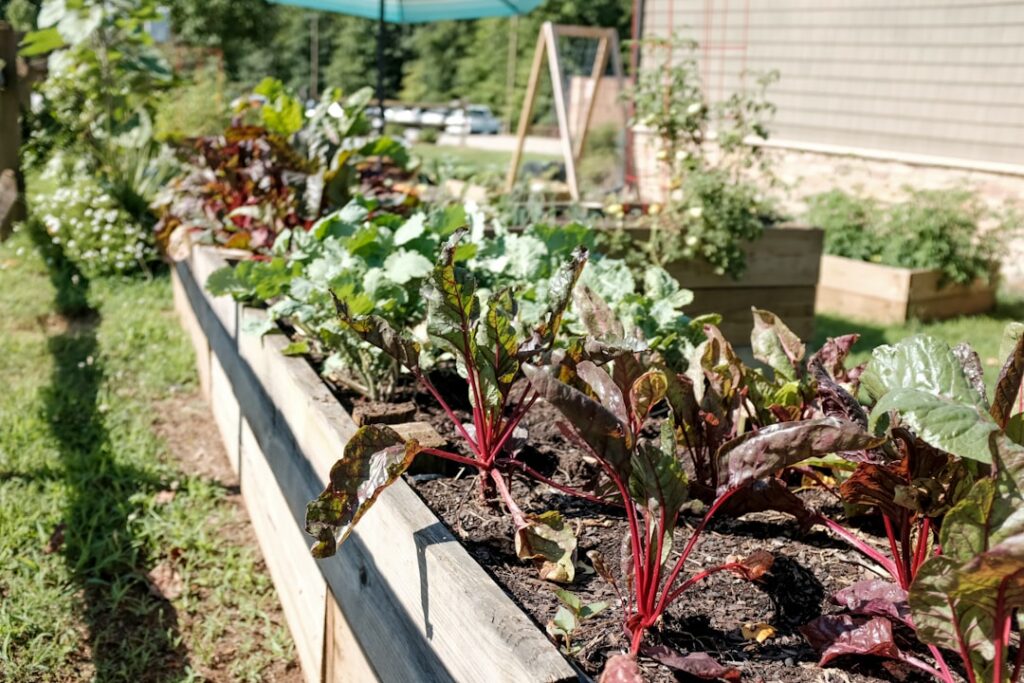
These raised planter box plans are the same two builds I hand to homeowners who want a garden bed that lasts a decade, not a season. Both use standard dimensional lumber from any yard, need only a drill and a saw, and go together in an afternoon. I will give you the exact boards, screws, corner posts, and soil volumes so you can price the job before you buy a single thing.
Whether you want a big 4-by-8-foot production bed or a compact 2-by-4-foot patio box, the method is identical. Read both cut lists, pick your size, and match the lumber to your budget.
- Choosing Your Lumber: Cedar vs Pine
- Plan A: The 4×8 Production Bed
- Plan B: The 2×4 Compact Box
- Calculate Your Soil Volume
- Should You Add a Liner?
- Hardware, Tools, and Fastener Details
- Positioning and Prepping the Site
- Filling and Planting Your New Bed
- Maintenance to Extend the Life of Your Box
- Cost Breakdown and Final Tips
Choosing Your Lumber: Cedar vs Pine
Wood choice drives both cost and lifespan, so decide this first. Western red cedar is naturally rot-resistant thanks to its oils and will last 10 to 15 years untreated. It is also the priciest, running about $3.50 to $6 per linear foot for a 2×10. Untreated pine or fir costs a third of that, around $1.50 to $2.50 per linear foot, but only lasts 4 to 7 years in contact with wet soil.
Douglas fir splits the difference and is a solid mid-tier pick. Skip old pressure-treated lumber for food crops if it makes you nervous, though modern ACQ and copper-azole treatments are rated safe for garden use by most extension services. My default recommendation for a bed you will keep is cedar for the walls and pressure-treated 4×4 for the buried corner posts, since those posts take the most rot pressure.
Plan A: The 4×8 Production Bed
This is the workhorse. At 4 feet wide you can reach the center from both sides, and 8 feet of length gives real growing room. I build these 11 inches tall using 2×12 boards, which is deep enough for carrots, potatoes, and tomato roots.
Cut List for the 4×8 Bed
- 2 side walls: 2×12 lumber cut to 96 inches (use full 8-foot boards, no cut needed)
- 2 end walls: 2×12 lumber cut to 45 inches (so outside dimension lands at 48 inches)
- 4 corner posts: 4×4 cut to 15 inches each (11 inches inside the box, 4 inches buried as a stake)
- Fasteners: 3.5-inch exterior deck screws, coated or stainless, about 40 pieces
Assembly Steps
- Stand a 4×4 post on end and butt one 96-inch side board against it, top edges flush. Drive four 3.5-inch screws through the board into the post.
- Attach the second side board to another post the same way.
- Set the 45-inch end boards between the two side assemblies, screwing into the posts to form a rectangle.
- Flip the box so the 4 inches of post below the boards point down. Set the box in place and press or tap the posts into the soil to anchor it and keep the walls from bowing.
For a bed longer than 6 feet, the long walls will bow outward under wet soil pressure. Add a center brace: a 2×12 cross-tie screwed across the middle, or a length of galvanized wire and a turnbuckle spanning the two long walls just below the top edge.
Plan B: The 2×4 Compact Box
When space or budget is tight, this small bed is perfect for herbs, salad greens, or a couple of pepper plants. I build it 9.25 inches deep from a single 2×10 board ripped down or used at full width.
Cut List for the 2×4 Bed
- 2 side walls: 2×10 cut to 48 inches
- 2 end walls: 2×10 cut to 21 inches (outside dimension lands at 24 inches)
- 4 corner posts: 2×2 or 4×4 offcuts cut to 12 inches
- Fasteners: 3-inch exterior deck screws, about 24 pieces
Assembly mirrors the big bed: screw the boards to the corner posts, keep the top edges flush, and leave a couple of inches of post below to stake into the ground. Because this box is short, it needs no center brace.
Calculate Your Soil Volume
Buying too little soil means a half-empty bed, and buying too much wastes money, so run the numbers. Volume in cubic feet equals length times width times depth, all in feet.
- 4×8 bed at 11 inches deep: 8 x 4 x 0.92 = about 29 cubic feet, roughly 1.1 cubic yards.
- 2×4 bed at 9.25 inches deep: 4 x 2 x 0.77 = about 6.2 cubic feet, roughly 0.23 cubic yards.
Bulk soil from a landscape yard costs $30 to $55 per cubic yard, versus $6 to $9 per cubic-foot bag at retail. For the big bed, bulk delivery saves real money. Fill with a mix of about 60 percent topsoil, 30 percent compost, and 10 percent coarse aeration like perlite or pine bark fines.
Should You Add a Liner?
A liner is optional but worth considering. Line the inside walls, not the bottom, with heavy-duty landscape fabric or 6-mil polyethylene stapled to the top few inches of the boards. This slows the soil’s contact with the wood and can add a couple of years to a pine bed’s life. Leave the bottom open so worms and roots move freely into the native soil and water drains.
Down in the bed’s base, lay a sheet of cardboard directly on the soil before filling. It smothers grass and weeds, then breaks down within a season once the roots are already established above it. Do not use plastic on the bottom or you will trap water and drown your plants.
Hardware, Tools, and Fastener Details
Do not cheap out on screws. Bright interior screws rust through in one wet season. Use coated exterior deck screws or, best of all, stainless steel in a 305 or 316 grade. For 2×12 lumber, 3.5-inch screws bite deep enough into the corner posts; for 2×10, 3-inch is plenty.
Pre-drill the ends of your boards with a 1/8-inch bit to keep the wood from splitting, especially with cedar, which is soft and prone to cracking near the ends. Your tool list is short: a circular saw or miter saw, a drill or impact driver, a tape measure, a speed square, and safety glasses.
Positioning and Prepping the Site
Before you set the finished box down, prep the ground under it. Pick a spot that gets at least six hours of direct sun for vegetables, and stay clear of large tree roots that will invade from below. Pull or mow the grass short, then rake the footprint roughly level so the box does not rock.
You do not need a foundation, but a couple of inches of the bed’s weight settling into soft turf is normal, so check the box with a level after filling and shim the low corners with flat stones if needed. If gophers or voles are a problem in your area, staple a layer of half-inch galvanized hardware cloth across the bottom before you fill; it costs about $1.50 per square foot and stops burrowing pests cold while still letting roots and water pass.
Filling and Planting Your New Bed
Fill the box in stages rather than dumping all the soil at once. Add a few inches, water lightly to settle it, and repeat until you reach about an inch below the top rail. That inch of freeboard keeps soil and mulch from spilling over the edge every time you water. Expect the soil to settle another inch or two over the first few weeks, so plan to top it off after the first good rain.
A fresh 4×8 bed at 11 inches deep grows almost anything: tomatoes caged on the north side, peppers and bush beans in the middle, and lettuce, radishes, and herbs along the sunny south edge. The 2×4 box suits a tidy herb garden or a cut-and-come-again salad bed. Whatever you plant, add 2 to 3 inches of straw or shredded-leaf mulch on top to hold moisture and block weeds.
Maintenance to Extend the Life of Your Box
A few small habits stretch a wooden bed’s lifespan by years. Every fall, brush loose soil off the top edges where water pools and rots the grain first. If you built with pine or fir, a coat of food-safe linseed oil or a raw tung oil on the outside faces every year or two slows weathering considerably; skip petroleum-based sealers on the interior where roots grow.
Watch the corners, since that is where boxes fail first as screws loosen and boards cup. Snug up any backed-out screws each spring, and if a board finally rots, the beauty of screwed construction is that you can pull that single board and replace it without rebuilding the whole box.
Cost Breakdown and Final Tips
Here is roughly what each bed costs to build and fill in the first year.
- 4×8 cedar bed: $110 to $160 in lumber and screws, plus $50 to $90 in soil, for a total near $160 to $250.
- 4×8 pine bed: $45 to $70 in lumber, plus soil, landing around $95 to $160 total.
- 2×4 bed: $25 to $45 in lumber, plus $15 to $30 in soil, for $40 to $75 total.
Set your finished bed on a level spot, check it with a 2-foot level side to side, and shim under the low posts with flat stones if the ground slopes. A bed that sits level waters evenly instead of pooling at one end. Build one this weekend, see how it grows, and you will almost certainly want a second by fall.