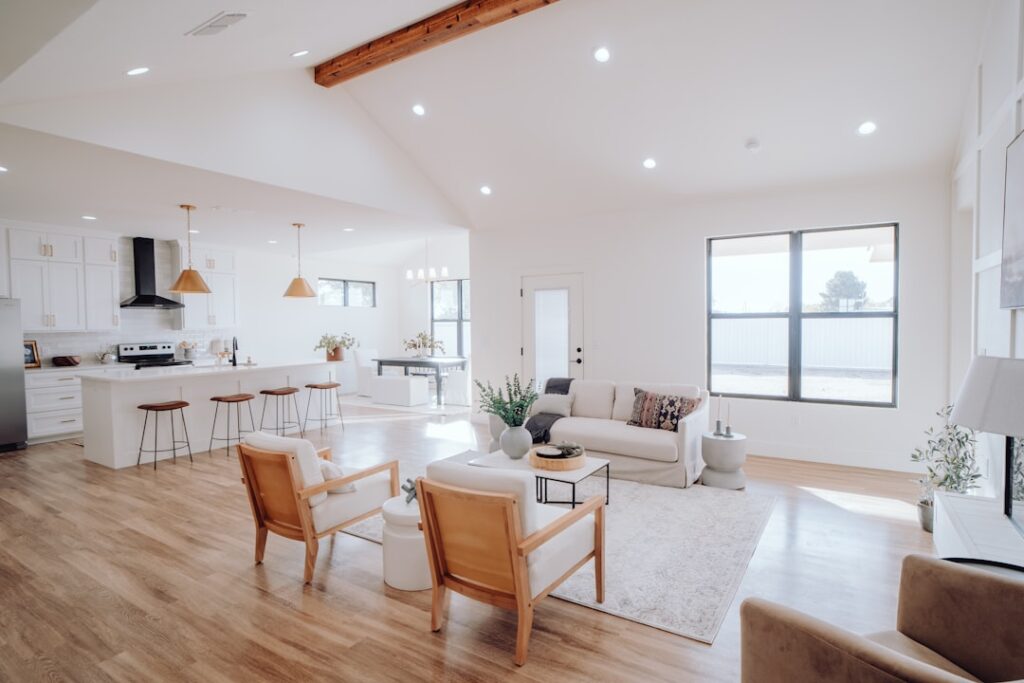
If you love the look of oak or walnut but worry about warping in a basement or over a concrete slab, real wood engineered flooring is probably the smartest product on the shelf for you. It gives you a genuine hardwood surface you can sand and finish, bonded to a stable plywood core that handles humidity far better than a solid plank. I have installed it in kitchens, finished basements, and second-floor condos over the years, and it consistently outperforms solid wood in the places where moisture and temperature swings would otherwise cause trouble. This guide walks you through what it actually is, where it shines, where it falls short, and how to buy a board that lasts 30 years instead of 10.
What Engineered Wood Flooring Actually Is
Every plank is a sandwich. The top layer, called the wear layer or veneer, is a slice of real hardwood, usually anywhere from 0.6mm on the cheapest imports up to 6mm on premium goods. Beneath that sits a core of three to twelve plywood plies, each glued with the grain running in alternating directions. That cross-ply construction is the whole trick: because the layers pull against each other, the board resists the seasonal expansion and cupping that plagues solid planks.
Do not confuse this with laminate. Laminate is a photograph of wood printed on paper and fused to fiberboard, and it will never be real timber underfoot. Engineered flooring is genuine sawn hardwood on top, so it looks, feels, and sounds like the real thing because it is the real thing. The difference shows up the moment you run your hand across the grain or drop a wine glass and hear the solid thunk instead of the hollow click of a laminate floor.
The Real Advantages You Get
Dimensional stability is the headline benefit. A solid oak plank can gain or lose a quarter inch of width across a 12-foot room between a humid August and a dry January. Engineered planks move a fraction of that, which is why you can install them over radiant heat, in below-grade basements, and directly over concrete where a solid floor would eventually buckle or gap.
You also get flexible installation. Many engineered products click together as a floating floor over a foam underlayment, meaning no nails, no glue, and a weekend DIY job for a competent homeowner. Others can be glued down or stapled to a subfloor. That versatility saves money on labor, since a floating install runs roughly $2 to $4 per square foot in labor versus $4 to $8 for a nailed solid floor.
Because the plank comes pre-finished from the factory with seven to nine coats of aluminum-oxide urethane, the surface is often tougher than a site-finished solid floor and you skip the days of sanding dust and fumes. You walk on it the day it goes down.
Wider boards are another quiet advantage. Solid wood becomes unstable and prone to cupping past about 5 inches of width, so classic strip floors are narrow. Engineered construction lets manufacturers offer 7-inch and even 9-inch planks that stay flat, giving you the wide, modern look that dominates design magazines without the movement problems a solid board that wide would suffer. That single feature is why so many high-end new builds specify engineered over solid.
The Downsides Worth Knowing
The biggest limitation is refinishing. A solid plank is three-quarters of an inch of workable wood and can be sanded five or six times over a century. A veneer floor with a 0.6mm top layer cannot be sanded at all without cutting through to the plywood, and even a 2mm layer gives you only one light screen-and-recoat. If you want a floor your grandchildren can refinish, buy a 4mm or 6mm wear layer or stick with solid.
Cheap engineered products also cut corners in the core. A thin veneer over a soft, low-ply core can telegraph subfloor imperfections and feel spongy underfoot. And while engineered wood tolerates humidity better than solid, it is still real timber, so standing water from a dishwasher leak or a burst pipe will still ruin it. This is not waterproof vinyl.
Understanding Wear-Layer Thickness
Wear layer is the single most important spec, so read the box carefully. A 0.6mm to 1mm veneer belongs in a rental, a guest room, or a flip where you only need it to look good for a few years. A 2mm to 3mm layer is the sweet spot for most homeowners, giving one refinish and a lifespan of 20 to 30 years with normal care. Splurge on a 4mm to 6mm wear layer only if you want multiple refinishes and plan to stay in the home for decades.
Watch how manufacturers describe it, because some list the total board thickness, which might be 1/2 inch or 5/8 inch, and bury the actual veneer number in the fine print. The total thickness tells you about stability and how the floor meets your existing doors; the veneer thickness tells you how long the real wood surface will survive.
What It Costs
Material pricing spans a wide range. Budget engineered oak with a thin veneer starts around $3 to $4 per square foot. Mid-grade planks with a respectable 2mm to 3mm wear layer and a wider board typically run $5 to $9 per square foot. Premium wide-plank European oak or American walnut with a thick veneer and character-grade grain can hit $10 to $15 or more.
Add installation and you are looking at a total installed cost of roughly $6 to $18 per square foot. For a 400-square-foot living room, budget somewhere between $2,400 and $7,000 depending on the product and whether you install it yourself. Do not forget the extras: underlayment at about $0.30 to $0.60 per square foot for a floating install, transition strips, and 8 to 10 percent overage for cuts and waste.
Choosing the Right Species and Finish
Oak remains the workhorse for good reason. It is hard, it hides scratches thanks to its open grain, and it takes stain evenly. Hickory and maple are even harder but show scuffs more on their smoother faces. Walnut is softer and dents more easily, but its deep chocolate color is unmatched for a warm, upscale room. Match the species hardness to your household: a home with big dogs and kids leans toward oak or hickory, while a low-traffic formal space can carry softer walnut.
Finish matters as much as species. Wire-brushed and matte finishes hide daily wear beautifully, which is why they dominate current sales. High-gloss finishes look stunning on install day but reveal every footprint and hairline scratch within a month. For most homes I steer people toward a matte or low-sheen wire-brushed board that ages gracefully.
How to Buy Smart
Order samples before you commit and live with them for a week, viewing each one under your actual daylight and evening lighting. Colors that look warm in a showroom often read gray or cold at home. Check the warranty too, but read it critically: a 30-year finish warranty is meaningless if the veneer is only 0.6mm thick.
Acclimate the boxes in the room for 48 to 72 hours before installation so the planks reach the home’s humidity. Confirm your subfloor is flat to within 3/16 inch over 10 feet, because no floating floor forgives a wavy base. When you weigh everything together, real wood engineered flooring gives you the authentic timber you want with the stability modern homes demand, and buying the right wear layer up front is what separates a floor you love for decades from one you regret in a few years.
Prefer to explore on your own?
See how new flooring looks in your actual room in seconds — free, no signup.
Try the free Floor Studio →