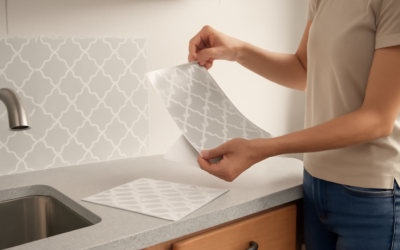
Renters lose roughly $1.2 billion in security deposits every year, and damaged subfloor adhesive is a leading culprit. Removable flooring sidesteps that problem entirely by floating, clicking, or peeling away when you move. The category has expanded well past cheap foam mats, with peel-and-stick luxury vinyl, interlocking PVC tiles, and floating click-lock planks all qualifying. If you need a surface that performs like permanent flooring but lifts without a putty knife, this guide breaks down what actually works.
What Counts as Removable Flooring
The category covers any floor system installed without permanent adhesive bonding to the subfloor. Most products fall into four groups: peel-and-stick LVT with releasable adhesive, snap-together interlocking PVC or rubber tiles, floating click-lock planks (laminate, SPC, WPC), and roll-out vinyl sheet held by perimeter tape or gravity. The common thread is that any homeowner with a utility knife and a pry bar can lift the floor in an afternoon without damaging the slab or plywood underneath.
Manufacturers like Achim, FloorPops, Lucida Surfaces, and Greatmats have built entire product lines around this category. Even mainstream brands such as Pergo and Karndean now offer click-lock LVP rated for floating installation, which technically qualifies as removable since no fasteners or glue touch the subfloor.
Best Use Cases
Apartments top the list. Most leases prohibit permanent floor changes, but a floating click-lock plank or peel-and-stick tile installed over existing vinyl or tile reads as a rug to a landlord. Basements come second because moisture-resistant SPC and rubber tiles can be pulled up if a slab cracks or a water heater fails. Other strong fits include event spaces, trade-show booths, garage gyms, sunrooms with seasonal temperature swings, and rental properties where turnover demands fast refresh.
Cost Per Square Foot
Pricing spans a wide range depending on construction. Budget peel-and-stick vinyl tile from Achim or FloorPops runs $0.79 to $1.50 per square foot at Home Depot or Lowe’s. Mid-tier floating LVP from Lucida or Smartcore lands at $2.50 to $4.50 per square foot with a 12 to 20 mil wear layer. Interlocking rubber tiles for gyms cost $2.00 to $5.00 per square foot in 8mm to 12mm thickness. Premium click-lock products from Karndean Looselay or COREtec push $5.00 to $7.50 per square foot but deliver a 22 mil commercial-grade wear layer and 25-year residential warranties.
Installation Methods Compared
Three install styles dominate the removable category, each with tradeoffs:
- Peel-and-stick: Releasable PSA adhesive sticks to clean, smooth subfloor. Fastest to install but the trickiest to remove cleanly after several years of heat cycling.
- Click-lock floating: Planks lock edge-to-edge over an attached or separate underlayment. No adhesive contacts the subfloor. Easiest to pull up and reinstall in another room.
- Interlocking tile: Rigid PVC or rubber squares with puzzle-piece edges. Designed for tool-free install and disassembly, ideal for gyms and garages.
Loose-lay LVP from Karndean uses a high-friction backing that grips the subfloor through weight alone, with no clicks or glue. It is the cleanest removal of any product on the market but costs $4.50 to $6.50 per square foot.
Pros and Cons
The advantages are obvious for renters and DIYers: no contractor needed, no specialty tools beyond a utility knife and tape measure, and full reversibility. A 200 square foot living room takes one motivated person about six hours to install start to finish. Damaged planks swap out individually without ripping up the whole floor.
The drawbacks deserve honest mention. Peel-and-stick tiles can curl at seams after two or three summers if the subfloor was not perfectly flat or clean. Click-lock floors require expansion gaps that look awkward against baseboards if the wall is wavy. Hollow sound underfoot is common on rigid floating systems unless you upgrade to an acoustic underlayment rated 18 to 22 IIC. Resale value contribution is also limited compared to glue-down LVT or nailed hardwood.
Subfloor Prep That Actually Matters
Removable does not mean forgiving. Peel-and-stick tile telegraphs every bump and trowel mark through the wear layer within months. Sweep, then damp-mop with a 50/50 isopropyl-water mix, and let it dry overnight before laying tile. For concrete, run an ASTM F1869 calcium chloride moisture test if the slab is below grade; anything above 5 pounds per 1,000 sq ft per 24 hours requires a moisture barrier under floating product. On plywood, fill any seam gaps wider than 1/8 inch with floor patch and sand smooth.
Brands Worth Considering
For peel-and-stick budget projects, FloorPops and Achim Nexus offer the widest pattern selection at sub-$1.50 per square foot. Lucida Surfaces sells a strong floating LVP for under $3.00 that handles light-traffic apartments well. Step up to Karndean LooseLay or COREtec Pro Plus for premium removable performance with 20 mil wear layers and FloorScore IAQ certification. For garage and gym applications, Greatmats and IncStores dominate the interlocking rubber and PVC tile market with thicknesses from 3/8 inch to 1 inch.
Expansion Gaps and Trim Details
Floating removable floors expand and contract with temperature and humidity. Leave a 1/4 inch expansion gap at every wall, doorway, and vertical obstacle per manufacturer spec. Cover gaps with shoe molding or quarter round nailed to the baseboard, never to the floor itself. Skipping the gap or pinning the trim to the planks causes peaking and ridge formation within the first heating season; the fix requires pulling apart the floor to reset alignment.
For peel-and-stick tile, the expansion concern is smaller but not zero. Leave a 1/16 inch gap at perimeter walls and conceal with caulk in a matching tone. For interlocking rubber and PVC tile, perimeter ramped edges from Greatmats or IncStores finish the installation cleanly and add safety at room transitions.
Final Verdict
Removable flooring earns its place when reversibility, speed, or rental-friendly install matters more than maximum durability or resale impact. Pick a click-lock floating plank with at least a 12 mil wear layer for living spaces, peel-and-stick for kitchens and small baths under 80 square feet, and interlocking rubber for any room that doubles as a gym. Skip it for whole-house remodels, high-traffic foyers, and homes where you plan to stay more than ten years; in those cases, a glue-down LVT or engineered hardwood will outperform on every metric except removability itself.
Prefer to explore on your own?
See how new flooring looks in your actual room in seconds — free, no signup.
Try the free Floor Studio →