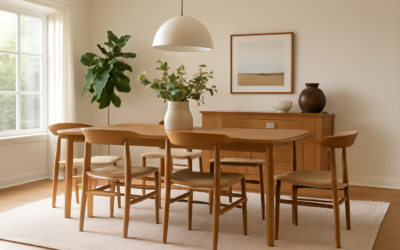
Nothing undermines a dining room faster than a rug that leaves chairs teetering half on and half off when guests sit down. Finding the right size dining table rug size chart match is really about one core rule: the rug must be large enough that every chair stays fully on it even when pulled out to sit. That single principle drives every measurement in this guide. Below you will find a clear size chart matched to common table shapes and seating counts, plus the formula to calculate the perfect rug for your own dining set.
The One Rule That Matters Most
Before any chart, understand the guiding principle: chairs must remain entirely on the rug both when tucked in and when pulled out to sit. If a chair’s back legs slide off the rug’s edge as someone sits down, the chair catches, wobbles, and the whole arrangement looks and feels wrong.
To make that happen, the rug needs to extend at least 24 inches beyond every edge of the table. That 24-inch margin accounts for the depth a chair travels when pulled out, plus the space a seated person’s chair occupies. Some designers push this to 30 inches for larger chairs or armchairs. Whenever you are between two rug sizes, always choose the larger one; a too-big rug looks intentional, while a too-small rug looks like a mistake.
Dining Table Rug Size Chart
Using the 24-inch-beyond-all-edges rule, here are the recommended rug sizes for common tables. Match your table’s dimensions and seating to find your target rug.
- Small square or round table (seats 4, about 36 to 44 in): 6 by 9 ft rectangular, or an 8 ft round.
- Rectangular table seating 4 to 6 (about 60 to 72 in long): 8 by 10 ft rug.
- Rectangular table seating 6 to 8 (about 72 to 96 in long): 9 by 12 ft rug.
- Large rectangular table seating 8 to 10 (96 in and up): 10 by 14 ft rug.
- Round table seating 4 to 6 (48 to 60 in diameter): 8 ft round rug.
- Oval table seating 6 to 8: 9 by 12 ft rectangular or a large oval rug.
These are starting points. Always verify against your actual table by adding 48 inches to both the length and width, since you need 24 inches on each side, and comparing to the rug sizes available.
How to Calculate Your Exact Rug Size
You do not have to rely on the chart alone. The formula is simple: take your table’s length and add 48 inches (24 inches for each end), then take the table’s width and add 48 inches (24 inches for each side). The result is the minimum rug size you need.
For example, a 72-inch by 40-inch rectangular table calculates to 120 inches by 88 inches, which is 10 feet by roughly 7.3 feet, so a 9-by-12 rug is the safe, standard choice that comfortably clears every chair. For a round table, add 48 inches to the diameter: a 54-inch round table needs a rug at least 102 inches, so an 8-foot round or 8-by-10 rectangle works. This math guarantees your chairs stay on the rug in every position.
Matching Rug Shape to Table Shape
Coordinating shapes creates visual harmony, though it is not a strict requirement. A rectangular or oval rug pairs naturally with a rectangular or oval table, echoing its lines and framing the setting cleanly. A round rug complements a round or square table beautifully, reinforcing the circular geometry.
That said, you can mix shapes intentionally. A round table over a rectangular rug can work in a rectangular room where the rug better fits the space. The priority is always the 24-inch clearance rule first, shape harmony second. If following the shape would force you into a rug too small to seat the chairs, choose the size that keeps chairs on the rug and let function win.
Placement and Proportion in the Room
Once you have the right size, center the rug precisely under the table so the border of exposed floor is even on all sides. The rug should feel balanced within the room, ideally leaving at least 18 to 24 inches of bare floor between the rug’s edge and the surrounding walls so it does not look wall-to-wall.
Be careful in smaller dining rooms: a rug sized correctly for the table might crowd the walls, in which case a slightly smaller table or a more compact seating count may be the better fix rather than shrinking the rug below the safe margin. In an open-concept space, the dining rug also helps define the eating zone, so a properly proportioned rug does double duty as a visual anchor.
Adjusting for Extendable and Odd-Shaped Tables
Tables with leaves complicate the math because the footprint changes. If you frequently extend the table for guests, size the rug to the fully extended length plus the 24-inch margin so chairs stay on the rug even when the table is at its largest. On the days the table is compact, the rug will simply have a bit more exposed border, which looks fine, whereas a rug sized only to the closed table leaves chairs hanging off when you extend it.
Odd shapes need the same 24-inch principle applied thoughtfully. For a live-edge or irregular table, measure to the widest points and add the margin there. For a long, narrow farmhouse table, a runner-proportioned large rectangle keeps the border even without an oversized rug crowding the walls. The rule never changes: every chair, pulled out to sit, must land fully on the rug.
Bench seating changes the calculation slightly. A bench that tucks fully under the table and does not slide out to seat someone needs less clearance on that side, so you can sometimes get away with a smaller margin behind a bench. Chairs on the remaining sides still require the full 24 inches, so size to the chairs, not the bench.
Common Dining Rug Mistakes to Avoid
The single most common error is buying a rug too small, one that leaves chairs catching on the edge when guests sit down. It makes the room feel cramped and looks like an afterthought, and no amount of styling fixes it. When you are unsure between two sizes, always go larger. A second frequent mistake is choosing a plush, high-pile rug that snags chair legs and traps every crumb, turning cleanup into a chore.
Other pitfalls include skipping the rug pad, which lets the rug shift and wear, and centering the rug on the room while ignoring the table, so the two do not align. Placing a patterned rug so busy it competes with the table setting is another. Nail the size first, keep the pile low, add a pad, and center it under the table, and your dining rug will look intentional and function flawlessly for years.
Choosing the Right Material Too
Size is the priority, but material matters under a dining table where spills and chair movement are constant. Choose a low-pile or flat-weave rug, which lets chairs slide easily and cleans up quickly, over a plush high-pile rug that traps crumbs and snags chair legs. Wool, polypropylene, and indoor-outdoor rugs all handle dining-room duty well.
Add a rug pad underneath to keep the rug from shifting and to protect your floor. With the correct size from the chart or formula, a shape that suits your table, and a practical low-pile material, your dining rug will seat every chair comfortably, protect the floor, and pull the whole room together exactly as it should.