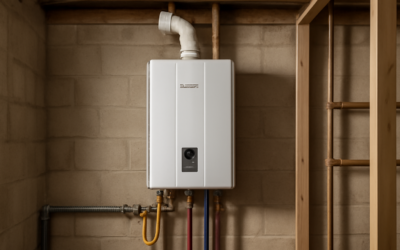
If you’ve ever run out of hot water halfway through a shower because someone else used it first, a tankless system solves that problem permanently. A Rinnai gas water heater is one of the most popular tankless options in American homes, heating water on demand rather than storing it, so you get a continuous supply that never runs dry. Rinnai has built its reputation on reliable, high-efficiency gas tankless units, but choosing and installing one correctly requires understanding sizing, gas and venting requirements, and the real costs involved.
This guide walks through how Rinnai tankless heaters work, the main model families, how to size one for your home, installation and cost realities, and the maintenance that keeps them running for 20 years.
How a Gas Tankless Heater Works
A traditional tank heater keeps 40 to 80 gallons hot around the clock, burning energy even when no one’s using water. A tankless unit works completely differently. When you open a hot tap, cold water flows through the unit, a powerful gas burner fires, and a heat exchanger raises the water to your set temperature instantly as it passes through. Close the tap, and the burner shuts off.
The result is endless hot water — you can run a shower indefinitely — and no standby energy loss from keeping a tank hot. Rinnai’s gas units use natural gas or propane and deliver high flow rates, which is why they’re favored for whole-home applications rather than just point-of-use.
Rinnai Gas Water Heater Model Families
Condensing Models (High Efficiency)
Rinnai’s condensing tankless heaters capture extra heat from the exhaust gases, pushing energy factor ratings to the highest levels and cutting fuel use. They vent with inexpensive PVC piping and are the top pick for efficiency-focused homeowners, though they cost more up front. Look to these for the best long-term operating savings.
Non-Condensing Models
These are the more affordable tankless units. They’re still far more efficient than a tank heater but require stainless-steel or category-appropriate venting, which can add to installation cost. A solid choice when budget matters and your venting run is short.
Sensei and SE+ Series
Rinnai’s Sensei line represents its modern condensing lineup, known for compact size, quiet operation, and smart features like Wi-Fi monitoring through an app. Many models offer recirculation compatibility for near-instant hot water at distant fixtures.
Sizing a Tankless Heater Correctly
Tankless sizing isn’t about gallons stored — it’s about flow rate, measured in gallons per minute (GPM), and the temperature rise your climate demands. Get this wrong and the unit will struggle to keep up during peak demand.
First, add up the GPM of fixtures you might run at once:
- Shower: 1.5 to 2.5 GPM
- Kitchen faucet: 1.0 to 1.5 GPM
- Bathroom faucet: 0.5 to 1.5 GPM
- Dishwasher: 1.0 to 1.5 GPM
- Washing machine: 1.5 to 2.0 GPM
Then factor in temperature rise. If your incoming groundwater is 50°F and you want 120°F output, the unit must raise the temperature 70 degrees — and colder climates demand more capacity for the same flow. A typical family home needs a unit rated around 7 to 11 GPM. In warm southern climates a smaller unit suffices; in the cold North, size up. When in doubt, err larger so you never run short during simultaneous demand.
Installation and Venting Requirements
Gas tankless installation is more involved than swapping a tank, and it’s generally a job for a licensed plumber:
- Gas supply: tankless units fire at very high BTU levels, so they often need a larger gas line (3/4-inch is common) than a tank heater used
- Venting: condensing models vent with PVC; non-condensing require stainless-steel venting rated for the heat
- Condensate drain: condensing units produce acidic condensate that must drain properly, sometimes through a neutralizer
- Electrical: even gas units need a 120-volt outlet for the electronics and ignition
- Mounting: the compact unit hangs on a wall, freeing up floor space compared to a bulky tank
Because of the gas, venting, and condensate work, professional installation is strongly recommended and often required by code and warranty.
Costs to Expect
Here’s a realistic budget picture:
- Unit cost: $600 to $1,700 depending on capacity and whether it’s condensing
- Professional installation: $1,000 to $3,000, more if gas-line or venting upgrades are needed
- Total installed: commonly $2,000 to $4,500 for a whole-home system
- Operating savings: tankless units can cut water-heating energy use by 20 to 40 percent versus an older tank
The higher upfront cost is offset over time by lower energy bills and a longer lifespan — Rinnai tankless units routinely last 20 years, roughly double a tank heater, and often qualify for utility or tax rebates.
Maintenance for a Long Lifespan
The single most important tankless maintenance task is annual descaling, especially in hard-water areas. Mineral scale builds up in the heat exchanger and reduces efficiency and flow over time. Once a year, a plumber (or a handy homeowner with a flush kit) circulates white vinegar or a descaling solution through the unit for 45 minutes to dissolve buildup. Rinnai units include isolation valves or accept a flush kit to make this straightforward. Also clean the inlet water filter periodically and check the venting for obstructions. Installing a water softener in hard-water homes dramatically reduces scaling and extends the heat exchanger’s life.
Is a Rinnai Tankless Right for You?
A Rinnai gas water heater is an excellent choice if you want endless hot water, lower energy bills, a compact wall-mounted footprint, and a unit that lasts two decades. It shines in households that run out of hot water with a tank, or homeowners who want to stop paying to keep water hot around the clock. Just budget for the higher installation cost, size it correctly for your climate and simultaneous demand, and commit to annual descaling. Do that, and you’ll enjoy reliable, efficient, on-demand hot water for the better part of a generation.
Tankless vs. Tank: Making the Switch
Homeowners replacing an aging tank often wonder whether the switch to tankless is worth the extra upfront cost. The everyday benefits are real: endless hot water so no one gets a cold shower, a compact wall-mounted unit that frees up floor space, and roughly 20 to 40 percent lower water-heating energy use than an old tank. The trade-offs are the higher purchase and installation price and the need for annual descaling. There’s also a brief lag — a few seconds of cold water before hot arrives — which a recirculation-compatible model or a small buffer tank can minimize. For households that frequently run out of hot water, value the space savings, or plan to stay in the home long enough to recoup the investment through lower bills and the unit’s 20-year lifespan, the switch pays off. For a short-term stay or a very tight budget, a high-efficiency tank may make more sense.
Frequently Asked Questions
How long does a Rinnai tankless water heater last?
With proper maintenance, Rinnai tankless units routinely last around 20 years — roughly double the lifespan of a typical tank heater. The key to reaching that longevity is annual descaling to prevent mineral buildup in the heat exchanger, plus cleaning the inlet filter and keeping the venting clear. Homes with hard water benefit greatly from a water softener to reduce scaling.
What size tankless heater does my home need?
Size by flow rate in gallons per minute and your climate’s temperature rise, not by tank gallons. Add up the GPM of fixtures you’d run simultaneously, then account for how much the unit must raise your incoming water temperature. Most family homes need roughly 7 to 11 GPM, sizing up in colder northern climates and down in warm southern regions.
Why does my tankless heater need annual descaling?
Mineral scale builds up inside the heat exchanger over time, reducing efficiency and flow, especially in hard-water areas. Once a year, circulating white vinegar or a descaling solution through the unit for about 45 minutes dissolves that buildup. Rinnai units include isolation valves or accept a flush kit to make the process straightforward for a plumber or a handy homeowner.