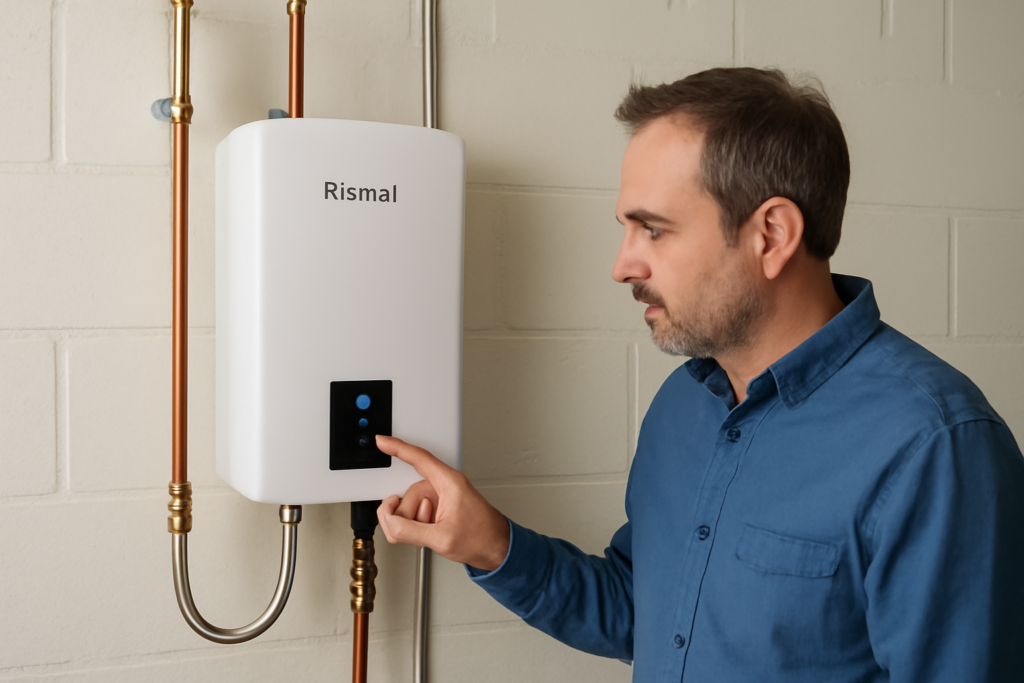
Most homeowners know Rinnai for its gas tankless units, so the arrival of an all-electric option has raised plenty of questions. A Rinnai electric tankless water heater delivers the same core promise — endless on-demand hot water without a bulky storage tank — but does it without gas lines or venting, opening tankless technology to homes where running a gas line isn’t practical. For anyone tired of a tank that runs cold mid-shower or eats floor space in a closet, an electric tankless unit can be a compelling upgrade, provided your electrical service can handle it. That last caveat is the whole story, and this guide walks through it.
We’ll cover how electric tankless heating works, the electrical demands that make or break an install, sizing for your climate, realistic costs, and how the electric approach stacks up against gas.
How Electric Tankless Heating Works
A tankless water heater makes hot water only when you call for it. When you open a hot tap, cold water flows into the unit, passes over powerful electric heating elements, and comes out hot on the other side — no tank sitting there reheating water around the clock. Because there’s no standby storage, you never run out of hot water and you’re not paying to keep 40 or 50 gallons warm 24 hours a day. The trade-off is that heating water instantly, on demand, takes a tremendous burst of energy, and for an electric unit that energy comes entirely from your electrical panel.
The Electrical Reality You Must Plan For
This is the single most important consideration, and it’s where many homeowners get surprised. Electric tankless whole-home units draw a lot of power — often requiring multiple dedicated double-pole breakers and heavy-gauge wiring, with total amperage that can strain or exceed the capacity of an older electrical service.
- Service size: Whole-home electric tankless units frequently need a 200-amp service, and homes with 100-amp panels often can’t support them without an upgrade.
- Dedicated circuits: A unit may require two, three, or more dedicated high-amperage breakers, each with appropriately sized wire.
- Panel space: You need open slots in the panel for those breakers, which not every home has.
Before buying, have a licensed electrician evaluate your panel and service capacity. A panel or service upgrade can add significant cost, and factoring it in upfront prevents an expensive mid-project surprise. In some homes the electrical upgrade costs more than the heater itself.
Sizing for Your Climate
An electric tankless unit is sized by how much it can raise the incoming water temperature at a given flow rate — the “temperature rise.” This matters enormously because your groundwater temperature depends on where you live. In the warm South, incoming water might be 65 to 70°F, so the unit only has to raise it 40 degrees to reach a comfortable 105 to 110°F. In cold northern climates, winter groundwater can drop into the 40s, demanding a much larger temperature rise and therefore more power for the same flow.
You also size for simultaneous demand — how many fixtures might run hot at once. Add up the flow rates of the showers, faucets, and appliances you want to run together, and choose a unit that delivers that combined gallons-per-minute at your required temperature rise. Undersizing leads to lukewarm water when demand peaks; a properly sized unit keeps every tap hot. In very cold regions, an electric whole-home unit may struggle to keep up with heavy simultaneous demand, which is worth weighing honestly.
Point-of-Use vs. Whole-Home
Not every electric tankless unit is meant to heat an entire house. Smaller point-of-use models mount right at a single fixture — a remote bathroom, a wet bar, an outdoor sink — and eliminate the long wait for hot water to travel from a distant tank. These draw far less power and often run on a single dedicated circuit, making them an easy add-on. Whole-home units are the high-amperage models that replace your tank entirely and carry the heavy electrical requirements. Deciding which you need shapes both the product choice and the electrical work.
Installation Overview
Electric tankless installation is simpler than gas in one crucial respect: there’s no gas line to run and no combustion venting required, so the unit can go almost anywhere with water and power. That flexibility is a real advantage, letting you mount it in a closet, utility room, or even under a sink for point-of-use models.
- Confirm electrical capacity and run the required dedicated circuits and wiring to the location.
- Mount the unit on the wall near the water lines — the compact size frees up the space a tank once occupied.
- Connect the plumbing, installing shutoff valves for future service and flushing.
- Wire the unit to the panel — a job for a licensed electrician given the amperage involved.
- Test and set the temperature, confirming steady output at your peak flow.
What It Costs
The heater itself typically runs several hundred to well over a thousand dollars depending on capacity, with whole-home units at the higher end. Where costs vary most is the electrical work: if your panel and service are ready, installation is modest, but if you need a service upgrade to 200 amps and new circuits, that can add a few thousand dollars. All in, budget realistically and get an electrician’s assessment first. Over time, the unit saves on standby energy losses and, with no tank to fail and flood, can last longer than a traditional storage heater — often 20 years or more with maintenance.
Electric vs. Gas Tankless
Choosing between electric and gas comes down to your home’s infrastructure. Electric units win on installation flexibility — no gas line, no venting, compact placement — and on simplicity, with fewer components to service. Gas tankless units generally handle higher flow rates and large simultaneous demand more easily, and they’re less affected by cold incoming water, but they require gas supply and proper venting. If you have no gas service or don’t want to run a line, electric is the natural path; if you have abundant gas and high hot-water demand in a cold climate, gas may keep up more comfortably.
Energy Efficiency and Operating Costs
The efficiency story for electric tankless units is nuanced. On the plus side, they eliminate standby losses entirely — there’s no tank of water being reheated around the clock, so you only spend energy when you actually draw hot water. Electric units also convert nearly all of the electricity they consume into heat, giving them very high point-of-use efficiency compared with gas models that lose some energy up the vent. For a household that uses hot water in short, intermittent bursts, that elimination of standby waste can translate into meaningful savings.
The counterweight is the cost of electricity itself, which varies widely by region and is often more expensive per unit of heat than natural gas. In areas with high electric rates, the operating cost of heating water electrically can offset some of the efficiency advantage. The honest way to evaluate it is to weigh your local electricity price, your hot-water habits, and the savings from removing the storage tank. Homes with solar panels or low-cost electricity see the strongest economic case, while those with cheap natural gas and high electric rates may find gas more economical to run day to day.
Maintenance to Maximize Lifespan
One of the underrated advantages of a tankless unit is longevity — with proper care, many last 20 years or more, roughly double the lifespan of a typical storage tank, and there’s no tank to corrode and eventually leak across the floor. Realizing that long life depends on a little routine maintenance, especially in hard-water areas.
- Flush periodically to remove scale. Mineral buildup on the heating elements is the main enemy of an electric tankless unit. In hard-water regions, flushing with a descaling solution once a year keeps the elements clean and efficient.
- Clean the inlet filter. Many units have a small screen that catches sediment before it reaches the heating chamber; rinsing it keeps flow strong.
- Consider a water softener. If your water is very hard, softening it upstream dramatically reduces scaling and extends the unit’s life.
- Install isolation valves. Service valves on the hot and cold connections make annual flushing quick and easy.
A few minutes of maintenance a year protects a unit that should outlast two or three conventional tanks.
Is It Right for You?
A Rinnai electric tankless water heater is an excellent fit for homes with adequate electrical service that want endless hot water, a compact footprint, and freedom from gas lines and venting. It shines in warmer climates and for point-of-use applications, and it removes the standby energy waste of a storage tank. The one non-negotiable is confirming your panel and service can supply the amperage before you commit. Do that homework, size the unit to your climate and peak demand, and you’ll enjoy hot water on demand without the tank — and often without ever running out mid-shower again.