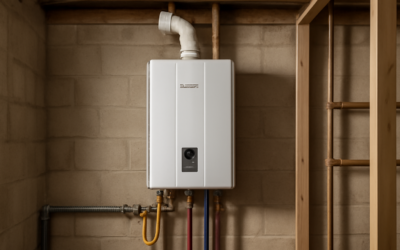
When people think tankless, they often think Rinnai, and for good reason, the brand has led the residential tankless market in North America for years. A Rinnai hot water heater heats water on demand instead of storing it, delivering an endless supply while saving space and cutting standby energy loss. But the lineup spans several series and gas types, and picking the wrong model or undersizing it leaves you with lukewarm showers. Here’s what you need to know to choose and live with one.
How Rinnai Tankless Units Work
Open a hot tap and a flow sensor ignites the gas burner, sending water through a heat exchanger that raises it to your set temperature in seconds. There’s no tank losing heat around the clock, so you only spend energy heating water you actually use. As long as gas and water keep flowing, the hot water never runs out, which is the whole appeal over a traditional 40- or 50-gallon tank.
The Rinnai Lineup
Rinnai organizes its residential tankless heaters into a few families, and knowing them narrows your search fast.
- RE Series: value-focused non-condensing units for smaller homes and budget-conscious buyers
- RL and RLX Series: mid-range non-condensing models, a common whole-home choice
- RU and RSC Sensei Series: premium condensing units with higher efficiency and stainless heat exchangers
Condensing models like the Sensei line capture extra heat from exhaust gases, reaching efficiency ratings up to 0.96 UEF, and they vent through inexpensive PVC. Non-condensing units cost less upfront but require metal venting and run slightly lower efficiency.
Natural Gas vs. Propane
Rinnai heaters come configured for either natural gas or liquid propane, and they are not interchangeable without a conversion kit. Confirm your fuel type before ordering. Both burn efficiently, but propane households should verify their tank and gas line can supply the high BTU demand during firing, which ranges from about 120,000 to 199,000 BTU per hour depending on the model.
Sizing for Your Home
Sizing hinges on two figures: flow rate in gallons per minute and the temperature rise your climate demands. Add up fixtures you’ll run simultaneously, roughly 2 to 2.5 GPM per shower and 1.5 GPM per faucet. Then factor in how cold your incoming water gets, because a colder inlet cuts the unit’s effective output.
- Warm climate, 1-2 baths: a 7-8 GPM model like an RL75 or RL94
- Cold climate, 2-3 baths: a 9-11 GPM Sensei model
- Large home with soaking tub: the largest 11 GPM unit or two heaters
Size for your coldest winter month, not the spec-sheet ideal. A unit rated 9 GPM in Florida might only deliver 5 GPM of usable hot water during a northern January.
Installation and Cost
A Rinnai tankless heater costs roughly $1,000 to $1,700 for the unit, with professional installation adding $1,000 to $2,500. First-time tankless conversions run higher because they often need new venting, an upsized gas line, and sometimes electrical for the ignition and controls. All in, budget $2,500 to $4,500 for a straightforward install and more for a full conversion.
Installation is best left to a licensed pro. Correct venting, gas sizing, and condensate drainage on condensing models are code-driven and safety-critical, and improper work voids the warranty, which runs up to 12 years on the heat exchanger for premium models.
Maintenance and Longevity
Tankless units last 20 years or more with basic care, roughly double a tank’s lifespan. The key maintenance task is descaling. In hard-water areas, mineral scale builds up in the heat exchanger and chokes efficiency over time.
- Install isolation valves during setup so you can flush the unit easily.
- Once a year, close the valves and circulate white vinegar through the exchanger for about 45 minutes.
- Flush with fresh water, reopen the valves, and you’re done.
Adding a water softener in hard-water regions dramatically extends the interval between descalings and protects the exchanger. Also clean the inlet water filter periodically to keep flow steady.
Recirculation for Instant Hot Water
One knock on tankless heaters is the wait for hot water to reach a distant faucet, since there’s no tank of pre-heated water sitting ready. Rinnai addresses this with models that support recirculation. A built-in or add-on recirculation pump keeps a small loop of hot water primed, so hot water arrives at the tap in seconds rather than after a long run of cold. Some Sensei models offer this with a scheduling feature that runs the pump only during your typical usage windows, saving energy. If instant hot water at a far bathroom matters to you, prioritize a recirculation-ready model.
Wi-Fi and Smart Controls
Newer Rinnai units add app connectivity through the brand’s control module, letting you monitor the heater, adjust the temperature, get maintenance alerts, and schedule recirculation from your phone. It’s a genuinely useful feature for spotting a problem early, such as a descaling reminder or an error code, before it becomes a cold-shower emergency. The connectivity is optional on most models and can be added later, so it’s not a make-or-break at purchase, but it’s a nice touch for a device you’ll rely on daily for two decades.
Is a Rinnai Right for You?
A Rinnai tankless heater makes sense if you want endless hot water, want to reclaim the floor space a tank occupies, and plan to stay long enough to recover the higher upfront cost through energy savings and a longer lifespan. It’s less compelling for very low-demand households or where extremely cold inlet water meets heavy simultaneous use without upsizing. For most homes, though, choosing the right series and gas type, sizing for winter, and flushing it yearly delivers two decades of reliable, space-saving hot water. Take the time to confirm your gas supply and venting before you buy, and the payoff is a heater you can genuinely forget about, one that quietly delivers an endless hot shower every morning for years to come.