
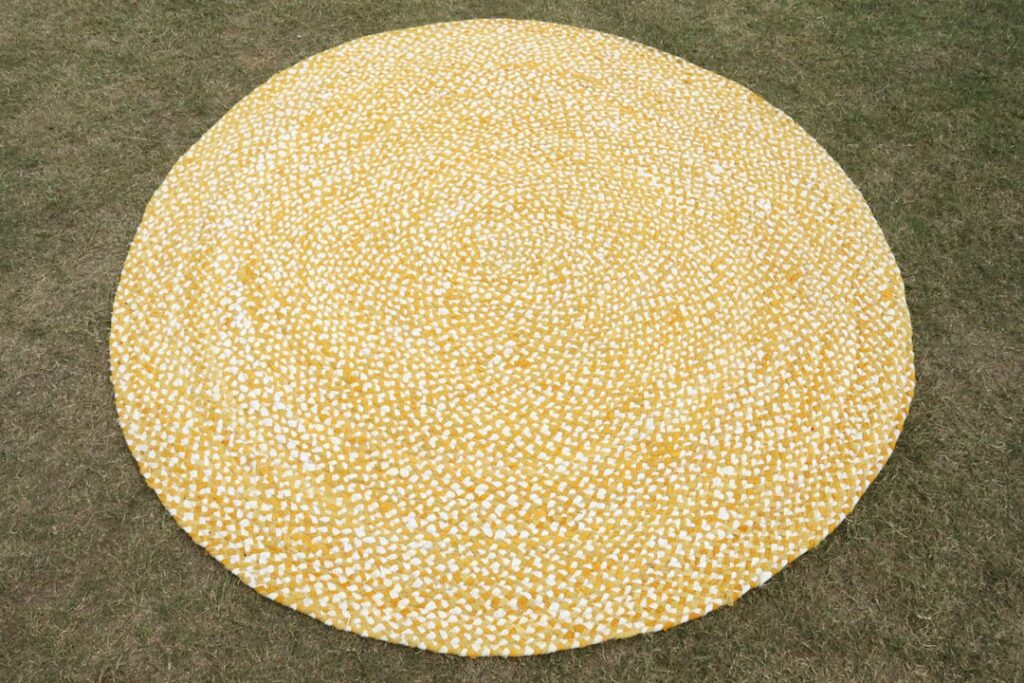
Rectangles dominate the rug aisle, but outdoors, circles often make more sense — patio furniture clusters, bistro sets, fire pit seating, and egg chairs are all radial arrangements that a round rug frames naturally. The catch is the word “waterproof.” A genuine round outdoor rug waterproof enough to live uncovered through summer storms is a specific product, not a marketing sticker, and plenty of “outdoor” rugs are merely water-resistant. This guide explains the material truth, how to size a circle (which works differently from sizing a rectangle), and how to keep any outdoor rug from becoming a mildew farm.
Part of our Roofing guide — explore the full guide →
- Waterproof vs. Water-Resistant: What the Labels Really Mean
- Sizing a Circle: Different Math Than a Rectangle
- Why Round Works So Well Outdoors
- Drainage, Mildew, and What Actually Ruins Outdoor Rugs
- Style and Color Strategy for Rounds
- UV and Fade Resistance: The Slow Killer
- Anchoring a Round Rug Against Wind
- Storing and Wintering Your Round Rug
- The Bottom Line
Waterproof vs. Water-Resistant: What the Labels Really Mean
No woven rug is waterproof in the raincoat sense — water passes between the fibers of any weave. What “waterproof” legitimately means in this category is that the rug material absorbs essentially no water itself, so it cannot rot, support mold growth from within, or stay soggy. Polypropylene (olefin) is the benchmark: it absorbs under 0.1 percent of its weight in moisture, dries in hours, and tolerates hose-downs and even diluted bleach. Recycled PET polyester — often woven from plastic bottles — performs nearly as well with a softer hand. PVC and EVA mat-style rugs, including reversible woven plastic “camping mat” designs, are the closest to truly waterproof and can sit in standing water without harm.
Be skeptical of natural-fiber rounds sold as outdoor pieces. Jute and sisal absorb water eagerly, brown-spot, and rot; they belong on covered porches at most. Also check the backing: some outdoor rugs add a latex or marine backing that resists moisture, while cheap indoor-style latex backings crumble after a season of wet-dry cycles. Flatwoven rugs with no backing at all often survive weather best, because water drains straight through and air reaches both faces.
Sizing a Circle: Different Math Than a Rectangle
Round rugs are sold by diameter, and the useful sizes outdoors are 5, 6, 8, and occasionally 9 or 10 feet. The furniture rules:
- Bistro set (two chairs, small table): 5-foot minimum, 6-foot ideal, so chairs stay on the rug when pulled back.
- Round dining table for four: table diameter plus 48 inches — a 42-inch table wants at least a 7.5- to 8-foot rug.
- Fire pit seating: do not put the pit on the rug. Instead, use one large round under the whole conversation zone only with a gas pit and a heat shield, or float the rug to one side under the seating arc.
- Egg chair or hanging chair: a 5- or 6-foot round centers the chair like a spotlight — one of the best-looking uses of the shape.
- Hot tub or plunge area landing: a 5-foot PVC or polypropylene round gives wet feet a fast-drying target.
Visually, leave at least 6 to 12 inches of decking or patio visible around the circle’s edge, and center the rug on the furniture grouping rather than on the patio slab — the rug’s job is to define the zone.
Why Round Works So Well Outdoors
Beyond matching radial furniture, circles solve outdoor-specific problems. Patios are often oddly shaped — L-returns, curved paver edges, corner cutouts — and a rectangle fights those lines while a circle ignores them gracefully. A round rug also softens the relentless right angles of decking boards and fence lines, which is why designers reach for circles on small balconies: a 5-foot round makes a 6×8 balcony feel styled instead of paved. And because a circle has no corners, it presents no corner to catch wind, chair legs, or foot traffic — curling is noticeably less of a problem than with rectangles.
Drainage, Mildew, and What Actually Ruins Outdoor Rugs
Outdoor rugs rarely die from rain falling on them. They die from moisture trapped beneath them. Water wicks under the rug, the deck or concrete beneath stays damp and dark, and mildew blooms on the underside — then stains the surface below. Prevention is straightforward: choose a flatwoven or perforated construction that drains, lift the rug after multi-day rains to let both faces dry, and use a non-absorbent outdoor rug pad (PVC coil or rubber waffle) that creates an air gap. On wood and composite decks, check under the rug monthly in wet climates; trapped moisture can discolor composite decking and encourage rot in wood.
Cleaning is refreshingly brutal: sweep or shake, hose off, scrub spots with dish soap and a deck brush, and for mildew hit polypropylene with a 10:1 water-bleach mix, rinse, and dry in the sun. Twice-a-season cleaning keeps a quality round looking new for 3 to 5 years of full exposure, longer under cover.
Style and Color Strategy for Rounds
A round rug reads as a deliberate design object, so its pattern matters more than a rectangle’s. Border and medallion patterns emphasize the circular shape and suit dining sets; all-over geometrics and stripes (which curve interestingly at the edge) suit lounging zones. Color-wise, mid-tone patterns hide the realities of outdoor life — pollen, leaf tannin, bird droppings — far better than pale solids. Solution-dyed fibers keep their color through UV exposure; surface-dyed budget rugs fade to pastel in one or two sunny seasons, so check for “solution-dyed” on the spec sheet if the rug will see direct sun. Reversible flatweaves earn their keep by literally flipping to a fresh face mid-season.
UV and Fade Resistance: The Slow Killer
Rain gets the blame, but sunlight does the quiet damage. Ultraviolet light breaks down both fiber and dye, and a rug that faces unshaded southern or western exposure ages years faster than one on a covered porch. The single spec that matters is solution-dyed fiber — pigment locked into the polypropylene or PET strand as it is extruded, so the color goes all the way through rather than being printed on the surface. Solution-dyed rounds hold usable color through three to five seasons of direct sun; surface-printed budget rugs can wash out to pastel in a single brutal summer. If the product page does not say “solution-dyed” or “UV-stabilized,” assume it fades fast. A simple habit extends any rug’s life: rotate a round 180 degrees mid-season so the furniture shadows and umbrella shade lines fade evenly instead of leaving a permanent light patch.
Anchoring a Round Rug Against Wind
Circles resist curling better than rectangles, but a lightweight flatweave still becomes a sail in a gust — and a rug that flips or migrates traps moisture and scuffs. On open decks and rooftops, weight matters: a heavier woven PVC or PET round stays put better than a featherweight olefin mat. A non-slip outdoor rug pad adds grip and the air gap that prevents mildew at the same time. In genuinely windy spots, low-profile rug grippers, outdoor-rated double-sided tape on hard surfaces, or discreet landscape staples through the edge into grass or composite keep the circle anchored. Just avoid anything that pins the rug so tightly that water and air cannot reach the underside — the whole point is to let both faces breathe and drain.
Storing and Wintering Your Round Rug
Even a waterproof rug lasts longer with an off-season break. Before storing, clean and fully dry it — rolling up a damp rug is how you grow mildew over the winter. Roll it rather than fold it (folds crease the backing and can crack stiffer PVC weaves), stand the roll upright in a dry garage or shed, and keep it off a bare concrete floor that can wick moisture into the bottom of the roll. Freeze-thaw cycles do little harm to synthetic fiber, but a rug left flat and frozen to the deck under snow will almost always mildew on its underside by spring. In mild climates where you leave the rug out year-round, lift and dry it after every prolonged wet spell and give it a full cleaning at each season change.
The Bottom Line
Buy the material first and the pattern second: solution-dyed polypropylene, PET, or woven PVC are the only fibers that make a round outdoor rug waterproof in any meaningful sense, and flatwoven, backing-free constructions handle drainage best. Size the circle to the furniture — diameter of the grouping plus room for pulled-back chairs — keep air moving underneath with a proper outdoor pad, and lift it to dry after soaking rains. Do that, and the round rug becomes the easiest, hardest-working design move on the whole patio.


