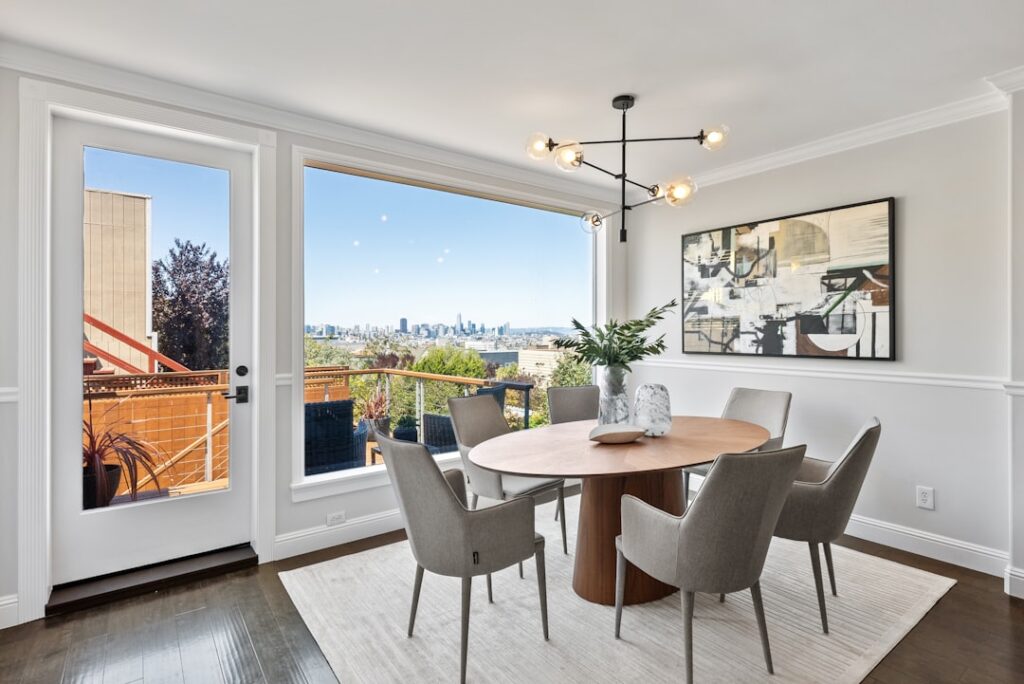
The most common dining room rug mistake in American homes is buying too small, and it gets worse with circles because a rug’s diameter always looks bigger online than under a table. A properly sized round rug for dining room use needs to extend 24 to 30 inches beyond the table edge on every side, so chairs stay on the rug even when guests slide back to stand. Get that number right and a round rug does what nothing else in the room can: it softens a boxy space, anchors a pedestal table, quiets chair scrapes, and protects hardwood underneath. This guide covers the sizing math, the materials that survive food service, and the layout rules designers actually follow.
Why Go Round Instead of Rectangular
Shape should follow the table, not the room. A round or oval table over a rectangular rug creates awkward triangular gaps at the corners where chair legs drop off the edge, and the mismatch reads as accidental. A circular rug under a circular table repeats the geometry, which visually locks the arrangement together and makes the dining zone feel intentional, especially in open-concept spaces where the “room” has no walls to define it.
Round rugs also flatter square rooms and square tables, where the curve breaks up the box-in-a-box effect. In small dining areas and breakfast nooks, a circle reads lighter than a rectangle of the same coverage because the eye tracks the curve rather than hard edges, and there are no corners jutting into walkways to trip over.
The Sizing Formula
Start with the table diameter and add 48 to 60 inches. That gives each side the 24 to 30 inch clearance a pulled-out chair needs. In practice:
- 36-42 inch bistro table (seats 2-4): 6 foot (72 inch) round rug minimum
- 48 inch table (seats 4): 8 foot (96 inch) round rug
- 54-60 inch table (seats 6): 8 foot works, 9 foot is comfortable
- 72 inch table (seats 8): 10 foot round rug
Then check the room. Leave at least 18 to 24 inches of bare floor between the rug’s edge and the walls or other furniture so the rug frames the space instead of wall-to-wall carpeting it. If your room cannot fit the correct rug size with that border, the honest answer is to go bare-floored rather than buy a 5 foot rug that ends mid-chair. Before ordering, tape the diameter on the floor with painter’s tape and pull a chair out over the line; thirty seconds of testing prevents an expensive return.
Materials That Survive a Dining Room
Dining rugs live under falling food, dragged chair legs, and the occasional glass of red wine, so fiber choice matters more here than anywhere else in the house.
Best Performers
Polypropylene and polyester (indoor/outdoor styles): the practical champions. They shrug off stains, many can be hosed down outside, and flatweave versions let chairs slide easily. Expect $100 to $300 for an 8 foot round. Wool: the premium pick at $300 to $900 for an 8 foot circle. Naturally soil-resistant thanks to lanolin, resilient under chair legs, and it hides crumbs between vacuumings; it just needs prompt blotting on wet spills. Low-pile blends with performance treatments (solution-dyed nylon, PET) split the difference.
Avoid Under a Table
Jute and sisal stain permanently from water alone and shed under chair traffic. High-pile and shag trap food and make chairs wobble. Viscose/rayon blends water-spot and crush. Save all three for bedrooms and living rooms.
Whatever the fiber, pick low pile, half an inch or less. Chairs must slide, and thick pile under a dining table wears in visible tracks within a year.
Protecting the Floor Underneath
A rug pad is not optional over hardwood or luxury vinyl. Choose a felt-and-rubber combination pad about 1/8 inch thick, cut 1 inch smaller than the rug all the way around, which keeps the rug from creeping, adds cushioning, and lets air circulate. Skip cheap PVC waffle pads on hardwood; some discolor polyurethane finishes over time. Add felt glides to chair feet, and lift the rug every few months to vacuum grit from both sides, because trapped grit works like sandpaper between rug backing and floor finish. Over wall-to-wall carpet, use a stiff carpet-on-carpet pad to stop the rug from rippling as chairs move.
Style Moves That Make the Room
Pattern is your friend in a dining room because it camouflages the inevitable. Medallion designs suit round rugs naturally since the motif radiates from the center where the table base sits. Overall geometric and Persian-style patterns hide crumbs and small stains far better than solid light colors; a solid ivory rug under a toddler’s chair is a countdown clock. Darker mid-tone grounds (navy, rust, charcoal, olive) with lighter pattern work hardest.
Coordinate scale, too: a bold large-scale pattern pairs with simple chairs, while ornate chairs want a quieter rug. If the room has a chandelier, center the rug under it, then center the table on the rug, so the vertical stack of light fixture, table, and rug reads as one column. In open floor plans, let the round rug’s edge define the dining zone and keep at least a walking lane of bare floor between it and the living area rug so the two do not fight.
Cleaning and Long-Term Care
Vacuum weekly with the beater bar off for flatweaves and delicate fibers. Blot spills immediately, working from the outside of the spot inward, with club soda or a mild dish-soap solution on synthetics and cold water on wool. Rotate the rug 90 degrees every six months so chair wear and sunlight fade evenly, which matters double for circles since the wear pattern is symmetrical and rotation is invisible. Machine-washable rug systems (Ruggable-style covers) are a legitimate option for households with young kids; verify the size range, since washable rounds commonly top out at 8 feet.
Budget Ranges at a Glance
Expect to spend $80 to $150 for a solid 6 foot synthetic round, $150 to $350 for an 8 foot polypropylene or performance-fiber rug, and $400 to $900 for an 8 foot wool piece from a mainstream retailer. Pads add $30 to $80 depending on diameter. The value sweet spot for most dining rooms is a patterned 8 foot synthetic in the $200 range plus a felt-rubber pad: cheap enough to replace after a decade of dinners without grief, durable enough to last that decade looking respectable. Spend up on wool when the dining room doubles as a showpiece and the household is past the spaghetti-flinging years.
Bottom Line
Buy the size the math demands, table diameter plus at least 48 inches, in a low-pile, patterned, stain-tolerant fiber, and set it on a felt-rubber pad with the chandelier, table, and rug centered on one axis. Do those four things and a round rug moves from decoration to the piece that quietly organizes the entire dining room.